
AIIMS Delhi NO - 2017
Medical & Surgical Nursing
Hard
What is the management of problem shown in ECG paper given below image?
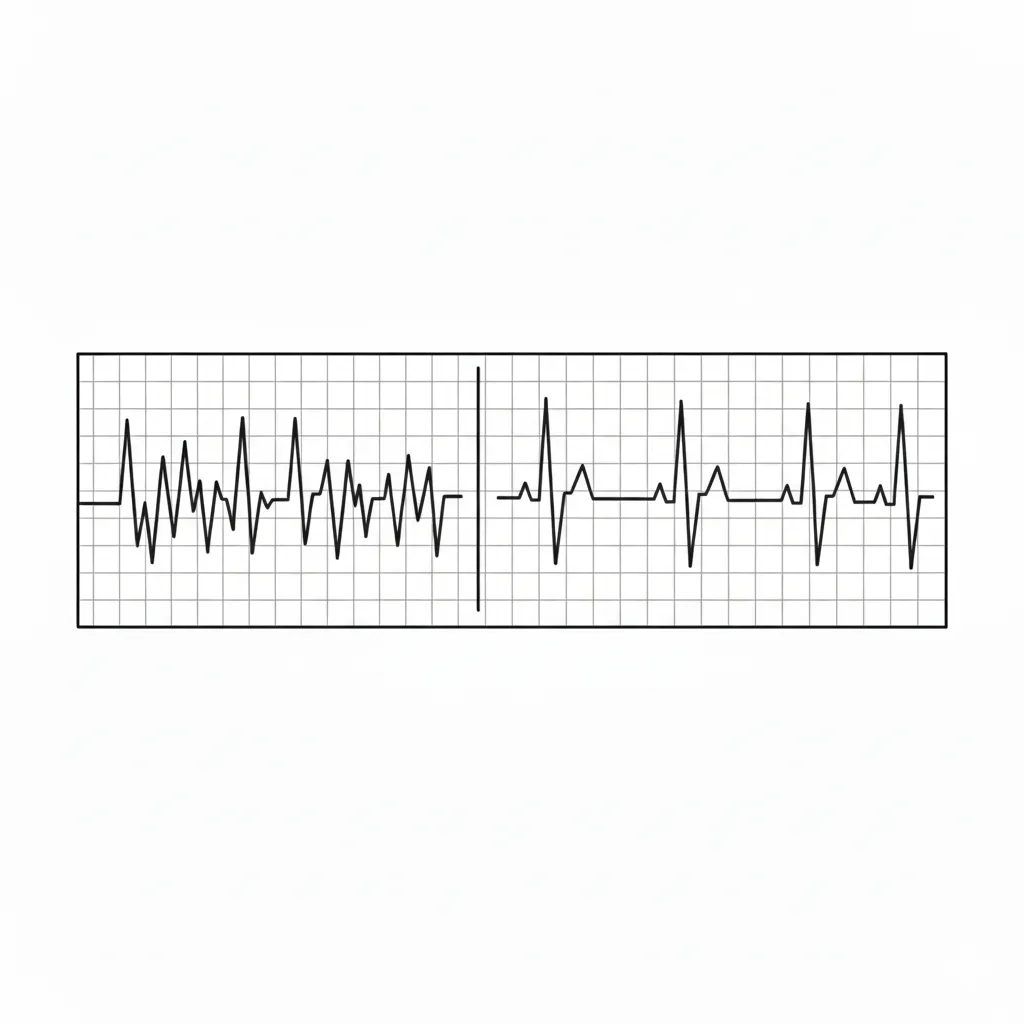
Appeared in: AIIMS Delhi NO - 2017
Explanation
- The ECG shows Ventricular Fibrillation (VF), a pulseless, lethal arrhythmia characterized by chaotic and rapid ventricular quivering.
- The immediate and definitive treatment for VF is defibrillation, which delivers an unsynchronized high-energy electrical shock.
- The purpose of defibrillation is to stop the chaotic electrical activity, allowing the heart's natural pacemaker to resume a normal rhythm and restore cardiac output.
Why Other Options Were Wrong
- Option B: A pacemaker is a device used to treat slow heart rates (bradyarrhythmias) or heart blocks by delivering electrical impulses to make the heart beat at a normal rate. It is not used for tachyarrhythmias like VF.
- Option C: Cardioversion delivers a synchronized electrical shock timed to the R wave of the QRS complex. It is used for unstable tachyarrhythmias where a pulse is present. Using it in VF is incorrect because there are no discernible QRS complexes to synchronize with, and the required intervention is an immediate unsynchronized shock.
- Option D: ECT (Electroconvulsive Therapy) is a psychiatric procedure used to treat severe mental health conditions, such as major depression. It involves inducing a brief seizure and is completely unrelated to the management of cardiac arrhythmias.
Related Visual

Clinical Relevance
- Nursing practice connection: This is primarily an exam-oriented knowledge point with limited direct bedside application, so retain Management of lethal cardiac arrhythmias based on ECG interpretation as background academic context rather than a clinical decision trigger.
- For a patient in Ventricular Fibrillation, every minute without CPR and defibrillation decreases the chance of survival by about 10%. Immediate recognition and action are critical nursing responsibilities.
- Nurses must be able to differentiate between shockable rhythms (VF, pulseless VT) and non-shockable rhythms (Asystole, PEA) as per ACLS guidelines.
- What if the patient had the same ECG but was found to have a pulse (a rare and transient event sometimes called 'perfusing VF')? The management would still be immediate defibrillation, as the rhythm will inevitably lead to pulselessness and cardiac arrest within seconds.
How to Approach the Question
- First, analyze the provided ECG strip. Note the key features: Is there a rhythm? Is it regular or irregular? Are P waves, QRS complexes, and T waves identifiable?
- Identify the rhythm based on your analysis. The chaotic, disorganized waveform with no clear components points to Ventricular Fibrillation (VF).
- Recall the clinical significance of VF. It is a lethal arrhythmia that results in no cardiac output (cardiac arrest).
- Consider the management options provided. Based on ACLS (Advanced Cardiac Life Support) protocols, the immediate treatment for VF is defibrillation.
- Differentiate the correct answer from the distractors. Understand why cardioversion (synchronized, for rhythms with a pulse), pacemakers (for bradycardia), and ECT (psychiatric treatment) are incorrect in this context.
Concept Tested & Keywords
- Concept Tested: Management of lethal cardiac arrhythmias based on ECG interpretation.
- Stem keywords: ECG paper, management
- Lead-in keywords: What is
- Clinical cues: The ECG shows a chaotic, irregular rhythm with no discernible waves, which is a hallmark of Ventricular Fibrillation.
Question ID
QUx9fuq7g6GDkh6qBkKj-V
Reference Book
E6 Nelson Textbook of Pediatrics(2024) — Volume 2 p. 642-644
E6 Medicine Harrison 22e Part 1 p. 2012-2014
Practise the full AIIMS Delhi NO - 2017
Attempt every question from this paper in a timed mock, then review the full solution for each one.
More Cardiovascular, Circulatory, and Hematologic Function Questions
- A patient was brought to ED with complaint of chest pain from last 1 hour. Which test is done to detect myocardial infarction?
- A patient is undergoing blood transfusion and suddenly shows complaints of transfusion reaction. What will be the priority nursing intervention?
- Normal hemoglobin level in adult is:
- The following all are blood transfusion complications from; EXCEPT:
- Symptoms of acute blood loss are:
- An obstruction of blood flowing from the left atrium into the left ventricle is known as:
- 'Sequestration crisis' is related to:
- Which is the most common HIV related malignancy?
- Calculate the pulse pressure from the below image of cardiac monitor:
- Identify the use of following machine used in pneumatic compression device:
More AIIMS Delhi NO - 2017 Questions
- Which is a live attenuated vaccine?
- The injection haloperidol is given intramuscularly by which technique?
- One of the most initial things that should be done by a nurse while going to a home visit?
- Most common type of shock in a trauma patient?
- Intraspinal medication is given in which IVD space?
- Most common cause of hypotension in trauma patients?
- Which blood group can be used in an emergency or when the desired blood group is not available?
- CSF draining from the nose and ear occurs in which type of skull fracture?
- Which characteristic of stool indicates normal functioning of an ascending colostomy?
- Allen test should be performed before?