
RRB Nsg. Superintendent-20 July 2019 (Shift-3rd)
Applied Nutrition & Dietetics
Easy
The anti-sterility vitamin is known as
Appeared in: RRB Nsg. Superintendent-20 July 2019 (Shift-3rd)
Explanation
- Vitamin E is widely known as the anti-sterility or anti-infertility vitamin due to its essential role in the normal functioning of the reproductive system.
- Its chemical name, tocopherol, is derived from the Greek words 'tokos' (childbirth) and 'pherein' (to bear), highlighting its connection to reproduction.
- Studies in animals show that a deficiency of Vitamin E can lead to infertility, including loss of sperm motility and inability to produce healthy ova.
- As a powerful antioxidant, Vitamin E protects the cells of the reproductive system from oxidative damage.
Why Other Options Were Wrong
- Option B: Vitamin A, or retinol, is primarily known as the 'anti-infective' vitamin. Its main role is related to vision, immune function, and cellular growth, not sterility.
- Option C: Vitamin D is known as the 'sunshine vitamin' or 'anti-rickets' vitamin. Its primary function is to regulate calcium and phosphate metabolism, which is crucial for bone health.
- Option D: Vitamin B refers to a complex of several different water-soluble vitamins (B1, B2, B3, B6, B12, etc.). While they are essential for energy metabolism, nerve function, and cell production, none are specifically termed the 'anti-sterility' vitamin.
Related Visual
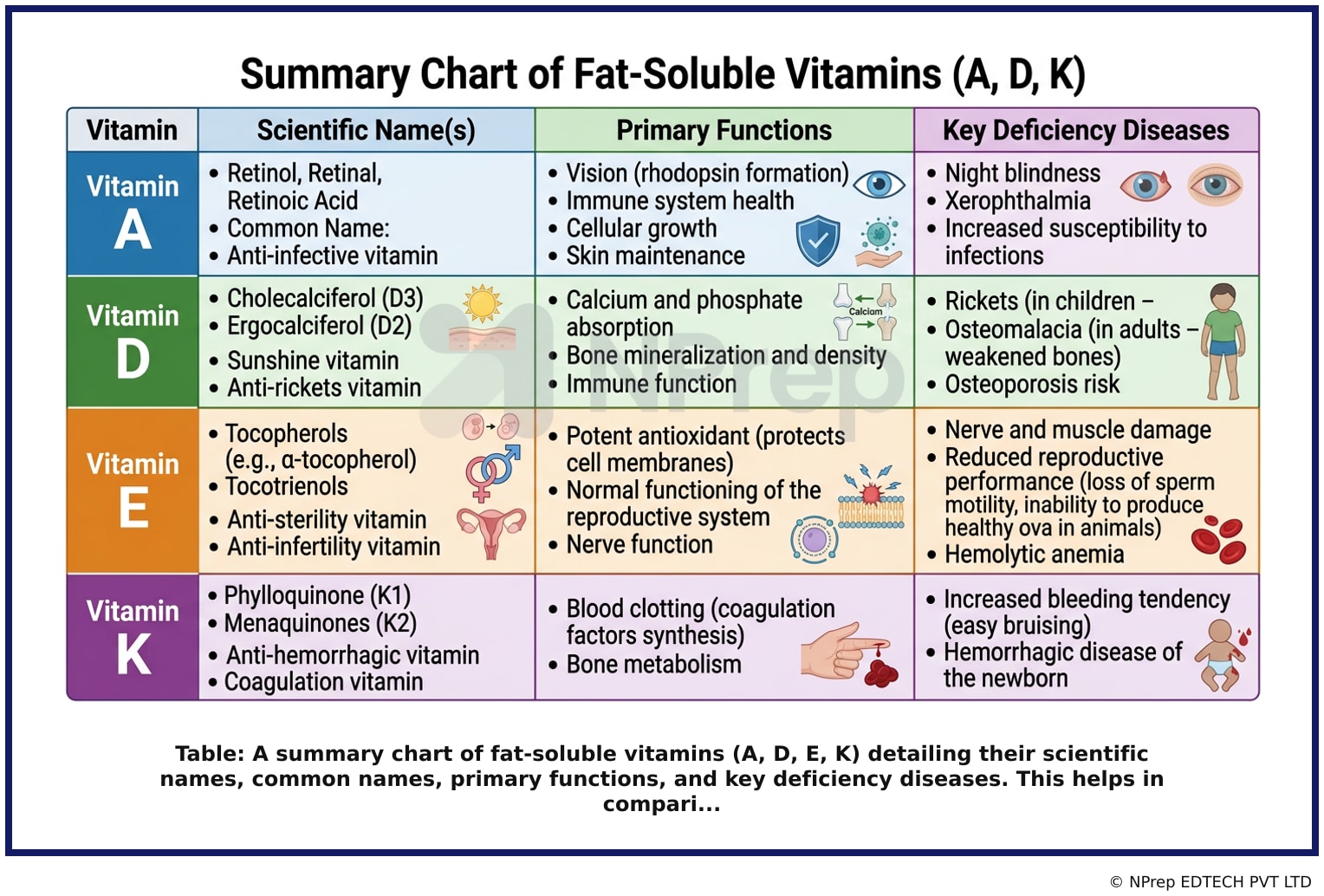
- Visual 1: Table: A summary chart of fat-soluble vitamins (A, D, E, K) detailing their scientific names, common names, primary functions, and key deficiency diseases. This helps in comparing and contrasting their roles at a glance.
Clinical Relevance
- Nursing practice connection: This is primarily an exam-oriented knowledge point with limited direct bedside application, so retain Alternative names and functions of vitamins as background academic context rather than a clinical decision trigger.
- When counseling patients with infertility, a nutritional assessment is important as deficiencies in certain micronutrients, like Vitamin E, can be a contributing factor.
- Nurses should educate patients that while Vitamin E is important, excessive intake (hypervitaminosis) can be toxic and may interfere with blood clotting, so supplementation should be done cautiously and under medical advice.
- What if? A patient on a strict, very low-fat diet reports issues with fertility. The nurse should recognize a higher risk for deficiency in fat-soluble vitamins (A, D, E, K), as their absorption depends on dietary fat, making Vitamin E deficiency a plausible concern.
How to Approach the Question
- First, identify the key phrase in the question stem: 'anti-sterility vitamin'.
- This is a factual recall question that tests your knowledge of the alternative names and primary functions of different vitamins.
- Systematically review the options. For each vitamin, recall its main function or common name.
- Recall that Vitamin A is for vision, Vitamin D is for bones, and Vitamin B is a complex for metabolism.
- Associate 'anti-sterility' with Vitamin E (Tocopherol), whose name itself relates to childbirth.
- Select the option that correctly matches the key phrase.
Concept Tested & Keywords
- Concept Tested: Alternative names and functions of vitamins
- Stem keywords: anti-sterility vitamin
- Lead-in keywords: known as
Question ID
QMsgb97-RKaTgbgPyHHTsw
Practise the full RRB Nsg. Superintendent-20 July 2019 (Shift-3rd)
Attempt every question from this paper in a timed mock, then review the full solution for each one.
More Vitamins Questions
- Early sign of Vitamin A deficiency is:
- Which of the following vitamin deficiency causes Bitot's spot and Xerophthalmia?
- Which vitamin does convert prothrombin to thrombin?
- Highest source of vitamin-C?
- Deficiency of which nutrient causes scurvy?
- A nurse is assessing a malnourished adolescent who has been consuming a vegan diet. For signs of which specific vitamin deficiency should the nurse a…
- A child is found to be deficient in iron. To increase the child's absorption of iron, which vitamin should a nurse encourage the parents to supplemen…
- Which one of the following vitamins helps in wound healing?
- Which of the following is precursor of vitamin A?
- Vitamin B1 is also known as?
More RRB Nsg. Superintendent-20 July 2019 (Shift-3rd) Questions
- Where is oxytocin synthesized?
- What is the name of the muscle that extends from the sphenoid bone to the mandible?
- Complementary feeding should be initiated at the completion of \ \ \ \ \ \
- Where is kidney located?
- Psychosocial development stage for infants is \ \ \ \ \ \ \ \ \ \
- What immunization is given at birth?
- Functional nursing is a method of providing
- Which disease is the dementia associated with asymmetric atrophy of the frontal and temporal lobes?
- Thromboangiitis obliterans is also known as
- What is the other name of pyridoxine?