
KGMU 2023
Applied Sociology
Easy
Social stratification is a system based on what?
Appeared in: KGMU 2023
Explanation
- Social stratification is the hierarchical arrangement of individuals into divisions of power, wealth, and status within a society.
- This system is fundamentally based on structured social inequality, where different groups have unequal access to resources, opportunities, and privileges.
- The very concept of 'strata' or layers implies a ranking system where some are positioned higher and others lower, which is the definition of inequality.
Why Other Options Were Wrong
- Option A: Social harmony is the opposite of what stratification often creates. The unequal distribution of resources and power inherent in stratification is a common source of social conflict and tension.
- Option B: Social stratification is a structural feature of society related to the distribution of power and resources, not a psychological state of mutual understanding between groups.
- Option D: Social stratification is a highly organized and institutionalized system of ranking. It is a form of social organization, not disorganization. Anomie or social breakdown would be examples of social disorganization.
Related Visual
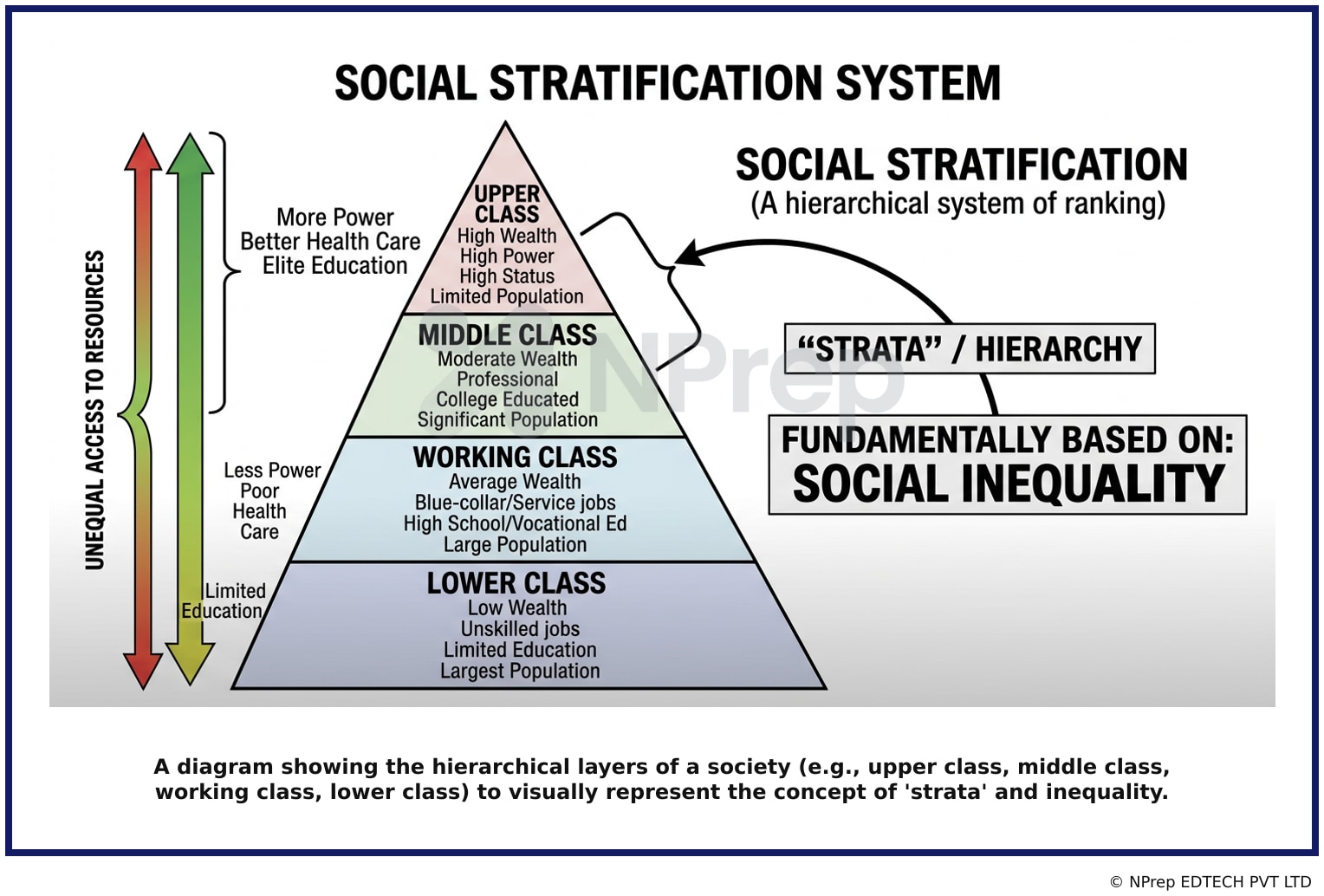
- Visual 1: Pyramid Diagram - A diagram showing the hierarchical layers of a society (e.g., upper class, middle class, working class, lower class) to visually represent the concept of 'strata' and inequality.
- Visual 2: Flowchart - A flowchart illustrating how factors like birth, wealth, and education lead to different positions within the social hierarchy.
Clinical Relevance
- Nursing practice connection: This is primarily an exam-oriented knowledge point with limited direct bedside application, so retain Definition and basis of Social Stratification as background academic context rather than a clinical decision trigger.
- Understanding social stratification is crucial for nurses to recognize how a patient's socioeconomic status, education, and background (social determinants of health) can influence their health outcomes, access to care, and health behaviors.
- This concept provides the framework for analyzing health disparities, where certain social groups experience a higher burden of disease, injury, and mortality.
- A nurse aware of stratification can provide more culturally competent and equitable care by anticipating barriers patients may face, such as cost of medication, lack of transportation, or low health literacy.
How to Approach the Question
- First, identify the core concept in the question, which is 'social stratification'.
- Recall the definition of this term. The word 'strata' means layers, which implies a ranking or hierarchy.
- Analyze what a hierarchical system inherently creates. A system that ranks groups as superior or inferior is, by definition, a system of inequality.
- Evaluate the options based on this understanding. 'Social Inequality' is the only option that directly describes the nature of a ranked, hierarchical system.
- Eliminate the other options. 'Harmony' and 'understanding' are contrary to the conflict and division often caused by stratification, while 'disorganization' is the opposite of the structured nature of stratification.
Concept Tested & Keywords
- Concept Tested: Definition and basis of Social Stratification
- Stem keywords: Social stratification, system
- Lead-in keywords: based on
- Negative lead-in flag: false
Question ID
QtMDYxWeupYiB6J3bwmef3
Practise the full KGMU 2023
Attempt every question from this paper in a timed mock, then review the full solution for each one.
More Social stratification Questions
- Polyandry means?
- Identify the demerit (disadvantage) of the caste system from the given options.
- When a person changes from one position to another position of equal status, it is called?
- The maintenance provided by a husband to his divorced wife is called?
- \ \ \ \ \ \ is an endogamous group associated with traditional occupations.
- The system of differentiations which includes a hierarchy of social positions are termed as:
- Given below are two statements:Statement I: Caste status is determined by birth, and it restricts social mobility.Statement II: The class system is n…
- Social stratification implies?
- All of the following are included in the upper class except?
- The phenomenon in society in which people move up and down and vice versa on social scale is known as?
More KGMU 2023 Questions
- The teacher scalded Aruna in front of her classmates during Project submission. Conclusion I: Aruna was not as popular as her other classmates. Concl…
- Aruna leaves and goes 8 meters in the North direction from a certain point. Then she turns right and travels for 12 meters. She again turns right and…
- Kiran is Sister of Raj. Raj is Son of Suresh and Vinita is Mother of Suresh then what is relation between Vinita and Kiran?
- A person who lives at the same time with another?
- Select the most appropriate meaning of the below idiom. A black sheep?
- The train has arrived...the station.
- A vendor sold 20 kg of potato at 18 Rs. per kg. He bought 2-liter milk at the rate of 46 Rs./liter, 2 kg sugar at the rate of 35 Rs./kg and 10 packet…
- Which one is the perfect square?
- A is the smallest. C is taller than B and D. E is neither the tallest nor the smallest. Find which one is the tallest?
- From an entrance, a person walks 28 meters left, then turns right and walks 13 meters. They turn right again and walk 12 meters, and then walk 16 met…