
DSSSB 14 August 2024
Medical & Surgical Nursing
Easy
Select the stage of the pressure ulcer shown in the given image. 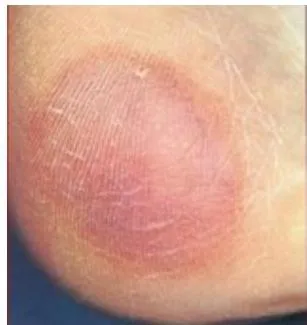
Appeared in: DSSSB 14 August 2024
Explanation
- The image shows a localized area of intact skin with a persistent purple or maroon discoloration, which is the defining characteristic of a Suspected Deep Tissue Injury (sDTI).
- Unlike a Stage 1 injury, which presents as non-blanchable redness (erythema), the purple/maroon color of an sDTI signifies damage to the underlying soft tissues at the bone-muscle interface.
- This type of injury results from intense and/or prolonged pressure and shear forces.
- Although the skin is intact, a DTI is considered a serious injury because it can rapidly deteriorate, revealing a full-thickness wound (Stage 3 or 4).
Why Other Options Were Wrong
- Option A: Stage 4 involves full-thickness skin and tissue loss with exposed bone, muscle, or tendon. The skin in the image is clearly intact.
- Option B: Stage 2 is defined by partial-thickness skin loss, presenting as a shallow open ulcer or a blister. The skin in the image is not broken.
- Option C: Stage 3 involves full-thickness skin loss where subcutaneous fat is visible. The skin in the image is intact.
Related Visual

Clinical Relevance
- Nursing practice connection: This is primarily an exam-oriented knowledge point with limited direct bedside application, so retain Staging of pressure injuries based on visual assessment as background academic context rather than a clinical decision trigger.
- Correctly identifying a Suspected Deep Tissue Injury is critical for patient safety. It is not a 'bruise' or a minor Stage 1 injury; it signals significant underlying damage and a high risk for rapid decline into a severe, full-thickness wound.
- Nursing priority for an sDTI is immediate and complete pressure offloading of the area to prevent further ischemia and tissue death. This is more urgent than for a stable Stage 1 injury.
- What if? If the area in the image was red instead of purple and blanched with pressure, it would not be a pressure injury but rather reactive hyperemia, a normal response to pressure. If it was red and did not blanch, it would be a Stage 1 pressure injury.
How to Approach the Question
- First, carefully analyze the image provided, paying close attention to the color of the lesion and the integrity of the skin.
- Note that the skin is intact, which immediately rules out Stage 2, 3, and 4 pressure injuries as they all involve broken skin.
- Next, focus on the color. The lesion is a deep purple/maroon, not red (erythema).
- Recall the definitions of pressure injury stages. Stage 1 is defined by non-blanchable redness. A persistent purple or maroon discoloration of intact skin is the specific definition of a Suspected Deep Tissue Injury (sDTI).
- Evaluate the given options. Since sDTI is the correct diagnosis based on visual evidence and is provided as an option, select it.
- If sDTI were not an option, you would recognize the question is flawed, as the image does not fit the other stages, but sDTI is the most accurate classification.
Concept Tested & Keywords
- Concept Tested: Staging of pressure injuries based on visual assessment.
- Stem keywords: pressure ulcer, stage, image
- Lead-in keywords: Select
- Clinical cues: The image shows intact skin with a deep purple/maroon discoloration on the heel, which is a key indicator for a specific type of pressure injury.
Question ID
QA2fivQBsEfI49Cmzxlgsa
Reference Book
E6 Nursing Fundamentals Potter Perry 12e Part 6 pp. 70-72, 69-71
E6 Nursing Fundamentals Taylor p. 557-559
Practise the full DSSSB 14 August 2024
Attempt every question from this paper in a timed mock, then review the full solution for each one.
More Integumentary Function Questions
- This type of dressing is known as:
- The following picture shows is bedsore present in bedridden patient. Which grade of bedsore is present?
- In second degree bedsore, there is an involvement of:
- What is the bath used to remove the irritation of certain types of skin diseases and provide soothing effect?
- A female patient has come with facial burn injury into the emergency department in conscious condition. What will be the treatment for this patient?
- A patient comes into the emergency with a burn injury of 40% then what is first nursing intervention?
- A nurse caring a bedridden patient with a pressure ulcer, 2 hourly position changes and massaging & rubbing the back but pressure sore does not heal.…
- Second degree burn considered?
- Identify the stage of pressure ulcer
- A 23 year old man comes to the emergency department with thermal burns. In this case according to rule of nine which part of the body burned maximum?
More DSSSB 14 August 2024 Questions
- Seven boxes A, B, C, D, R, S and T are kept one over the other but not necessarily in the same order. Only three boxes are kept below B. Only two box…
- Read the given statements and conclusions carefully. Assuming that the information given in the statements is true, even if it appears to be at varia…
- Identify the figure given in the options which when put in place of '?' will logically complete the series.
- If the water source is placed along A-B, as shown in the figure, which of the given options will be the water reflection of the given figure?
- Based on the English alphabetical order, three of the following four letter-cluster pairs are alike in a certain way and thus form a group. Which let…
- In a certain code language, 'time to study' is coded as 'mh cy sp' and 'study the case' is coded as 'bg km cy'. How is 'study' coded in that language?
- Ehmran ranked $62^{\text{nd}}$ from the bottom and $11^{\text{th}}$ from the top in his class. How many students are there in his class?
- A, B, C, D, Q and R live on six different floors of the same building. The lowermost floor in the building is numbered 1, the floor above it is numbe…
- Select the set in which the numbers are related in the same way as are the numbers of the following sets. (NOTE: Operations should be performed on th…
- What should come in place of '?' in the given series? 18 39 67 102 144 ?