
RRB Staff Nurse Jaipur-6th June 2018
Applied Physiology
Medium
Persons of AB blood group are universal acceptors because
Appeared in: RRB Staff Nurse Jaipur-6th June 2018
Explanation
- Individuals with AB blood group are called universal recipients because their plasma does not contain the naturally occurring anti-A or anti-B antibodies (agglutinins).
- Antibodies in a recipient's plasma are what attack foreign antigens on donor red blood cells, causing a potentially fatal transfusion reaction (agglutination).
- Since AB plasma has no such antibodies, it will not mount an immune attack against A, B, or O red blood cells, allowing for the safe reception of packed RBCs from all ABO types.
Why Other Options Were Wrong
- Option A: This statement is a definition, not an explanation. It describes what a universal acceptor is, but does not explain the underlying biological reason why they can accept blood from all groups.
- Option C: This is factually incorrect. Individuals with the AB blood group are characterized by the presence of both A and B antigens on their red blood cells.
- Option D: This is incorrect as blood transfusion compatibility is determined by the antigen-antibody system, not by proteins involved in the clotting cascade. Clotting and immune reactions to transfusions are separate physiological processes.
Related Visual
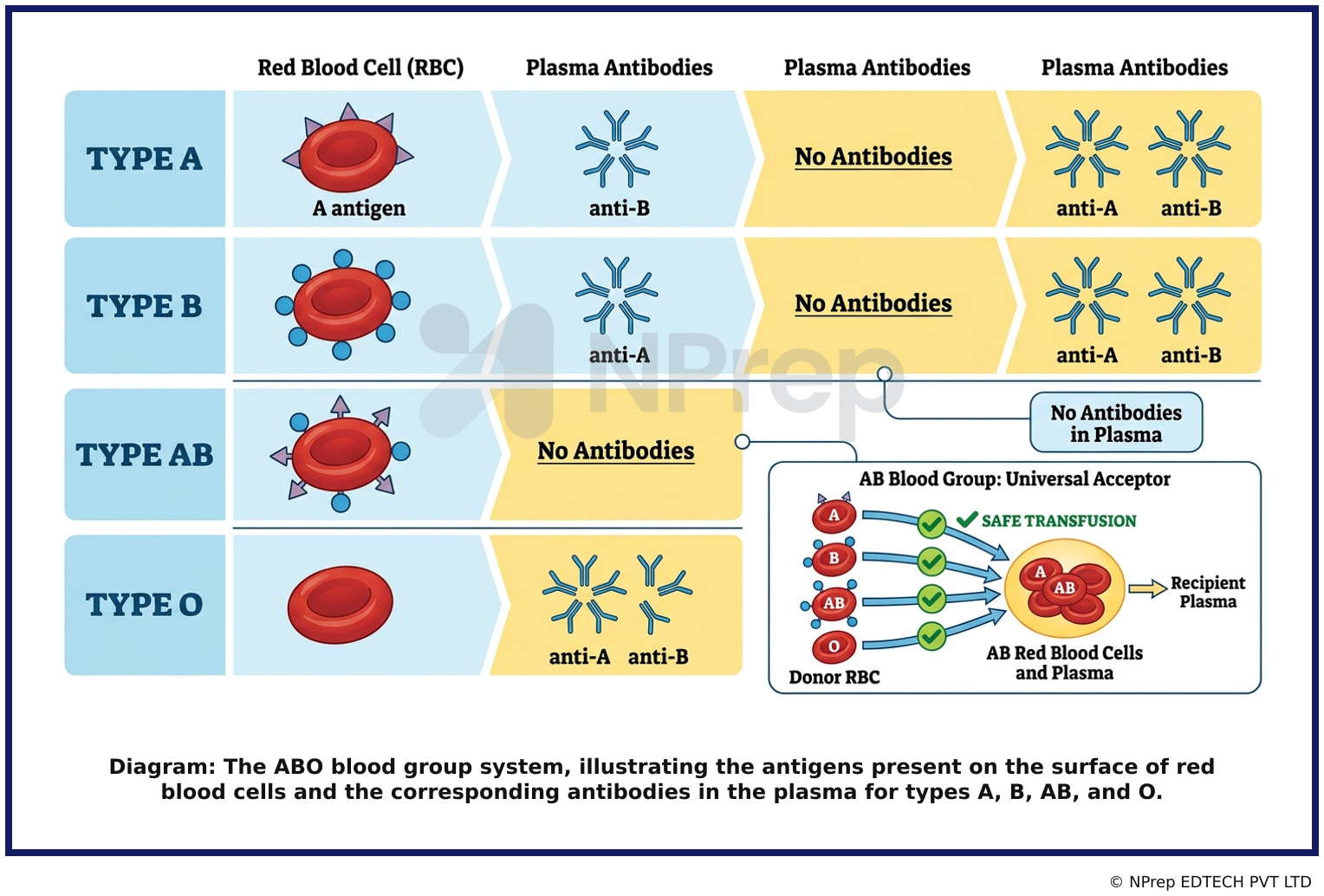
- Visual 1: Diagram: The ABO blood group system, illustrating the antigens present on the surface of red blood cells and the corresponding antibodies in the plasma for types A, B, AB, and O.
- Visual 2: Flowchart: Blood transfusion compatibility, showing which blood types can donate to and receive from others, highlighting Type AB as the universal recipient and Type O as the universal donor.
Clinical Relevance
- Nursing practice connection: Knowing ABO Blood Group System and Transfusion Compatibility helps nurses interpret findings accurately and avoid errors in routine assessment, medication administration, and patient teaching.
- Accurate blood typing and cross-matching are critical nursing responsibilities before any blood transfusion to prevent life-threatening acute hemolytic transfusion reactions.
- A hemolytic reaction occurs when the recipient's antibodies attack the donor's red blood cells, leading to symptoms like fever, chills, back pain, and potentially renal failure and shock.
- What if? If a patient with AB blood is Rh-negative (AB-), they are still a universal recipient for red blood cells from all ABO groups, but they should ideally only receive Rh-negative blood to prevent Rh sensitization and a future immune reaction.
How to Approach the Question
- First, identify the core of the question. It asks for the reason ('because') behind a known fact (AB group are universal acceptors).
- Differentiate between a definition and a mechanism. One option defines a universal acceptor, but doesn't explain the underlying biology.
- Recall the fundamental principles of the ABO system: Antigens are on the red blood cells (RBCs), and antibodies are in the plasma.
- Analyze the transfusion interaction: The recipient's antibodies react with the donor's antigens. For a universal recipient to not have a reaction, they must lack the attacking antibodies.
- Evaluate each option based on this principle. This logic points directly to the absence of antibodies in the plasma as the correct explanation.
Concept Tested & Keywords
- Concept Tested: ABO Blood Group System and Transfusion Compatibility
- Stem keywords: AB blood group, universal acceptors
- Lead-in keywords: because
Question ID
QXQ654XF8uhdlrhQXx-qjy
Practise the full RRB Staff Nurse Jaipur-6th June 2018
Attempt every question from this paper in a timed mock, then review the full solution for each one.
More Blood Questions
- Universal blood donor?
- What is the average lifespan of Red blood cells?
- In the clotting mechanism, prothrombin is changed into thrombin in the presence of?
- What is the synonym of Clotting Factor II?
- Antibodies are produced by?
- What is the approximate normal level of haematocrit/ packed cell volume in men?
- An individual with which of the following blood groups is a universal donor?
- Which blood cells increase during an infection?
- Antibodies are produced by?
- Chief regulatory among the immune cells are?
More RRB Staff Nurse Jaipur-6th June 2018 Questions
- Complete the analogy Pearl : Necklace :: Flower : ?
- Find compound interest on Rs. 5000 at 12% p.a. for 1 year, compounded half-yearly.
- Chronic diarrhea is caused by
- Directions: In the following question, insert proper mathematical signs between the figures in the sum: If $\times$ means 'Minus'; $\div$ means 'Mult…
- If MEN is coded as MIN and WOMAN as WUMIN, then CHILD will be coded as
- The spinal cord is made up of
- The ligaments join
- On your way to take an examination, you suddenly get an attack of diarrhoea. If you stop at a nearby drug store for an over the counter opioid with a…
- Penicillin was discovered by
- Movements of the baby felt by the pregnant mother are known as