
DSSSB -28 August 2019 (Shift-2)
Edition 3
Easy
Loud drum-like high pitch sounds on percussion are known as?
Appeared in: DSSSB -28 August 2019 (Shift-2)
Explanation
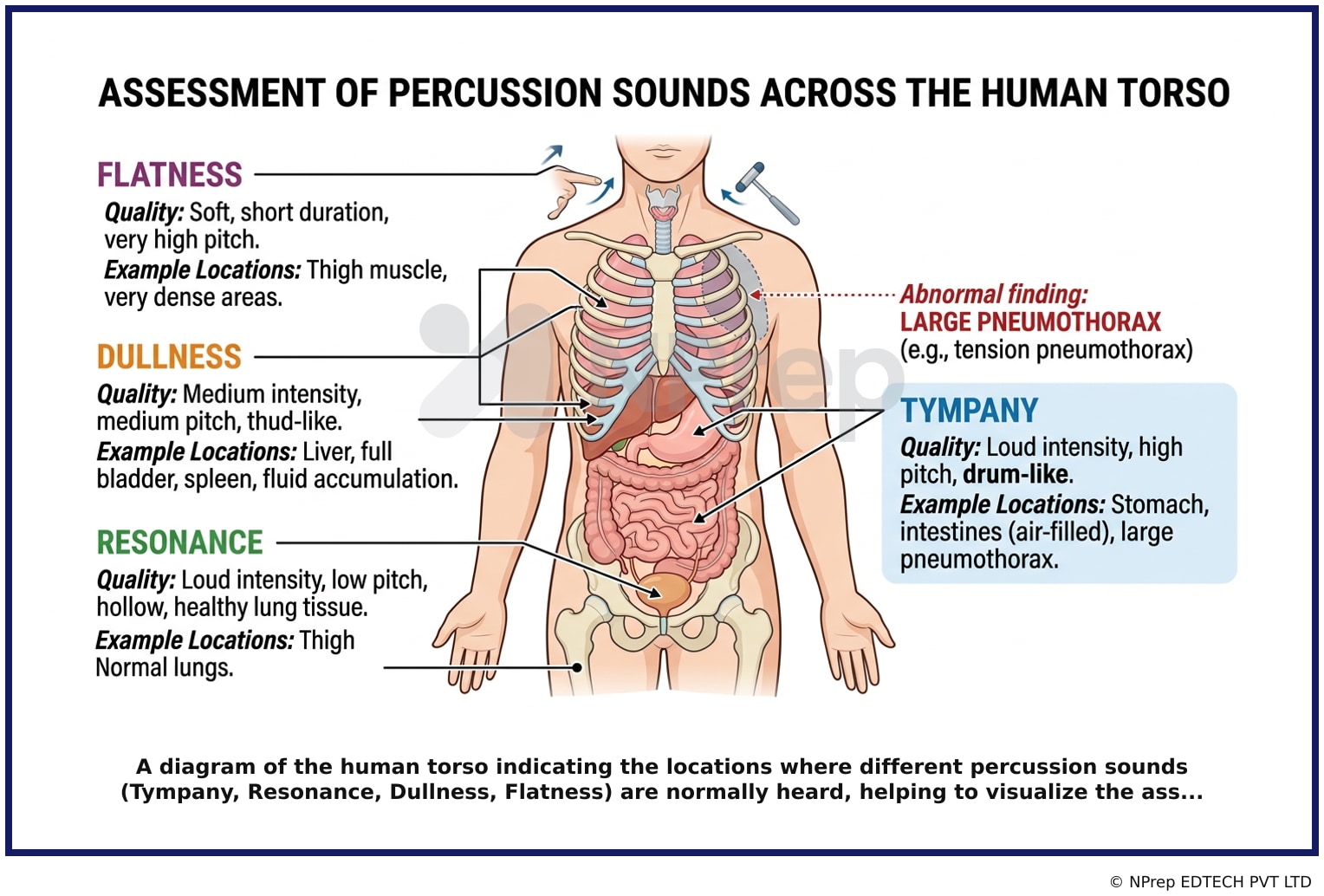
- Tympany is the correct term for a loud, high-pitched, drum-like sound heard during percussion.
- This sound is characteristic of air-filled spaces.
- It is normally heard over the stomach and intestines.
- In the context of the chest, a tympanic note can indicate a large pneumothorax (collapsed lung).
Why Other Options Were Wrong
- Option A: Resonance is a low-pitched, hollow sound, not high-pitched and drum-like. It is the expected sound over normal, healthy lungs.
- Option B: Crackles are sounds heard during auscultation with a stethoscope, not sounds produced by percussion. They indicate fluid or secretions in the airways.
- Option C: Hyperresonance is a very loud, low-pitched, booming sound, which is different from the high-pitched, drum-like quality of tympany. It indicates an excess of air.
Related Visual
Clinical Relevance
- Nursing practice connection: This is primarily an exam-oriented knowledge point with limited direct bedside application, so retain Identification of percussion sounds in physical assessment as background academic context rather than a clinical decision trigger.
- Percussion is a fundamental nursing skill used to assess the condition of underlying organs and tissues without invasive procedures.
- Identifying an abnormal percussion note (e.g., dullness over a lung field that should be resonant) can be an early sign of pathology like pneumonia, pleural effusion, or a tumor, prompting further investigation.
- What if? If a nurse percusses the abdomen and hears widespread dullness instead of the expected tympany, it could signify ascites (fluid accumulation), a mass, or an enlarged organ, requiring notification of the healthcare provider.
How to Approach the Question
- First, identify the key descriptors in the question: 'loud', 'drum-like', and 'high pitch'. Also, note the assessment technique: 'percussion'.
- Recall the five basic percussion notes: flatness, dullness, resonance, hyperresonance, and tympany.
- Systematically compare the characteristics of each note with the descriptors in the question.
- Eliminate 'Crackles' immediately, as it is an auscultatory sound, not a percussion note.
- Differentiate between the remaining options. 'Resonance' is the normal lung sound (low-pitched). 'Hyperresonance' is a booming, low-pitched sound. 'Tympany' is a high-pitched, drum-like sound.
- Conclude that 'Tympany' is the only term that matches all the descriptors provided in the question.
Concept Tested & Keywords
- Concept Tested: Identification of percussion sounds in physical assessment
- Stem keywords: percussion, loud, drum-like, high pitch
- Lead-in keywords: known as
Question ID
qbU9R4oavSMy9eXMcTBV8
Reference Book
E6 Nursing Fundamentals Taylor p. 716-718
Practise the full DSSSB -28 August 2019 (Shift-2)
Attempt every question from this paper in a timed mock, then review the full solution for each one.
More Fundamental of Nursing Questions
- A group of symptoms is known as?
- What is the frictional force exerted by the fluids also called?
- एक रोगी को अंतःपेशी ( intramuscular) इंजेक्शन दिया जाना है। नर्स को सुई किस कोण पर निवेश करनी चाहिए?
- The dolor sign of inflammation refers to:
- The first-aider can stop bleeding by - Except?
- Complication that can be prevented by using foot rest?
More DSSSB -28 August 2019 (Shift-2) Questions
- Read the given statement and conclusions carefully. Assuming that the information in the statement is true, even if they appear to be at variance wit…
- Out of the given options, three are similar in a certain manner. However, one option is NOT like the other three. Select the option which is differen…
- Five girls took part in a race. Rashi finished before Manisha but behind Garima. Ankita finished before Sakshi but behind Manisha. Who won the race?
- If a mirror is placed on the line MN, then which of the answer figures will be the right mirror image of the given figure?
- Out of the given options, three are similar in a certain manner. However, one option is NOT like the other three. Select the option which is differen…
- Which of the following answer figures completes the series of the question figure?
- Out of the given options, three are similar in a certain manner. However, one option is NOT like the other three. Select the option which is differen…
- Which of the following cubes in the answer figure CANNOT be made based on the unfolded cube in the question figure?
- Which two signs should be interchanged to make the below equation mathematically correct? (56+6) 8 × 3 + 3 \= 18
- Two men Kashish and Yash start from the same point. Kashish walks 0.3 km west, then turns north and walks 0.45 m, then turns to his right and walks 0…