
RRB Nsg. Superintendent-20 July 2019 (Shift-1)
Reasoning
Medium
In this question, relationship between different elements is shown in the statement. This statement is followed by three conclusions. Assume the given statement to be true and choose the answer from the given options:
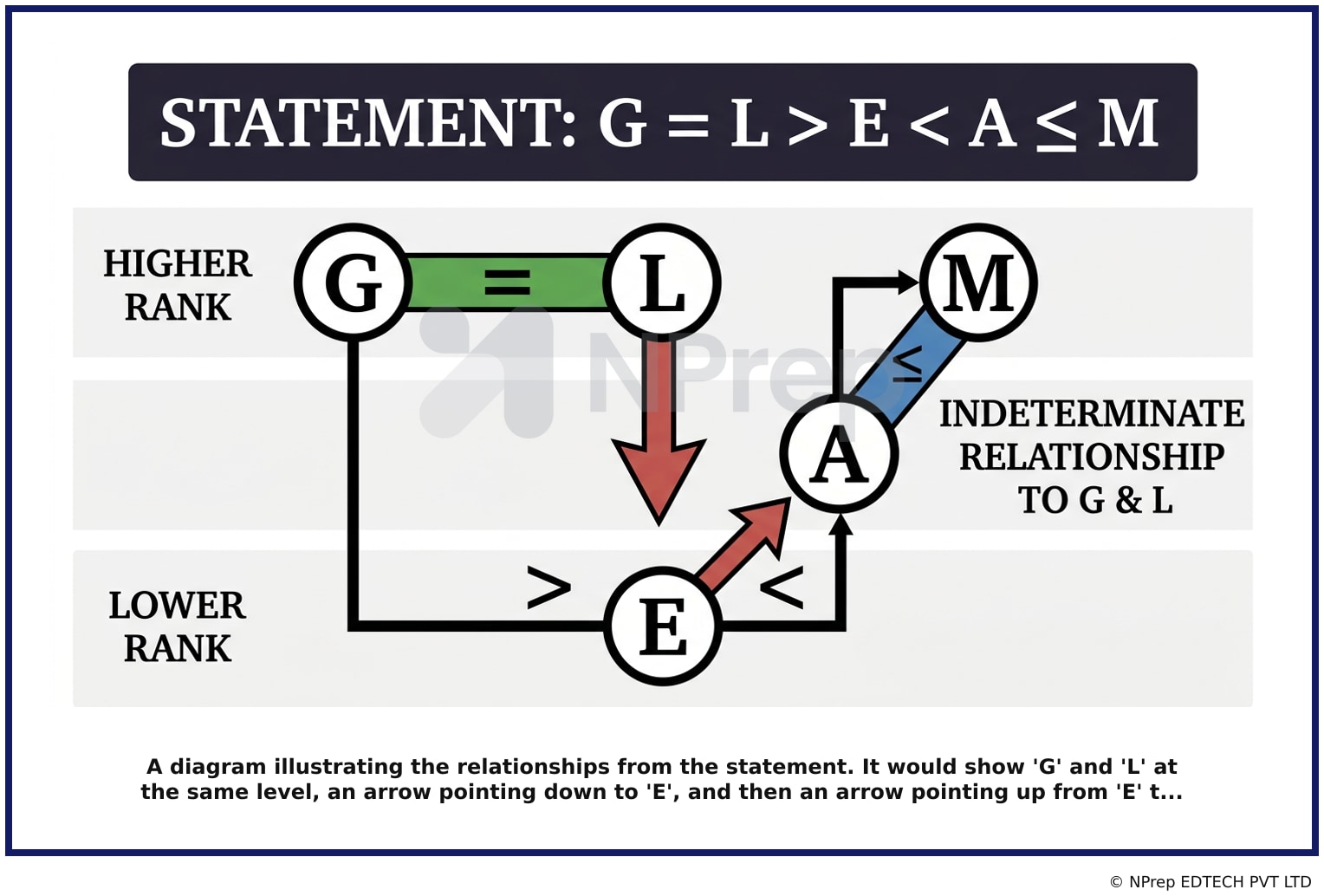
Statements: G = L > E < A <_ M
Conclusions:
i) L > M
ii) G <A
iii) A > L
Appeared in: RRB Nsg. Superintendent-20 July 2019 (Shift-1)
Explanation
- The provided statement
G = L > E < A ≤ Mcontains opposing inequality signs (>and<) in the path between the elements of each conclusion. - When a logical path between two elements contains opposing signs (e.g.,
X > Y < Z), no definite relationship can be established between the outer elements (X and Z). - Conclusion i (L > M) fails because the path is
L > E < A ≤ M, showing opposing signs. - Conclusion ii (G < A) fails because the path
G = L > E < Aalso has opposing signs. - Conclusion iii (A > L) fails because while both A and L are greater than E, their direct relationship cannot be determined.
Why Other Options Were Wrong
- Option A: This option claims all conclusions follow, but as demonstrated, none of the conclusions can be logically proven from the statement.
- Option B: This option claims conclusions i and ii follow. However, both are invalid due to the presence of opposing inequality signs in their respective logical paths.
- Option D: This option claims conclusions ii and iii follow. Both are invalid. Conclusion ii has opposing signs, and for conclusion iii, the relationship between A and L is indeterminate.
Related Visual
Clinical Relevance
- Nursing practice connection: This is primarily an exam-oriented knowledge point with limited direct bedside application, so retain Logical Reasoning - Coded Inequalities as background academic context rather than a clinical decision trigger.
- While this is a logical reasoning question, the underlying skill is critical for nursing practice.
- Nurses must use deductive and inductive reasoning to interpret patient data, prioritize care, and anticipate outcomes. For example, interpreting a series of vital signs (like
Temp > 38°C,HR > 100,BP < 90/60) requires logically connecting disparate data points to identify a potential condition like sepsis. - This type of logical analysis is fundamental to the nursing process (Assessment, Diagnosis, Planning, Implementation, Evaluation).
How to Approach the Question
- First, carefully read the statement and break it down into individual relationships:
G = L,L > E,E < A,A ≤ M. - Next, examine each conclusion one by one.
- For each conclusion, trace the path between the two elements using the relationships from the statement.
- The key rule is: If the path contains opposing inequality signs (e.g.,
>and<), no definite conclusion can be drawn. This is the most common reason for an invalid conclusion. - Evaluate Conclusion i (L > M): The path is
L > E < A ≤ M. It contains>and<. Therefore, it does not follow. - Evaluate Conclusion ii (G < A): The path is
G = L > E < A. It contains>and<. Therefore, it does not follow.
Concept Tested & Keywords
- Concept Tested: Logical Reasoning - Coded Inequalities
- Stem keywords: relationship, statement, conclusions, G = L > E < A ≤ M
- Lead-in keywords: choose the answer
Question ID
Q9LdqstAJSe2D1KXZZ56Pq
Reference Book
E6 Psychology Morgan King 9e Part 2 p. 67-69
Practise the full RRB Nsg. Superintendent-20 July 2019 (Shift-1)
Attempt every question from this paper in a timed mock, then review the full solution for each one.
More General Intelligence and Reasoning Questions
- 'Bull' is related to 'cow' in the same way as 'Horse' is related to?
- Identify the number of rhombus in the following figure.
- Identify the contra-positive statement of the conditional statements. If the basketball team score 60 points then the entire students section gets fr…
- From the given answer figures, select the one in which the question figure is hidden/embedded? Question Figure: Answer Figures:
- Out of the given options, three are similar in a certain manner. However, one option is NOT like the other three. Select the option which is differen…
- If a paper is folded and cut according to the given diagram, how will the paper appear after unfolding it?
- Select the term from the options that has the same relation as given below.
- A and B together can do a piece of work in 10 days. A alone can do it in 30 days, the time in which B alone can do it is :
- A train is running at the speed of 100 km/hr and every 75 km train stops for 3 minutes. How much time will it take to reach 600 km?
- Free throw' is given in which of the following sports?
More RRB Nsg. Superintendent-20 July 2019 (Shift-1) Questions
- Which one of the following is NOT a type of back massage?
- Urethral opening located behind the penis on the ventral surface?& x20;
- Vulsellum forceps is used for gripping the
- Universal safety precautions are a set of guidelines to protect the?
- Which type of crutch is frequently used by patients of all ages on a short-term basis?
- A condition of the inner ear characterized by episodic vertigo, tinnitus, and sensorineural hearing loss is referred to as?
- Growth hormone is secreted by which of the following endocrine glands?
- Breakdown of glycogen to glucose is known as?
- Which is the functional unit of the kidneys?
- Inadequate pumping action of the heart is known as?