
RRB Nsg. Superintendent-21 July 2019 (Shift-2nd)
Reasoning
Hard
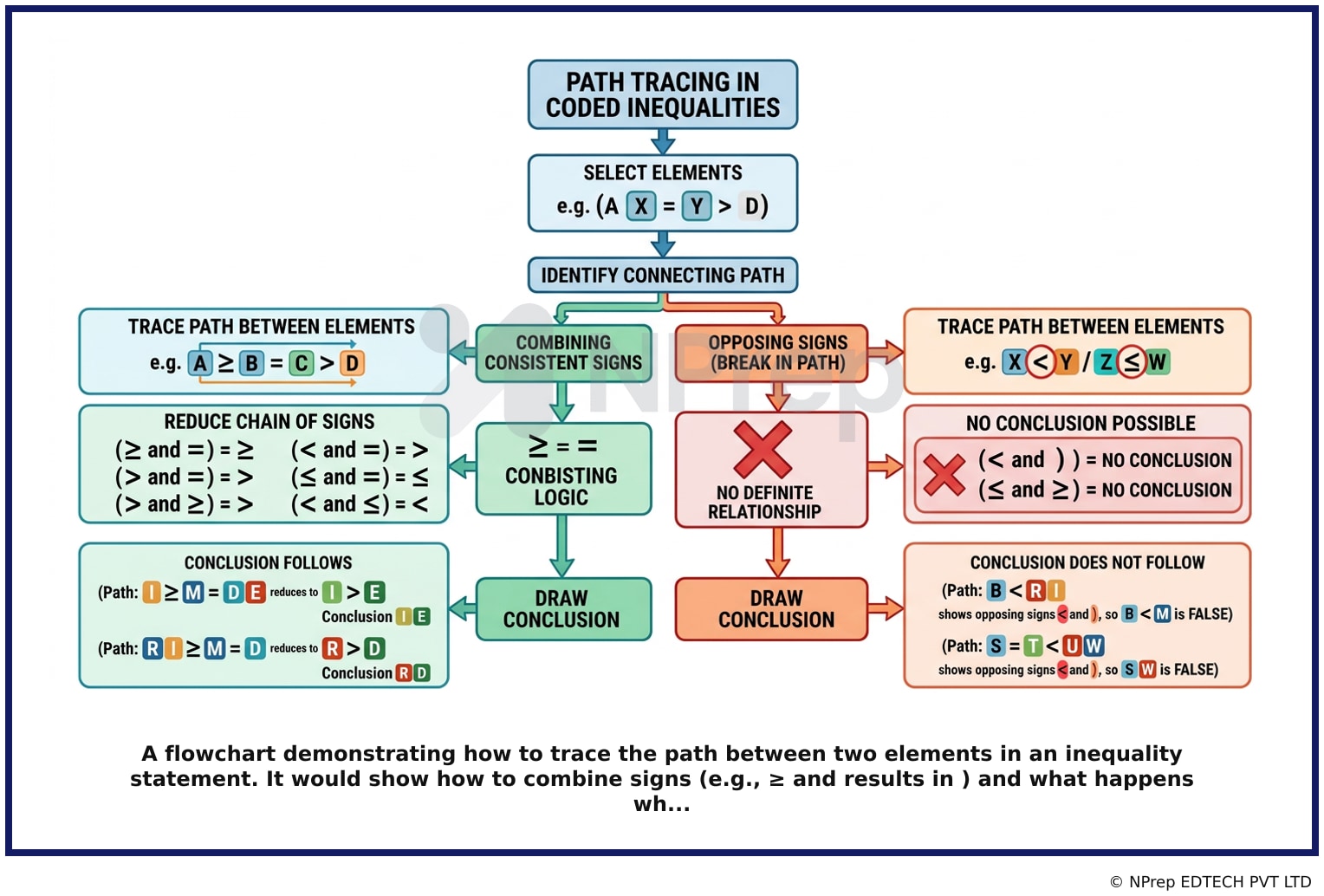
In this question, relationship between different elements is shown in the statement. This statement is followed by three conclusions. Assume the given statement to be true and choose the answer from the given options: Statement: B < R > I ≥ M = D > E Conclusions: i) B < M ii) I > E iii) R > D
Appeared in: RRB Nsg. Superintendent-21 July 2019 (Shift-2nd)
Explanation
- This option correctly identifies that only conclusions (ii) and (iii) logically follow from the main statement.
- Conclusion (ii) I > E is true because the path I ≥ M = D > E simplifies to I ≥ D > E, which means I must be greater than E.
- Conclusion (iii) R > D is true because the path R > I ≥ M = D simplifies to R > I ≥ D, which means R must be greater than D.
Why Other Options Were Wrong
- Option A: This option is incorrect because it includes conclusion (i) B < M, which is false. No definite relationship can be established between B and M due to the opposing signs (< and >) in the path B < R > I.
- Option B: This option claims that all conclusions follow, which is incorrect. Conclusion (i) B < M is false because of the opposing signs in the path connecting B and M.
- Option D: This option is incorrect because it excludes the valid conclusion (iii) R > D. The path R > I ≥ M = D clearly establishes that R is greater than D.
Related Visual
Clinical Relevance
- Nursing practice connection: This is primarily an exam-oriented knowledge point with limited direct bedside application, so retain Logical Reasoning - Coded Inequalities as background academic context rather than a clinical decision trigger.
- While not a clinical question, this type of logical reasoning is a foundational skill for nursing.
- Nurses use deductive reasoning to interpret patient data, connect symptoms to potential diagnoses, and evaluate the effectiveness of interventions.
- Strong analytical skills help in prioritizing care, especially when multiple patient needs and data points must be considered simultaneously.
How to Approach the Question
- First, carefully read the main statement that establishes the relationships: B < R > I ≥ M = D > E.
- Next, analyze each conclusion individually by tracing the path between the two elements in the main statement.
- For Conclusion (i) B < M, trace the path B < R > I ≥ M. Notice the opposing signs '<' and '>'. This immediately means no definite conclusion can be drawn. Mark it as false.
- For Conclusion (ii) I > E, trace the path I ≥ M = D > E. Combine the relationships: I is greater than or equal to M, M is equal to D, and D is greater than E. This chain (I ≥ D > E) confirms that I is greater than E. Mark it as true.
- For Conclusion (iii) R > D, trace the path R > I ≥ M = D. Combine the relationships: R is greater than I, I is greater than or equal to M, and M is equal to D. This chain (R > I ≥ D) confirms that R is greater than D. Mark it as true.
- Finally, review your findings: (i) is false, (ii) is true, and (iii) is true. Select the option that matches this result, which is 'Only ii) and iii) follow'.
Concept Tested & Keywords
- Concept Tested: Logical Reasoning - Coded Inequalities
- Stem keywords: relationship, statement, conclusions, inequality
- Lead-in keywords: choose the answer
Question ID
Q0z84umRilMx7dDd6NANur
Practise the full RRB Nsg. Superintendent-21 July 2019 (Shift-2nd)
Attempt every question from this paper in a timed mock, then review the full solution for each one.
More General Intelligence and Reasoning Questions
- 'Bull' is related to 'cow' in the same way as 'Horse' is related to?
- Identify the number of rhombus in the following figure.
- Identify the contra-positive statement of the conditional statements. If the basketball team score 60 points then the entire students section gets fr…
- From the given answer figures, select the one in which the question figure is hidden/embedded? Question Figure: Answer Figures:
- Out of the given options, three are similar in a certain manner. However, one option is NOT like the other three. Select the option which is differen…
- If a paper is folded and cut according to the given diagram, how will the paper appear after unfolding it?
- Select the term from the options that has the same relation as given below.
- A and B together can do a piece of work in 10 days. A alone can do it in 30 days, the time in which B alone can do it is :
- A train is running at the speed of 100 km/hr and every 75 km train stops for 3 minutes. How much time will it take to reach 600 km?
- Free throw' is given in which of the following sports?
More RRB Nsg. Superintendent-21 July 2019 (Shift-2nd) Questions
- The most common cause of embolism is ?
- Myopia is corrected by using?
- The normal human body temperature is maintained by& x20;
- \ \ \ \ \ \ denotes one who never completed a pregnancy to the stage of& x20;
- The process involved in the development of a mature ovum is called & x20;
- The larynx is closed during swallowing by: & x20;
- How are ECG changes presented in ischemia and myocardial infarction? & x20;
- What information the nurse should consider while collecting the history of a child with suspected rheumatic fever?& x20;
- The storage form of carbohydrates in animals is& x20;
- Paedophilia is a form of