
Combined AIIMS - 2020 (Jodhpur, Bhopal, Patna, Raipur)
Medical & Surgical Nursing
Easy
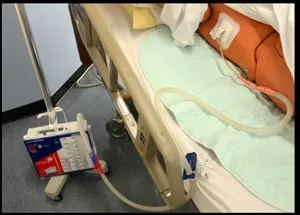
Identify the procedure shown in the image:
Appeared in: Combined AIIMS - 2020 (Jodhpur, Bhopal, Patna, Raipur)
Explanation
- The image clearly shows a multi-chambered drainage unit connected by tubing to a patient's chest, which is characteristic of a water seal drainage system.
- This system is designed for continuous drainage of air or fluid from the pleural space to help re-expand a collapsed lung.
- The key components visible or implied are the collection chamber, the water seal chamber (which acts as a one-way valve), and a suction control mechanism, all hallmarks of this system.
Why Other Options Were Wrong
- Option B: Thoracocentesis is an intermittent procedure using a needle and syringe to aspirate fluid from the pleural space. The image shows a continuous, closed drainage system, not a needle aspiration setup.
- Option C: Catheterization typically refers to urinary catheterization for draining the bladder. The equipment and anatomical location in the image are related to the chest, not the urinary system.
- Option D: Bronchoalveolar lavage is an endoscopic procedure where fluid is instilled and suctioned from the lungs via a bronchoscope. The image does not show a bronchoscope or the internal airways.
Related Visual

Clinical Relevance
- Nursing practice connection: This is primarily an exam-oriented knowledge point with limited direct bedside application, so retain Identification of chest drainage systems as background academic context rather than a clinical decision trigger.
- Nurses are responsible for managing patients with chest tubes, which includes monitoring drainage amount and color, assessing for air leaks (bubbling), checking for tidaling, and ensuring the system remains below the chest level to prevent backflow.
- A key safety measure is to always have sterile water, gauze, and clamps at the bedside in case the tube becomes dislodged or the system breaks.
- What if? If the water seal chamber shows continuous, vigorous bubbling, it indicates a significant air leak in the system or from the patient. The nurse's first action is to assess the system for loose connections, starting from the patient and moving towards the drainage unit. If no leak is found in the tubing, it signifies a persistent air leak from the lung, which must be reported.
How to Approach the Question
- First, carefully analyze the image provided. Identify the key pieces of equipment and their connection to the patient (mannequin).
- Note the tubing originating from the chest area and connecting to a multi-chambered device on the floor. This is a critical visual clue.
- Recognize the device as a chest drainage unit (e.g., Pleur-evac).
- Evaluate the given options based on your visual identification. 'Water seal drainage system' accurately describes the entire apparatus shown.
- Eliminate the other options by considering their definitions: Thoracocentesis (needle aspiration), Catheterization (usually urinary), and Bronchoalveolar lavage (endoscopic lung wash). None of these match the visual evidence.
- Confirm your choice by recalling that the purpose of this system is to drain the pleural space, which aligns with the function of a water seal drainage system.
Concept Tested & Keywords
- Concept Tested: Identification of chest drainage systems
- Stem keywords: procedure, image
- Lead-in keywords: Identify
- Negative lead-in flag: false
Question ID
QeIoQDrawH5EEE52G3nH7A
Reference Book
E6 Nursing Fundamentals Potter Perry 12e Part 5 pp. 2-4, 33-35
Practise the full Combined AIIMS - 2020 (Jodhpur, Bhopal, Patna, Raipur)
Attempt every question from this paper in a timed mock, then review the full solution for each one.
More Urinary Tract Function Questions
- Assessing the laboratory findings which results would the nurse most likely to expect to find in a client with chronic renal failure?
- A nurse is taking care of Chronic renal dysfunction patient. What diet she will advise for this patient?
- A patient is admitted with acute renal kidney injury, and nurse is advised to monitor strict urine output. She notices urine output is less than 100…
- The following are the use of the central line catheter; EXCEPT:
- The involuntary loss of urine through an intact urethra as a result of sudden increase in the intra-abdominal pressure is called:
- Which of the following is the warning sign post renal transplantation?
- What is contraindicated in male patient reporting the symptoms of redness and ecchymosis in the scrotum region?
- A patient with low urine specific gravity will have all the following characteristics; EXCEPT:
- Food contraindicated with CRF and spironolactone:
- When initiating the use of a newly inserted Central Venous Access Device (CVAD), what is the recommended syringe size for the initial flushing proced…
More Combined AIIMS - 2020 (Jodhpur, Bhopal, Patna, Raipur) Questions
- The position used for most of the gynecological procedures?
- Thyroid eye disease (TED) is also known as:
- How many items are included in the WHO surgical safety checklist: SITOSO?
- In iron deficiency anemia, the fingernails become spoon shaped, this condition is referred to as:
- Which of the following code is associated with cardiac arrest during medical emergency?
- How is blood loss measured in Post-partum hemorrhage?
- The traction used for cervical spine injury:
- In operation theater during cauterization, the electric current passing from a single electrode is called:
- Tracheostomy is done in which tracheal ring?
- The instrument used for measuring fetal heart rate (FHR):