
AIIMS Delhi NO - 2018
Nursing Foundation
Easy
Identify the position shown in the image below?
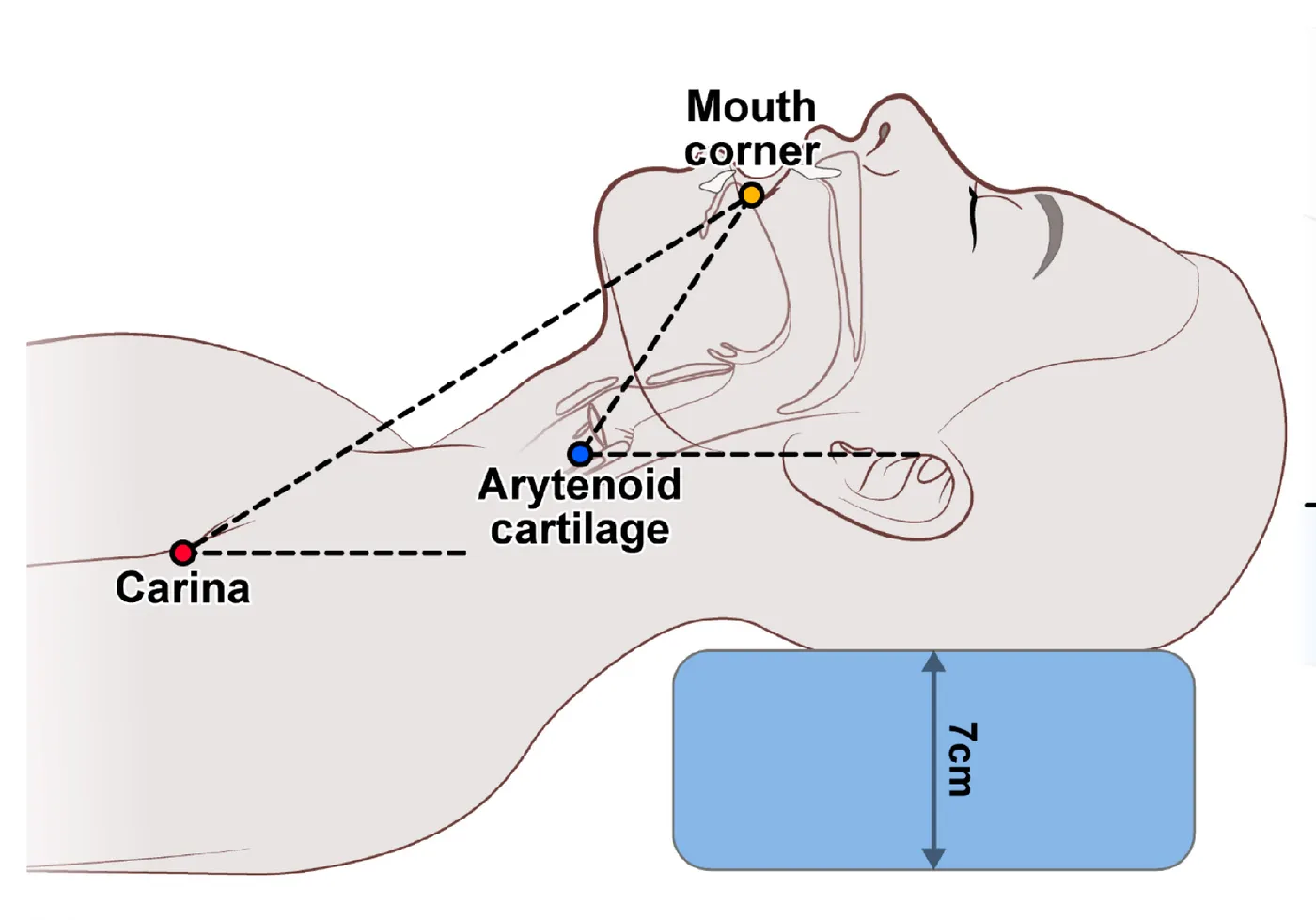
Appeared in: AIIMS Delhi NO - 2018
Explanation
- The image shows a patient with their head elevated on a pillow and their neck extended.
- This specific posture is known as the 'sniffing the morning air' or Sniff position.
- This position is intentionally created to align the oral, pharyngeal, and laryngeal axes of the airway.
- The primary purpose of the Sniff position is to facilitate easier and more successful endotracheal intubation by providing a straight-line view of the vocal cords.
Why Other Options Were Wrong
- Option A: The Prone position involves the patient lying on their abdomen (face down), which is the opposite of what is shown in the image.
- Option B: While the patient is on their back, which is a component of the supine position, the Supine position specifically means lying flat. The image clearly shows the head is elevated and the neck is extended, which is a modification of the simple supine position.
- Option D: The Dorsal position (often called Dorsal Recumbent) involves the patient lying on their back with their knees bent and feet flat on the bed. The image does not show the patient's lower body, but the defining characteristic of head and neck extension for the Sniff position makes this option incorrect.
Related Visual

Clinical Relevance
- Nursing practice connection: This is primarily an exam-oriented knowledge point with limited direct bedside application, so retain Identification of patient positioning for clinical procedures as background academic context rather than a clinical decision trigger.
- Mastering patient positioning is a fundamental nursing skill critical for patient safety, comfort, and the success of various medical procedures.
- The Sniff position is a cornerstone of airway management in anesthesia, emergency medicine, and critical care. Failure to achieve this position can make intubation difficult or impossible.
- What if? If the patient had a suspected cervical spine injury, the Sniff position would be contraindicated due to the neck extension. In such cases, a jaw-thrust maneuver without head-tilt would be used to open the airway.
How to Approach the Question
- First, carefully observe the key features of the patient's posture in the image. Note the relationship between the head, neck, and torso.
- Identify the most prominent action: the head is tilted back and elevated, and the neck is extended.
- Relate this posture to a familiar action. The position resembles someone 'sniffing the air'.
- Evaluate the given options based on your observation. 'Prone' is face down. 'Supine' is flat on the back. 'Dorsal' involves bent knees.
- The 'Sniff position' option directly matches the visual evidence of head elevation and neck extension.
- Conclude that the Sniff position is the correct answer as it is specifically defined by the posture shown.
Concept Tested & Keywords
- Concept Tested: Identification of patient positioning for clinical procedures.
- Stem keywords: position, image
- Lead-in keywords: Identify
- Clinical cues: Head elevated on a pad
- Clinical cues: Neck extended
Question ID
QKT0-fy7kZKv2COepurEJl
Reference Book
E6 Nursing Fundamentals Taylor p. 208-210
E6 Nursing Fundamentals Potter Perry 12e Part 4 p. 155-157
Practise the full AIIMS Delhi NO - 2018
Attempt every question from this paper in a timed mock, then review the full solution for each one.
More Nursing Care & Specific Procedures Questions
- Identify the procedure done in the given image:
- Match the following:
- Look at the image and tell which of the following is incorrect combination:
- Identify the airway used in emergency in the following image:
- According to hospital's protocol during emergency situation "code pink" is used for which condition?
- Which is the appropriate nursing action by nursing officer after taking ABG sample from radial artery?
- The common veins used for placement of central line are all; EXCEPT:
- Who discovered Catgut suture?
- The sutures used to close deep, multi-layer lacerations are:
- You are preparing to suction a patient who is intubated with a 4.5 mm endotracheal tube (ETT). What size suction catheter would you choose to minimiz…
More AIIMS Delhi NO - 2018 Questions
- Another tentative diagnosis made for the client is Wernicke's Encephalopathy. If the client has this, the nurse anticipates that the first physician'…
- A 35-year-old man was in an automobile accident with an admitting diagnosis of a head injury. He has a Glasgow Coma Scale score of 4. Upon MRI and CT…
- A 28-year-old male client is admitted to the hospital for a suspected brain tumor. While assessing this client, the nurse would keep in mind that the…
- Following admission to the hospital, a diagnosis of increasing intracranial pressure was made. The nursing intervention appropriate in the care of th…
- The nurse has orders to administer phenytoin (Dilantin) 100 mg IV as an anticoagulant. The priority action while administering this drug is to:
- The client is to take lithium regularly after she is discharged from the hospital. The nursing care plan includes discharge planning. The most import…
- A patient is taking a proper diet as prescribed for bulimia nervosa, but the patient's weight is not gaining. Which nursing action is appropriate?
- Identify the size of the cannula shown here?& x20;
- Identify the following image? & x20;
- Identify the instrument below?& x20;