
AIIMS Delhi NO - 2018
Medical & Surgical Nursing
Easy
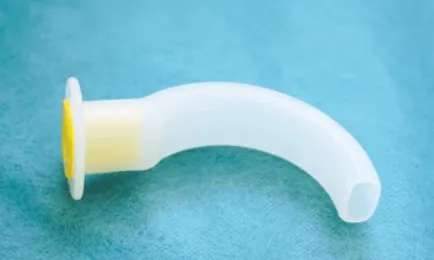
Identify the item in the below denote image? 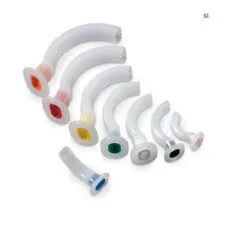
.jpg)
.jpg)
Appeared in: AIIMS Delhi NO - 2018
Explanation
- The device shown in the image is an Oropharyngeal Airway (OPA), also called a Guedel airway.
- It is a rigid, curved plastic tube inserted into the mouth of an unconscious patient to maintain a patent airway.
- Its function is to prevent the tongue from displacing backward and obstructing the oropharynx.
- The visible features—a flange, a bite block, and a curved body—are all characteristic of an OPA.
Why Other Options Were Wrong
- Option B: An NPA (Nasopharyngeal Airway) is a soft, flexible tube inserted through the nose, which is visually and functionally different from the rigid oral device shown.
- Option C: An LMA (Laryngeal Mask Airway) is a more complex supraglottic airway device with an inflatable mask that seals around the laryngeal inlet. The device in the image is a simple adjunct, not an LMA.
- Option D: IGAM is not a standard acronym for an airway device. It is likely a typo for i-gel. An i-gel is a supraglottic airway with a soft, non-inflatable gel cuff, which looks very different from the rigid plastic OPA.
Related Visual

Clinical Relevance
- Nursing practice connection: This is primarily an exam-oriented knowledge point with limited direct bedside application, so retain Identification of basic airway management adjuncts as background academic context rather than a clinical decision trigger.
- Correctly identifying airway adjuncts is a fundamental skill in emergency care and anesthesia to prevent life-threatening hypoxia.
- Proper sizing of an OPA is critical. It is measured from the corner of the patient's mouth to the angle of the jaw. An incorrectly sized OPA can worsen airway obstruction.
- OPAs should only be used in deeply unconscious patients without a gag reflex. Inserting an OPA in a patient with an intact gag reflex can induce vomiting and aspiration.
How to Approach the Question
- First, carefully examine the image provided. Note the key features of the device: its shape (J-curved), material (rigid plastic), and components (flange at one end).
- Next, read the options provided: OPA, NPA, LMA, and IGAM.
- Recall the definitions and appearances of each of these airway devices.
- Compare the visual features from the image with your knowledge of the options. The rigid, J-shaped oral device matches the description of an Oropharyngeal Airway (OPA).
- Eliminate the other options based on their distinct characteristics: NPA is soft and nasal, LMA has an inflatable mask, and i-gel (assuming IGAM is a typo) has a soft gel cuff.
Concept Tested & Keywords
- Concept Tested: Identification of basic airway management adjuncts.
- Stem keywords: Identify, item, image
- Lead-in keywords: NOT
- Clinical cues: The image shows a rigid, J-shaped medical device, which is a key feature of an OPA.
- Negative lead-in flag: NOT changes the reasoning strategy; look for the exception or incorrect statement rather than the true statement.
Question ID
Qo0blMYoACQFAzo4h8YcNM
Reference Book
E6 Nursing Fundamentals Potter Perry 12e Part 4 p. 254-255
E6 Nursing Brunner Adult Health 3SA Vol 2 Part 3 p. 115-117
Practise the full AIIMS Delhi NO - 2018
Attempt every question from this paper in a timed mock, then review the full solution for each one.
More Integumentary Function Questions
- This type of dressing is known as:
- The following picture shows is bedsore present in bedridden patient. Which grade of bedsore is present?
- In second degree bedsore, there is an involvement of:
- What is the bath used to remove the irritation of certain types of skin diseases and provide soothing effect?
- A female patient has come with facial burn injury into the emergency department in conscious condition. What will be the treatment for this patient?
- A patient comes into the emergency with a burn injury of 40% then what is first nursing intervention?
- A nurse caring a bedridden patient with a pressure ulcer, 2 hourly position changes and massaging & rubbing the back but pressure sore does not heal.…
- Second degree burn considered?
- Identify the stage of pressure ulcer
- A 23 year old man comes to the emergency department with thermal burns. In this case according to rule of nine which part of the body burned maximum?
More AIIMS Delhi NO - 2018 Questions
- Another tentative diagnosis made for the client is Wernicke's Encephalopathy. If the client has this, the nurse anticipates that the first physician'…
- A 35-year-old man was in an automobile accident with an admitting diagnosis of a head injury. He has a Glasgow Coma Scale score of 4. Upon MRI and CT…
- A 28-year-old male client is admitted to the hospital for a suspected brain tumor. While assessing this client, the nurse would keep in mind that the…
- Following admission to the hospital, a diagnosis of increasing intracranial pressure was made. The nursing intervention appropriate in the care of th…
- The nurse has orders to administer phenytoin (Dilantin) 100 mg IV as an anticoagulant. The priority action while administering this drug is to:
- The client is to take lithium regularly after she is discharged from the hospital. The nursing care plan includes discharge planning. The most import…
- A patient is taking a proper diet as prescribed for bulimia nervosa, but the patient's weight is not gaining. Which nursing action is appropriate?
- Identify the size of the cannula shown here?& x20;
- Identify the following image? & x20;
- Identify the instrument below?& x20;