
RUHS, Jaipur, PB B.Sc Nursing Entrance-2022
Medical & Surgical Nursing
Easy
Clubbing of fingers is sign of-
Appeared in: RUHS, Jaipur, PB B.Sc Nursing Entrance-2022
Explanation
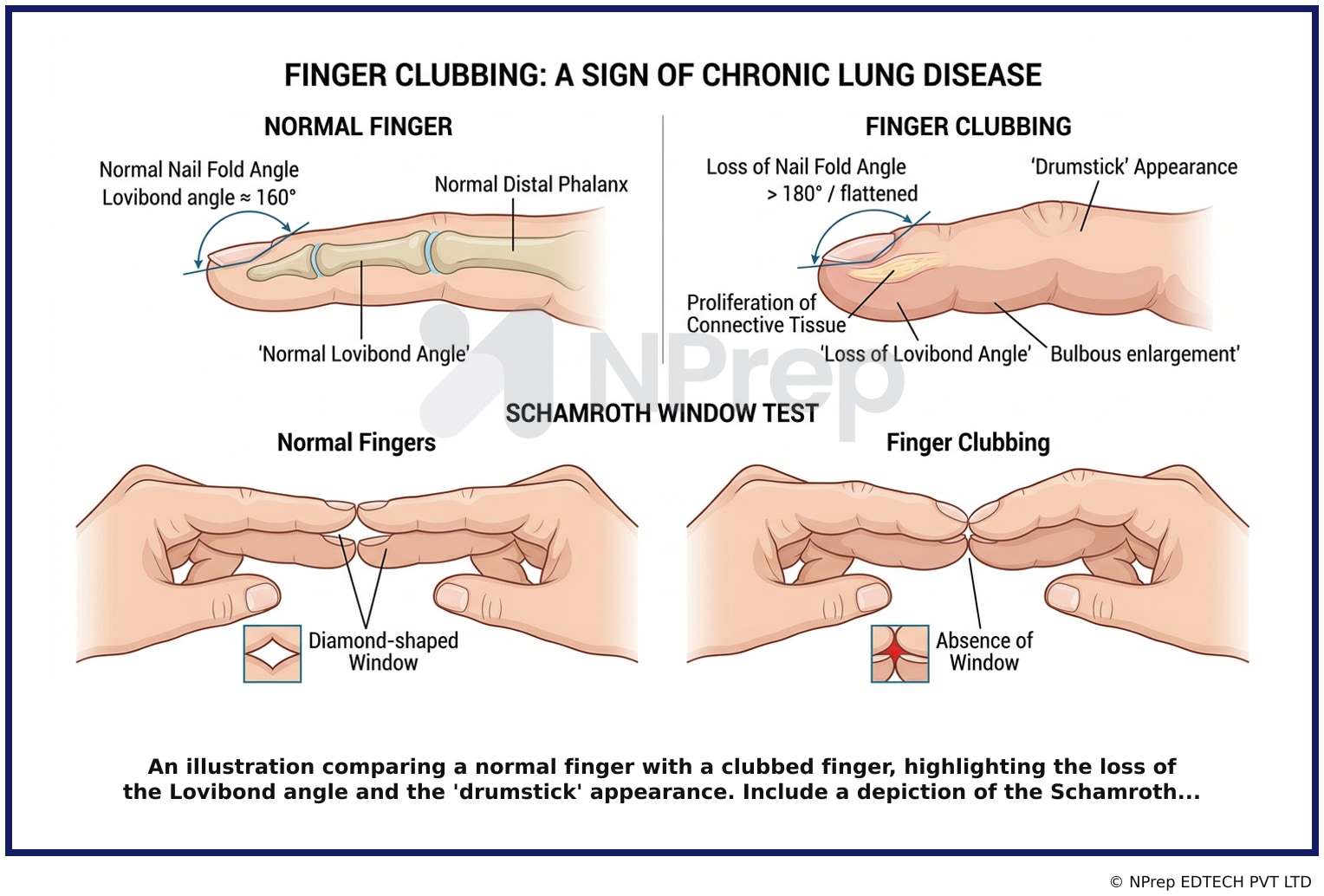
- Finger clubbing is the bulbous enlargement of the distal segments of the fingers and toes due to the proliferation of connective tissue.
- It is strongly associated with conditions that cause chronic hypoxemia (low blood oxygen levels) over a prolonged period.
- Chronic lung diseases such as lung cancer, bronchiectasis, cystic fibrosis, and interstitial lung disease are classic causes of chronic hypoxemia, leading to the development of clubbing.
Why Other Options Were Wrong
- Option A: This is an acute condition causing inflammation and dehydration. It does not cause the long-term hypoxia required for clubbing to develop.
- Option B: Shock is an acute state of circulatory collapse and systemic hypoperfusion. Clubbing is a chronic sign that develops over months to years, not from an acute event.
- Option C: While a chronic condition, renal disease is primarily associated with anemia, uremia, and electrolyte disturbances. It is not a recognized or common cause of finger clubbing.
Related Visual
Clinical Relevance
- Nursing practice connection: This is primarily an exam-oriented knowledge point with limited direct bedside application, so retain Clinical signs of chronic disease as background academic context rather than a clinical decision trigger.
- The presence of finger clubbing is a significant clinical finding that should always prompt a thorough investigation for serious underlying systemic diseases, particularly lung cancer, chronic lung infections, and cyanotic heart disease.
- Nurses are often the first to notice subtle physical changes like early clubbing during routine patient assessments and play a key role in reporting these findings.
- What if? If a patient with new-onset clubbing is also a long-term smoker with a persistent cough, the nurse's priority is to ensure prompt referral for investigation of bronchogenic carcinoma (lung cancer), as this is a classic presentation.
How to Approach the Question
- First, identify the key clinical sign in the question: 'clubbing of fingers'.
- Recall the pathophysiology of clubbing, which is linked to chronic conditions, particularly those causing long-term hypoxia.
- Evaluate each option based on this understanding.
- Eliminate acute conditions like 'Acute gastroenteritis' and 'Shock' because clubbing is a chronic sign that develops over an extended period.
- Compare the remaining chronic conditions. 'Chronic lung disease' is a classic and common cause of hypoxia-induced clubbing.
- Recognize that 'Chronic renal disease' is not typically associated with clubbing, making 'Chronic lung disease' the best answer.
Concept Tested & Keywords
- Concept Tested: Clinical signs of chronic disease
- Stem keywords: Clubbing of fingers, sign of
- Lead-in keywords: BEST, MOST RELEVANT CLUE
- Negative lead-in flag: false
Question ID
QH0dm6-6ieVHEKjwg4U6KX
Reference Book
E6 Medicine Harrison 22e Part 1 p. 320-322
E6 Medicine Harrison 22e Part 2 pp. 874-876, 875-877
Practise the full RUHS, Jaipur, PB B.Sc Nursing Entrance-2022
Attempt every question from this paper in a timed mock, then review the full solution for each one.
More Gas Exchange and Respiratory Function Questions
- Which is the most relevant knowledge about oxygen administration to a client with COPD?
- Patient in emergency department diagnosed to have fluid and air present in lung. What is the above-mentioned condition known as?
- Patient is suffering from dyspnea. Which position will you provide for patient to relieve?
- Which of the following is not involved in chest physiotherapy?
- Respiration which is abnormally shallow for two or three breaths followed by irregular period of apnea is termed:
- Identify the following instrument which is used in diagnostic procedures:
- Identify the instrument shown in the following image:
- Identify the tube in the following image:
- A patient suddenly develops respiratory difficulties such as dyspnea, what is the first priority of the nursing officer?
- Which of the following method is used for high flow oxygen administration:
More RUHS, Jaipur, PB B.Sc Nursing Entrance-2022 Questions
- Foetoscope is used to -
- Fundal height at the 24th week of pregnancy is ?
- Normal fetal heart rate at 38 weeks of gestational period is ?
- Fetal movement that is felt by the mother from 18th week of gestation is called ?
- Which type of pelvis has rounded brim?
- Which of the following is not an indication of caesarean section?
- At the 10cm dilatation of cervix during labor, fetal heart rate should be assessed at least-
- A mother in labor has been pushing effectively for 1 hour. The primary physiological need of mother in between contractions is ?
- Softening and blue purple discoloration of cervix in early pregnancy is called-
- Which of the following nursing intervention is most appropriate initially if uterus feels soft and boggy in the immediate post-partum period?