
NORCET 7 Prelims -2024
Mental Health Nursing
Easy
Aversion therapy is used in the treatment of which of the following conditions?
Appeared in: NORCET 7 Prelims -2024
Explanation
- Aversion therapy is a behavioral technique based on classical conditioning.
- It works by pairing an undesirable behavior (like smoking) with an unpleasant or noxious stimulus (like a bad taste or nausea).
- The goal is to create a conditioned aversion to the behavior, making it less likely to occur.
- This method is most commonly used for substance use disorders, including smoking and alcohol addiction, and other impulsive behaviors.
Why Other Options Were Wrong
- Option B: Depression is a mood disorder primarily treated by addressing distorted thought patterns and neurochemical imbalances.
- Option C: Panic attacks are episodes of intense fear. Treatment focuses on managing the physiological and cognitive aspects of anxiety, not creating an aversion.
- Option D: Aversion therapy is generally not used for OCD. The primary treatment involves confronting fears without performing compulsions.
Related Visual
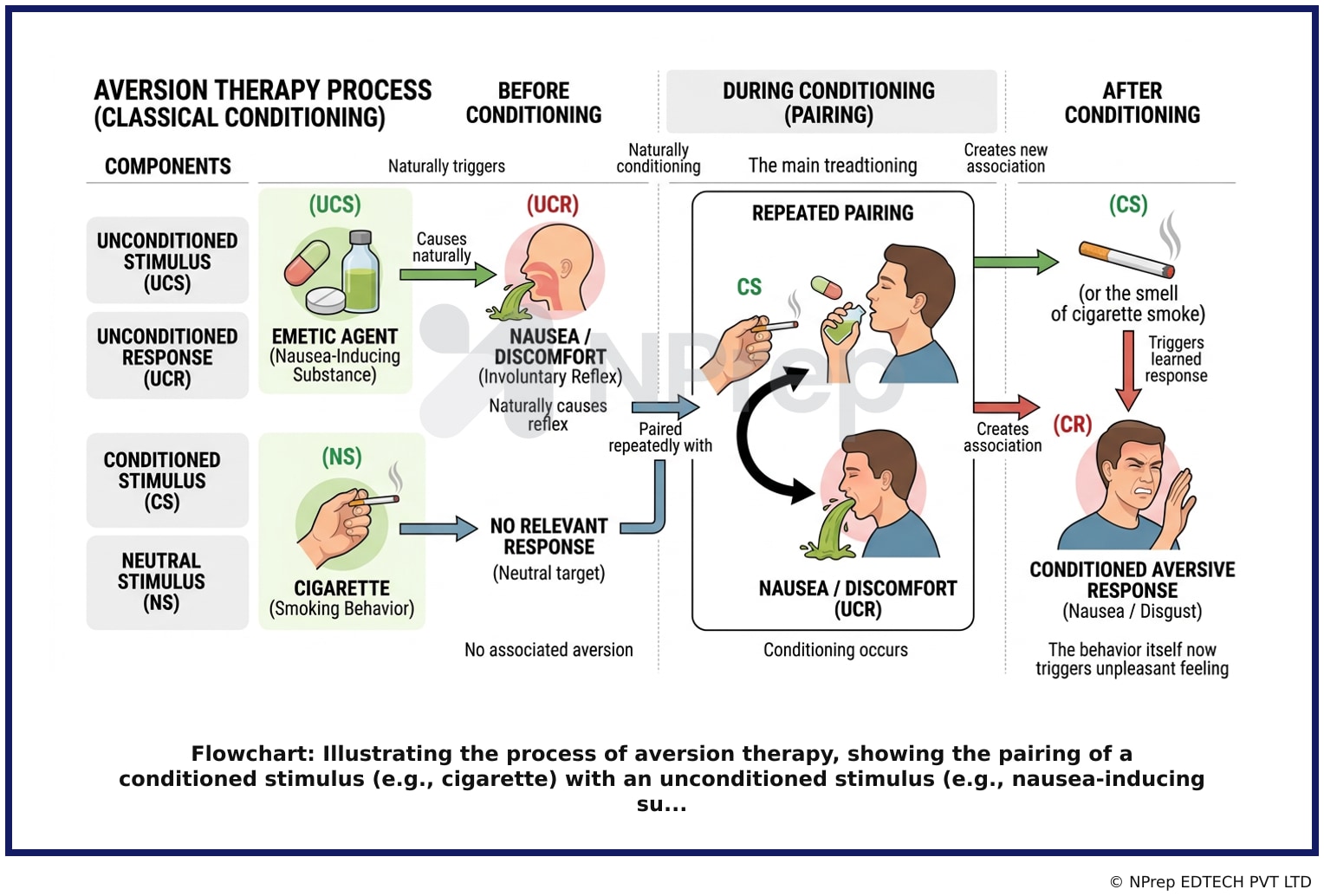
- Visual 1: Flowchart: Illustrating the process of aversion therapy, showing the pairing of a conditioned stimulus (e.g., cigarette) with an unconditioned stimulus (e.g., nausea-inducing substance) to create a conditioned aversive response.
Clinical Relevance
- Nursing practice connection: Knowing Behavioral Therapy: Aversion Therapy Application helps nurses interpret findings accurately and avoid errors in routine assessment, medication administration, and patient teaching.
- Nurses play a vital role in supporting patients undergoing behavioral therapies by providing education, monitoring for physical and psychological side effects, and reinforcing therapeutic goals.
- Ethical considerations are paramount in aversion therapy. The nurse must ensure the patient has given informed consent and that the therapy is conducted in a safe, controlled, and respectful manner.
- What if the patient wants to quit smoking but refuses aversion therapy due to its unpleasant nature? The nurse should then educate the patient on alternative, evidence-based smoking cessation strategies, such as nicotine replacement therapy (NRT), varenicline, bupropion, and supportive counseling.
How to Approach the Question
- First, identify the core concept in the question stem, which is 'Aversion therapy'.
- Recall the definition of aversion therapy: pairing an unwanted behavior with an unpleasant stimulus to stop the behavior.
- Analyze the given options to determine which condition is a behavioral problem that could be treated by creating a negative association.
- Smoking addiction is a classic example of a learned, rewarding behavior that can be targeted with counter-conditioning.
- Eliminate the other options by recalling their primary treatments. Depression, panic attacks, and OCD are primarily treated with cognitive therapies and/or medication, not aversion therapy.
Concept Tested & Keywords
- Concept Tested: Behavioral Therapy: Aversion Therapy Application
- Stem keywords: Aversion therapy, treatment
- Lead-in keywords: which of the following conditions
- Negative lead-in flag: false
Question ID
QMqCn4tdutHOxS5gailuKd
Practise the full NORCET 7 Prelims -2024
Attempt every question from this paper in a timed mock, then review the full solution for each one.
More Treatment modalities and therapies used in mental disorders Questions
- Based on the knowledge of electroconvulsive treatment, the nurse explains to the student nurses that atropine is given before the treatment primarily…
- Modified ECT is not given frequently on routine practice because of:
- What is the difference in regular ECT and modified ECT?
- The following are the indications of electroconvulsive therapy; EXCEPT:
- The absolute contraindication for electroconvulsive therapy is:-
- Nurse attending to a patient receiving electroconvulsive therapy (ECT) in a psychiatry department should ensure the compliance of all of the followin…
- \ \ \ \ \ \ is a family therapy approach that focuses on both the biological and the psychosocial components of a problem?
- The techniques of psychoanalysis include the following, EXCEPT?
- Which of the following is NOT true regarding Brief Cognitive Therapy?
- Which of the following equipment should be kept ready to use before ECT?
More NORCET 7 Prelims -2024 Questions
- A patient with kidney failure has been found to have 4+ protein in their urine. The nurse recognizes this finding as indicating:
- Which of the following is a true statement regarding breast milk?
- Based on the image showing the placement of ECG electrodes, where should the V1 lead be placed?
- Which type of anemia is characterized by macrocytic RBCs with megaloblastic changes?
- A nurse is caring for a patient with Chronic Obstructive Pulmonary Disease (COPD) and notices that the patient is using a CPAP machine. The nurse und…
- If a tracheostomy tube becomes dislodged, the nurse should:
- A nurse is assessing an endotracheal tube and needs to press the cricoid. This technique is known as:
- Which vaccine is typically given at the 6-week immunization visit?
- A patient is being administered general anesthesia. The nurse should assess the patient for:
- A nurse is using a non-rebreather mask on a patient. The oxygen flow is set at 10–15 L/min, but the reservoir bag is not inflating. What should the n…