
RUHS, Jaipur, M.Sc Nursing Entrance Exam-2015
Child Health Nursing (Pediatrics)
Easy
A newborn's mother asks the nurse why Vitamin K is given to her newborn? The nurse explains that Vitamin K helps in:
Appeared in: RUHS, Jaipur, M.Sc Nursing Entrance Exam-2015
Explanation
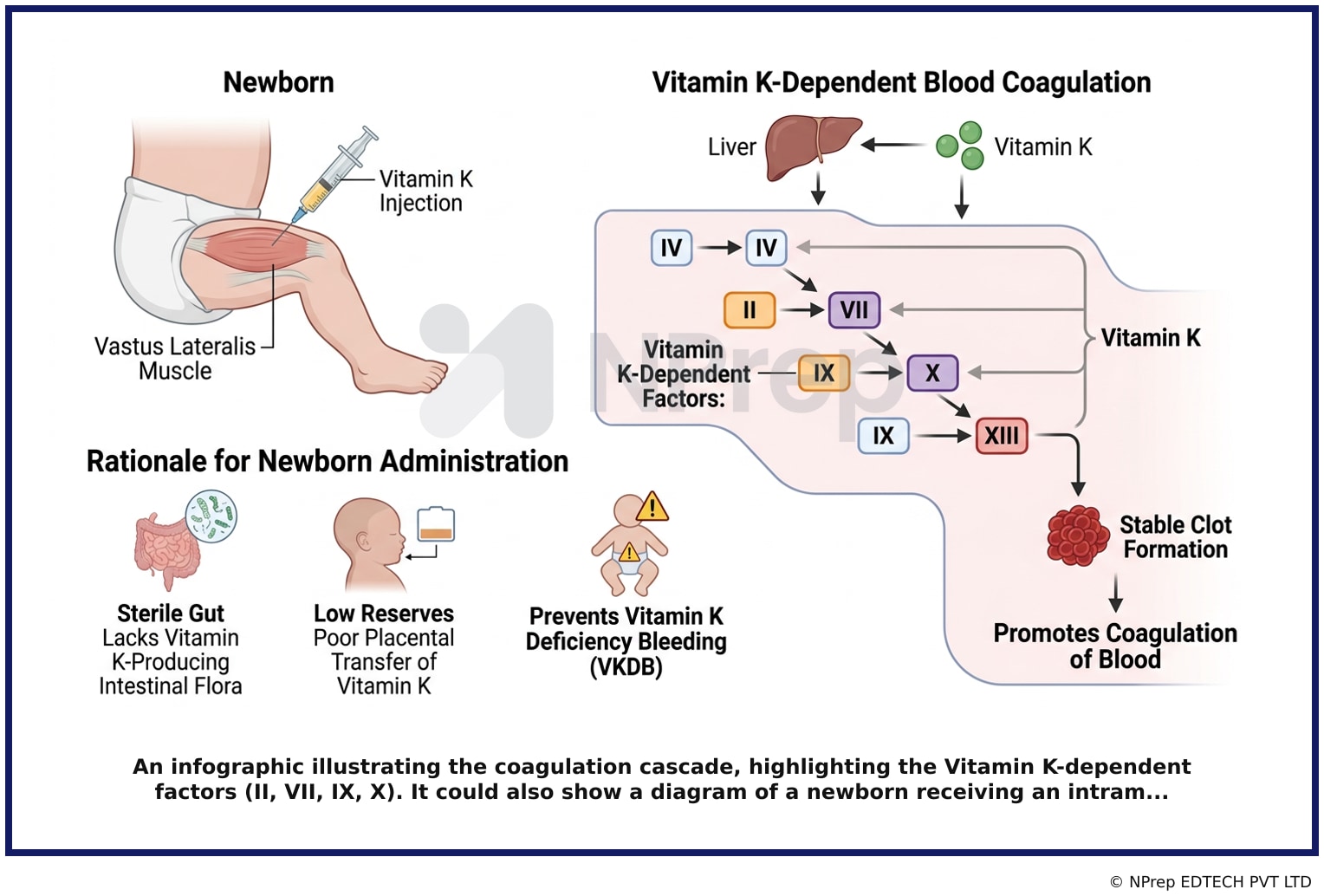
- Vitamin K is essential for the synthesis of clotting factors II, VII, IX, and X in the liver, which are necessary for blood coagulation.
- Newborns are born with a sterile gut and lack the intestinal flora that produce Vitamin K.
- Vitamin K has poor placental transfer, leading to low reserves in the newborn at birth.
- Administering Vitamin K prevents Vitamin K Deficiency Bleeding (VKDB), a potentially life-threatening condition.
Why Other Options Were Wrong
- Option B: Vitamin K does not directly promote gut maturation. The immaturity of the gut (being sterile) is the reason for the deficiency, but the vitamin itself does not mature the gut.
- Option C: The immunization process involves stimulating the immune system to produce antibodies. Vitamin K is a nutrient involved in clotting, not immunity.
- Option D: While severe bleeding in the brain (an intracranial hemorrhage, a complication of VKDB) can impair brain function, Vitamin K's primary role is not direct brain growth.
Related Visual
Clinical Relevance
- Nursing practice connection: Knowing The rationale for prophylactic Vitamin K administration in newborns helps nurses interpret findings accurately and avoid errors in routine assessment, medication administration, and patient teaching.
- It is a critical nursing responsibility to ensure that every newborn receives prophylactic Vitamin K as per hospital protocol to prevent VKDB.
- Nurses play a key role in educating parents about the importance of Vitamin K, addressing their concerns, and obtaining informed consent.
- What if a parent refuses the Vitamin K injection? The nurse must explain the risks of VKDB, including the potential for spontaneous internal bleeding, and document the refusal thoroughly. The primary healthcare provider must be notified, and the parents should be educated on the signs of bleeding to watch for.
How to Approach the Question
- Identify the core subject of the question: the function of Vitamin K in a newborn.
- Recall the key physiological facts about newborns: they have a sterile gut and limited reserves of certain nutrients.
- Connect Vitamin K to its primary function in the body, which is its role in the synthesis of clotting factors.
- Evaluate the options based on this knowledge. 'Coagulation of blood' is the direct and primary reason for administration.
- Eliminate the other options by identifying their inaccuracies: gut maturation, immunization, and brain growth are not the direct functions of Vitamin K.
Concept Tested & Keywords
- Concept Tested: The rationale for prophylactic Vitamin K administration in newborns.
- Stem keywords: newborn, mother, Vitamin K
- Lead-in keywords: helps in
Question ID
QflW7dHCxlFf6PaC9WRj__
Reference Book
E6 Obstetrics Williams p. 16-33
E6 Nelson Textbook of Pediatrics(2024) — Volume 1 pp. 1136-1138, 1137-1139
Practise the full RUHS, Jaipur, M.Sc Nursing Entrance Exam-2015
Attempt every question from this paper in a timed mock, then review the full solution for each one.
More Newborn Infants Questions
- When palpating the abdomen of hypertrophic pyloric stenosis infant, the Nurse finds:
- A pre-eclampsia woman's baby is lying with her mother. Neonate is born in 37 weeks. After 57 hours, when nurse is monitoring vital signs of baby, tem…
- Normally enteral feedings are flushed with water to open blocked tube and ease feeding. In which area it is done with air?
- A nurse is advised to give injection vitamin K for new born baby. The route and dose of Vitamin K is:
- Identify the following instrument used in hyperbilirubinemia monitoring based on the image:
- Which of the following equipment is used in Neonatal Resuscitation program?
- All of the following are the benefits of KMC (Kangaroo mother care); EXCEPT:
- Waxy or cheese like white substance found coating the skin of newborn human baby is known as:
- Identify 'at risk' infants from the following:-
- What is the normal length of the neonate body?
More RUHS, Jaipur, M.Sc Nursing Entrance Exam-2015 Questions
- Example of ball and socket joint is?
- Excessive exercise without rest results in accumulation of carbon dioxide and Lactic acid and this causes fatigue in muscles. Therefore, what advice…
- Which of the following test is done to find out the difference between the demographic variables of the groups?
- A failure in lymphatic system to return body fluids adequately results in?
- The trachea or wind pipe is made up of cartilage rings; shape of the rings is?
- Which of the following is a master gland which influences the endocrine glands?
- One of the functions of cerebellum is to?
- Most of the infections spread to the ear from throat through?
- Food cooked in copper utensils lose ascorbic acid quickly because it?
- Lipids can be stored in the body as a food resource because they are?