
KGMU 2023
Medical & Surgical Nursing
Medium
A burn patient come in casualty in upper body and both upper extremities are burned. The nurse from where should take the pulse rate?
Appeared in: KGMU 2023
Explanation
- The popliteal artery is located in the popliteal fossa, behind the knee, which is part of the lower extremity.
- The question specifies that the burns are on the upper body and upper extremities, making the lower extremities unaffected.
- Assessing a pulse in an unburned area is crucial for accuracy, patient comfort, and preventing infection or further tissue damage.
- Therefore, the popliteal site is the only safe and accessible option among the choices.
Why Other Options Were Wrong
- Option A: The radial artery is located at the wrist, which is part of the upper extremity. This area is burned as per the clinical scenario, making it an unsuitable site.
- Option B: The brachial artery is located in the antecubital fossa (inner elbow), part of the upper extremity. This area is burned and should be avoided.
- Option C: The carotid artery is in the neck, which is part of the upper body. This area is described as being burned, making it inappropriate for routine assessment.
Related Visual
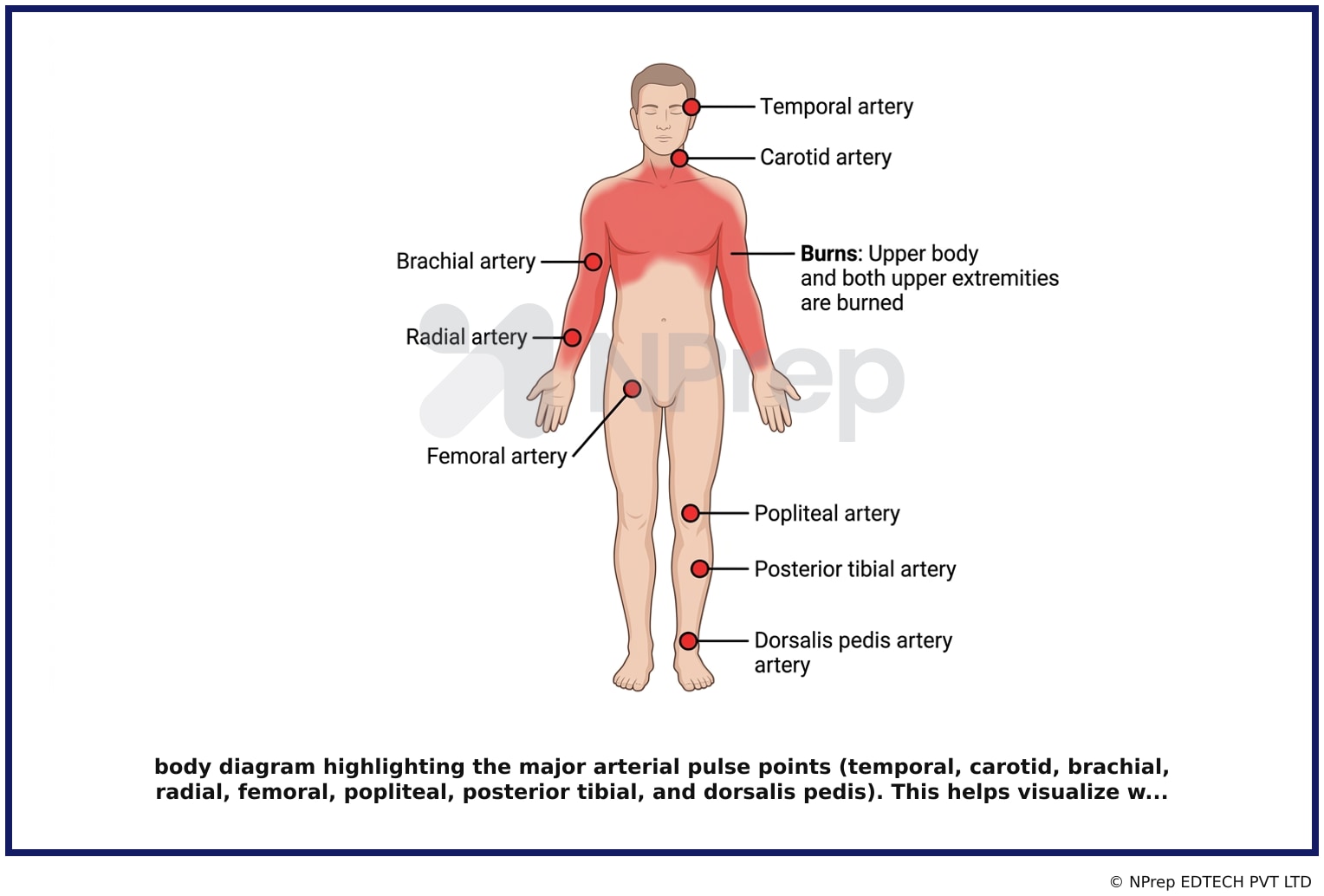
- Visual 1: Anatomical Diagram - A full-body diagram highlighting the major arterial pulse points (temporal, carotid, brachial, radial, femoral, popliteal, posterior tibial, and dorsalis pedis). This helps visualize why the popliteal site is appropriate when the upper body is compromised.
Clinical Relevance
- Nursing practice connection: Knowing Selection of an appropriate site for pulse assessment in a burn patient helps nurses interpret findings accurately and avoid errors in routine assessment, medication administration, and patient teaching.
- In burn management, selecting a non-injured site for vital signs is a fundamental patient safety principle to prevent pain, infection, and inaccurate data.
- Inaccurate pulse assessment can lead to missed signs of shock or compromised circulation, delaying critical interventions like fluid resuscitation or escharotomy.
- What if? If the patient had burns on all four extremities, the nurse would need to assess a central pulse, such as the femoral pulse (if the groin is unburned), or rely on an apical pulse (auscultated over the heart) and electronic cardiac monitoring for an accurate heart rate.
How to Approach the Question
- First, identify the core clinical problem: a burn patient needs a pulse check.
- Next, carefully note the location of the injuries as described in the stem: 'upper body and both upper extremities'.
- Mentally (or physically) map the anatomical locations of the four pulse sites given in the options.
- Eliminate any options located within the burned areas (Radial, Brachial, Carotid).
- Select the remaining option that is located in an uninjured area (Popliteal).
Concept Tested & Keywords
- Concept Tested: Selection of an appropriate site for pulse assessment in a burn patient.
- Stem keywords: burn patient, upper body, upper extremities, pulse rate
- Lead-in keywords: where should
- Clinical cues: Location of burns (upper body and both upper extremities) is the critical information needed to determine the correct pulse site.
Question ID
QmNCYm6l31w-SNk3UIyteO
Practise the full KGMU 2023
Attempt every question from this paper in a timed mock, then review the full solution for each one.
More Integumentary Function Questions
- This type of dressing is known as:
- The following picture shows is bedsore present in bedridden patient. Which grade of bedsore is present?
- In second degree bedsore, there is an involvement of:
- What is the bath used to remove the irritation of certain types of skin diseases and provide soothing effect?
- A female patient has come with facial burn injury into the emergency department in conscious condition. What will be the treatment for this patient?
- A patient comes into the emergency with a burn injury of 40% then what is first nursing intervention?
- A nurse caring a bedridden patient with a pressure ulcer, 2 hourly position changes and massaging & rubbing the back but pressure sore does not heal.…
- Second degree burn considered?
- Identify the stage of pressure ulcer
- A 23 year old man comes to the emergency department with thermal burns. In this case according to rule of nine which part of the body burned maximum?
More KGMU 2023 Questions
- The teacher scalded Aruna in front of her classmates during Project submission. Conclusion I: Aruna was not as popular as her other classmates. Concl…
- Aruna leaves and goes 8 meters in the North direction from a certain point. Then she turns right and travels for 12 meters. She again turns right and…
- Kiran is Sister of Raj. Raj is Son of Suresh and Vinita is Mother of Suresh then what is relation between Vinita and Kiran?
- A person who lives at the same time with another?
- Select the most appropriate meaning of the below idiom. A black sheep?
- The train has arrived...the station.
- A vendor sold 20 kg of potato at 18 Rs. per kg. He bought 2-liter milk at the rate of 46 Rs./liter, 2 kg sugar at the rate of 35 Rs./kg and 10 packet…
- Which one is the perfect square?
- A is the smallest. C is taller than B and D. E is neither the tallest nor the smallest. Find which one is the tallest?
- From an entrance, a person walks 28 meters left, then turns right and walks 13 meters. They turn right again and walk 12 meters, and then walk 16 met…