
NORCET 1 - 2020
Nursing Foundation
Easy
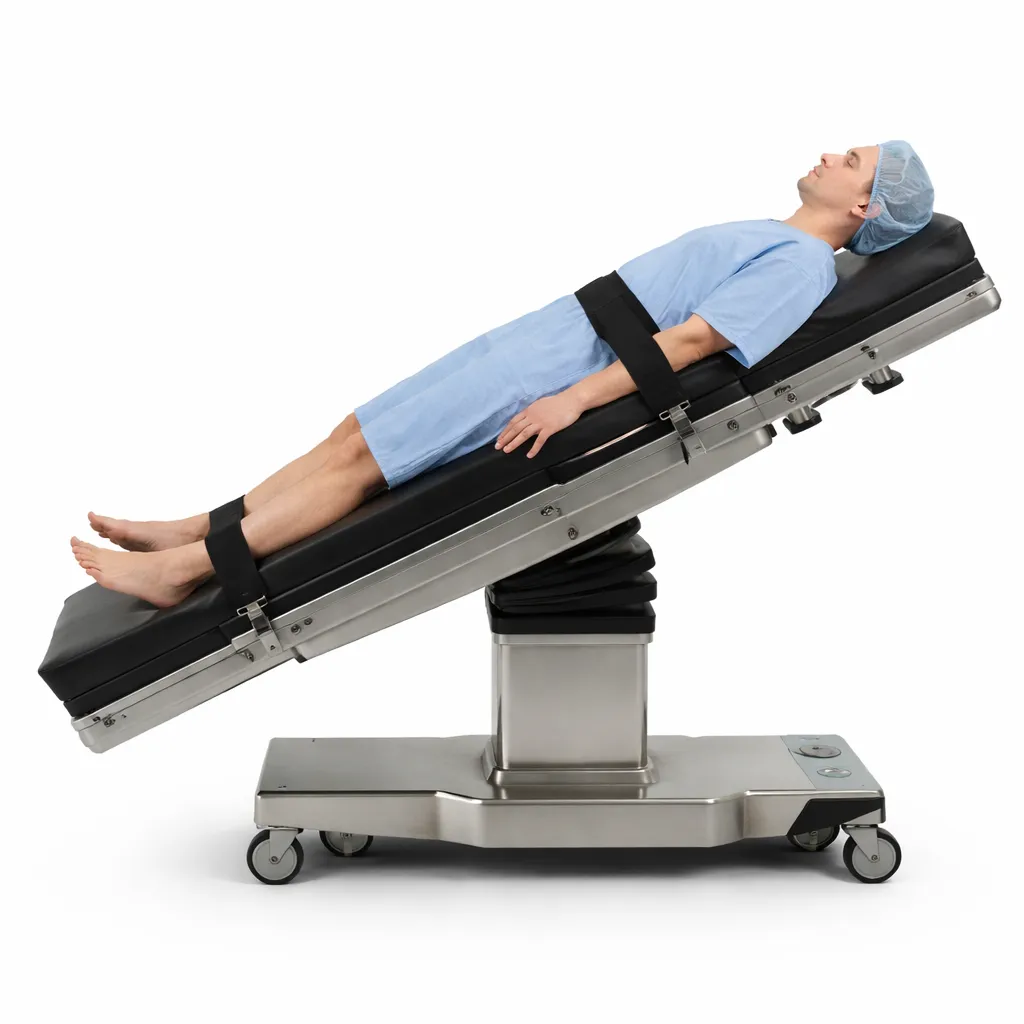
Identify the position in a given image.
Appeared in: NORCET 1 - 2020
Explanation
- The image shows a patient lying on their back with the entire bed tilted so the head is higher than the feet.
- This specific orientation is defined as the Reverse Trendelenburg position.
- This position uses gravity to pull the abdominal organs downward, which can help improve breathing in certain patients and is used during some surgical procedures on the head and neck.
- It is also used to help reduce the risk of gastroesophageal reflux and aspiration.
Why Other Options Were Wrong
- Option B: The lithotomy position involves the patient lying on their back with their legs raised and supported by stirrups. The image does not show the patient's legs in stirrups.
- Option A: The Trendelenburg position is the opposite of the position shown. In the Trendelenburg position, the patient's head is lower than their feet.
- Option D: The dorsal recumbent position involves the patient lying on their back with their knees flexed and feet flat on the bed. The bed itself is not tilted in this position.
Related Visual

Clinical Relevance
- Nursing practice connection: This is primarily an exam-oriented knowledge point with limited direct bedside application, so retain Identification of standard patient positions as background academic context rather than a clinical decision trigger.
- Correct patient positioning is a fundamental nursing skill crucial for patient safety, comfort, and the effectiveness of medical procedures.
- Improper positioning can lead to complications such as pressure injuries, nerve damage, respiratory compromise, and hemodynamic instability.
- Understanding the indications for each position allows the nurse to anticipate patient needs and prepare the environment for examinations or procedures.
How to Approach the Question
- First, carefully observe the image to identify the key features of the patient's position.
- Note the patient's orientation (supine, prone, lateral) and the angle of the bed or examination table.
- In this image, the key feature is that the entire bed is tilted, and the patient is lying on their back.
- Next, determine the relationship between the head and the feet. Here, the head is clearly higher than the feet.
- Recall the definitions of the patient positions listed in the options.
- Match your observation (supine, head higher than feet) with the correct term, which is Reverse Trendelenburg position.
Concept Tested & Keywords
- Concept Tested: Identification of standard patient positions
- Stem keywords: Identify, position, image
- Lead-in keywords: Identify
Question ID
QoT1VZ7XBoDA9MJBzL5-H2
Reference Book
E6 Nursing Fundamentals Taylor p. 211-213
Practise the full NORCET 1 - 2020
Attempt every question from this paper in a timed mock, then review the full solution for each one.
More Comfort, Rest & Sleep & Pain Questions
- Identify the position in the following image:
- How many faces are there in Wong-Baker facial pain rating scale?
- Which position is mostly recommended for rectal examination?
- Out of the following, which comfort device prevents the external rotation of the hips of a bedridden patient?
- What is the position called that patient sits at the side of the bed with the head resting on the overhead table on top of several pillows?
- The process of Straight, deep and firm stroking type of back massage is called
- Hot application cause?
- In trying to relieve the pain of a patient, the Nursing sister asks him to identify a really happy scene he has experienced. This is called -
- Which intervention is the most appropriate to include in a care plan for improving sleep in an older adult?
- Which of the following is a type of pain that is protective, temporary and usually self-limiting and resolves with tissue healing?
More NORCET 1 - 2020 Questions
- The relation between the fetal presenting part and maternal pelvis is known as?
- Which vaccine can be frozen?
- Which vaccine, after administration, forms blisters, heals by itself, and forms a permanent scar mark?
- Identify the conjugate measured in the picture?& x20;
- A post LSCS woman passes 400 ml urine in the past 24 hours. This condition is known as?
- Red color urine is caused by which anti-tubercular drug?
- Visualization of bone occurs in which stage of burn?
- The given retractor is used in which of the following surgeries?
- Identify the size of IV Cannula in the image?
- What will you do if you have a needle stick injury from an HIV patient?