
NORCET 1 - 2020
Child Health Nursing (Pediatrics)
Easy
Identify the color of the IV cannula used in the pediatrics unit?
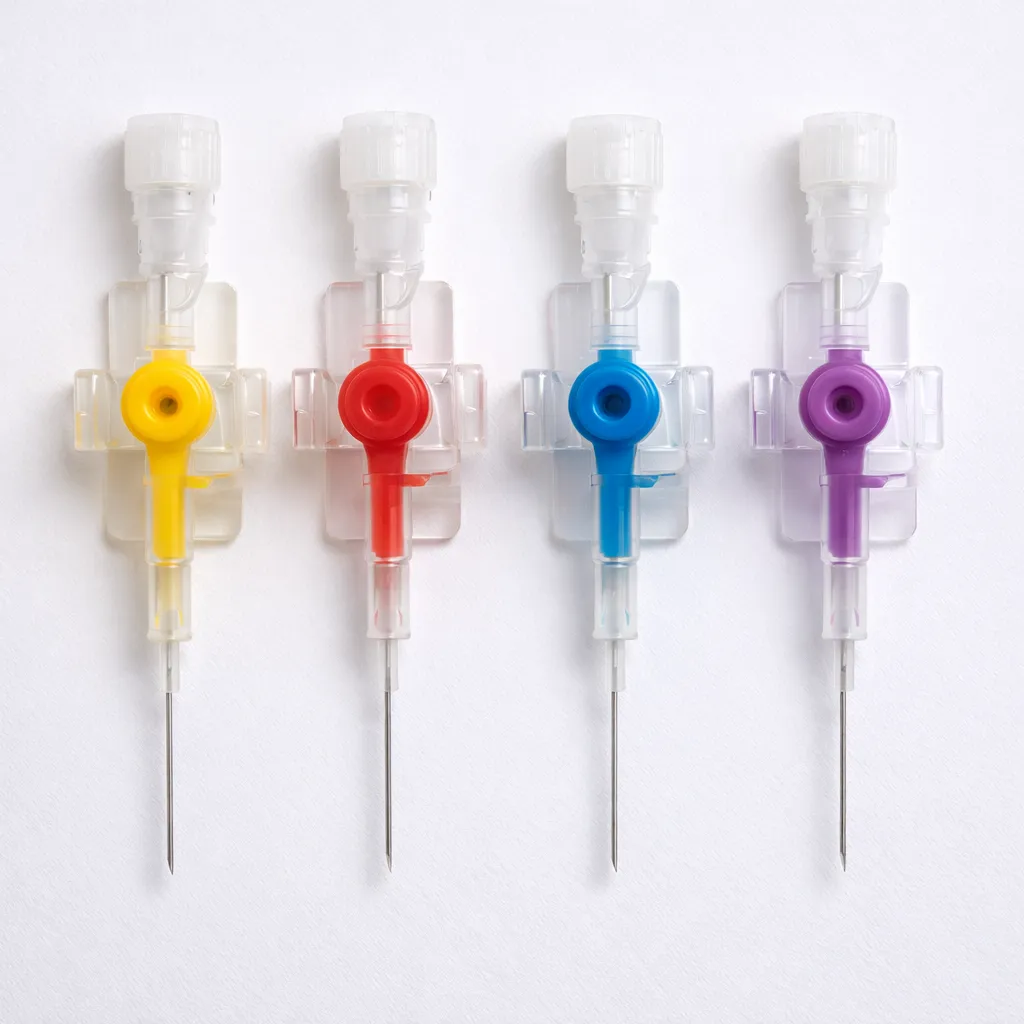
Appeared in: NORCET 1 - 2020
Explanation
- The yellow color-coded hub on an IV cannula signifies a 24-gauge (24G) size.
- A 24G cannula is recommended for pediatric and neonatal patients because their veins are smaller and more fragile.
- Using a smaller gauge minimizes insertion-related trauma and reduces the risk of complications like infiltration and phlebitis in children.
Why Other Options Were Wrong
- Option B: An orange cannula is 14G, which is the largest bore size. It is used for rapid, large-volume fluid resuscitation in adult trauma patients and is completely unsuitable for a child's small veins.
- Option C: A grey cannula is 16G, a large bore catheter used for rapid fluid or blood administration during surgery or trauma in adults. It is too large and would damage a child's vein.
- Option D: A green cannula is 18G. While smaller than 14G or 16G, it is still considered a large cannula and is typically used for blood transfusions or medication administration in adults. It is generally too large for most pediatric patients.
Related Visual

Clinical Relevance
- Nursing practice connection: This is primarily an exam-oriented knowledge point with limited direct bedside application, so retain IV cannula color coding and appropriate size selection for pediatric patients as background academic context rather than a clinical decision trigger.
- Selecting the correct IV cannula size is a critical nursing skill that directly impacts patient safety and comfort.
- Using a cannula that is too large for the vein can cause significant pain, infiltration, extravasation (leakage of vesicant drugs), and thrombophlebitis, leading to loss of IV access and potential tissue damage.
- In pediatric nursing, meticulous site selection and using the smallest effective gauge are paramount to preserving venous access for potential future needs.
How to Approach the Question
- First, identify the core of the question, which is asking for the specific IV cannula color used for the 'pediatrics' patient population.
- Recall or reference the standard color-coding system for IV cannulas. The image provided serves as a direct reference.
- Associate the patient population (pediatrics) with the appropriate cannula size. Children have small, fragile veins, so they require a small gauge (higher number) cannula.
- Look at the provided image or recall that a 24-gauge cannula is indicated for pediatric use.
- Identify the color associated with the 24-gauge cannula, which is yellow.
- Select the option that matches this color.
Concept Tested & Keywords
- Concept Tested: IV cannula color coding and appropriate size selection for pediatric patients.
- Stem keywords: IV cannula, pediatrics unit, color
- Lead-in keywords: Identify
- Clinical cues: The term 'pediatrics unit' is a key clinical cue, indicating the patient population is children, which requires specialized equipment like smaller gauge cannulas.
Question ID
QGvCbTLPbSZhcWnvcmYgN1
Reference Book
E6 Nursing Fundamentals Taylor pp. 1092-1094, 819-821
Practise the full NORCET 1 - 2020
Attempt every question from this paper in a timed mock, then review the full solution for each one.
More Common Medical Procedures Questions
- An order for prednisolone reads 10 mg four times a day. The dose for the child is 2 mg/kg/day. How many pounds does the child weigh?
- Identify the Cannula used in infants as per the image:
- The preferred site for IM injection in infants is?
- The size of IV cannula used for neonates is?
- The size of intravenous cannula used for a neonate is?
- Additional fluid requirement in a neonate who is placed under phototherapy for prevention & severity of jaundice?
- Which gauge cannula in the picture below is used in children?& x20;
- Which position is given to a child after lumbar Puncture?
- What are the urine specific gravity and color of urine in a 6-year-old child?
- For a 10-month-old child, an IM injection can be given in the?
More NORCET 1 - 2020 Questions
- The relation between the fetal presenting part and maternal pelvis is known as?
- Which vaccine can be frozen?
- Which vaccine, after administration, forms blisters, heals by itself, and forms a permanent scar mark?
- Identify the conjugate measured in the picture?& x20;
- A post LSCS woman passes 400 ml urine in the past 24 hours. This condition is known as?
- Red color urine is caused by which anti-tubercular drug?
- Visualization of bone occurs in which stage of burn?
- The given retractor is used in which of the following surgeries?
- Identify the size of IV Cannula in the image?
- What will you do if you have a needle stick injury from an HIV patient?