
RRB Nsg. Superintendent-20 July 2019 (Shift-3rd)
Psychology
Easy
Who is the founder of modern psychology?
Appeared in: RRB Nsg. Superintendent-20 July 2019 (Shift-3rd)
Explanation
- Sigmund Freud is considered the founder of modern psychology due to his development of psychoanalysis, which introduced groundbreaking concepts about the unconscious mind.
- His theories on the structure of personality (Id, Ego, Superego) and the influence of unconscious drives on behavior fundamentally changed the field of psychology and laid the groundwork for modern psychotherapy.
- While Wilhelm Wundt is the father of experimental psychology, Freud's focus on clinical application and the inner workings of the mind earns him the title of father of modern psychology.
Why Other Options Were Wrong
- Option B: Girald Kalpan is not a recognized figure in the history of psychology. The name may be a misspelling or a fabrication.
- Option C: Erik Erikson was a prominent psychoanalyst known for his theory of psychosocial development. He was a follower and extender of Freud's work, not the founder of modern psychology.
- Option D: Ugo Cerletti (misspelled as Eugo Carletti) was an Italian neurologist who, with Lucio Bini, developed electroconvulsive therapy (ECT). While this is a significant contribution to psychiatry, it is a specific treatment method, not the foundation of modern psychology.
Related Visual
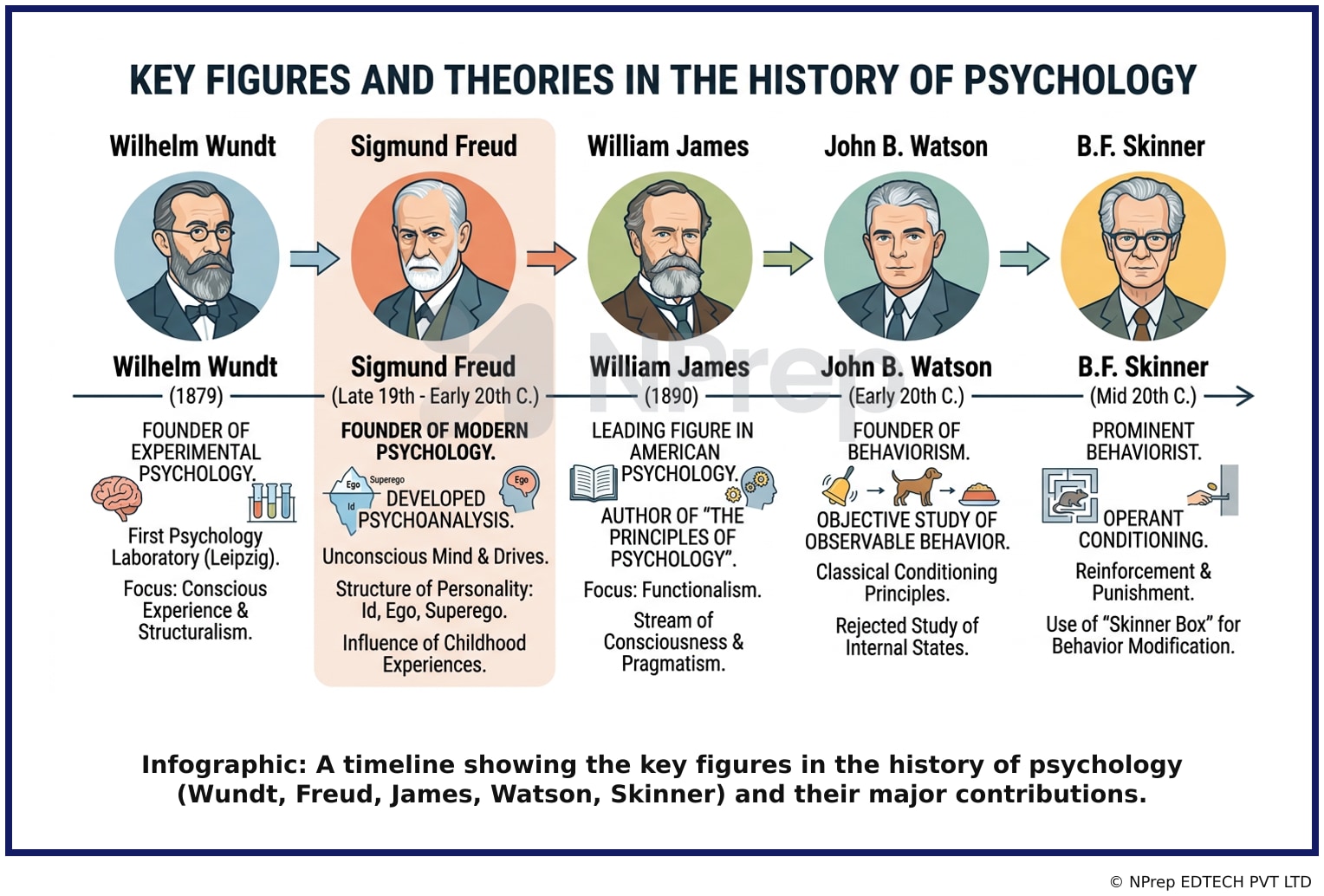
- Visual 1: Infographic: A timeline showing the key figures in the history of psychology (Wundt, Freud, James, Watson, Skinner) and their major contributions.
- Visual 2: Diagram: A visual representation of Freud's model of the mind, showing the relationship between the Id, Ego, and Superego, and the conscious, preconscious, and unconscious levels.
Clinical Relevance
- Nursing practice connection: This is primarily an exam-oriented knowledge point with limited direct bedside application, so retain History of Psychology as background academic context rather than a clinical decision trigger.
- Understanding the historical roots of psychology, particularly Freud's theories, helps nurses appreciate the basis for many modern psychotherapeutic approaches used in mental health nursing.
- Freud's concept of defense mechanisms (e.g., denial, projection) is still highly relevant in clinical practice for understanding patient and family reactions to illness and stress.
- What if the question asked for the founder of behavioral psychology? The answer would change to John B. Watson, who focused on observable behaviors and conditioning, forming the basis for behavioral therapies like CBT.
How to Approach the Question
- Identify the key terms in the question: "founder" and "modern psychology".
- Recognize that the term "modern psychology" can be interpreted in different ways. The options provided are crucial for determining the expected answer.
- Evaluate each option based on historical knowledge. Recall or look up the major contributions of each figure.
- Eliminate incorrect options. Erikson was a post-Freudian, Cerletti invented a specific therapy, and 'Girald Kalpan' is not a known psychologist.
- This leaves Sigmund Freud as the most plausible answer among the choices, as the founder of the highly influential psychoanalytic school of thought.
- Mentally note the distinction between Freud (founder of psychoanalysis/modern psychology) and Wilhelm Wundt (founder of experimental psychology) to clarify the concept.
Concept Tested & Keywords
- Concept Tested: History of Psychology
- Stem keywords: founder, modern psychology
- Lead-in keywords: Who is
Question ID
QlnwFPx0CnzfNpKogbuWe3
Practise the full RRB Nsg. Superintendent-20 July 2019 (Shift-3rd)
Attempt every question from this paper in a timed mock, then review the full solution for each one.
More Introduction Questions
- Psychology is defined as the science of:
- 'Behaviorism', the science of behavior, was propounded by whom?
- The branch of psychology that deals with the group behavior and inter-relationship of people is?
- Psychoanalysis was founded by?
- Given below are the three types of psychological investigations:& x20; (1) field experiments,& x20; (2) laboratory experiments, and& x20; (3) ex post…
- \ \ \ \ \ \ is relatively a large area of psychology which deals with the fundamental rules, principles, and theories of psychology in relation to th…
- What is psychology?
- Who is known as the Father of Psychology?
- Social psychology deals with?
- Psychology is a?
More RRB Nsg. Superintendent-20 July 2019 (Shift-3rd) Questions
- Where is oxytocin synthesized?
- What is the name of the muscle that extends from the sphenoid bone to the mandible?
- Complementary feeding should be initiated at the completion of \ \ \ \ \ \
- Where is kidney located?
- Psychosocial development stage for infants is \ \ \ \ \ \ \ \ \ \
- What immunization is given at birth?
- Functional nursing is a method of providing
- Which disease is the dementia associated with asymmetric atrophy of the frontal and temporal lobes?
- Thromboangiitis obliterans is also known as
- What is the other name of pyridoxine?