
UPRVUNL - 2021
Medical & Surgical Nursing
Medium
Which of the following is the most appropriate clinical test to confirm iron deficiency anemia?
Appeared in: UPRVUNL - 2021
Explanation
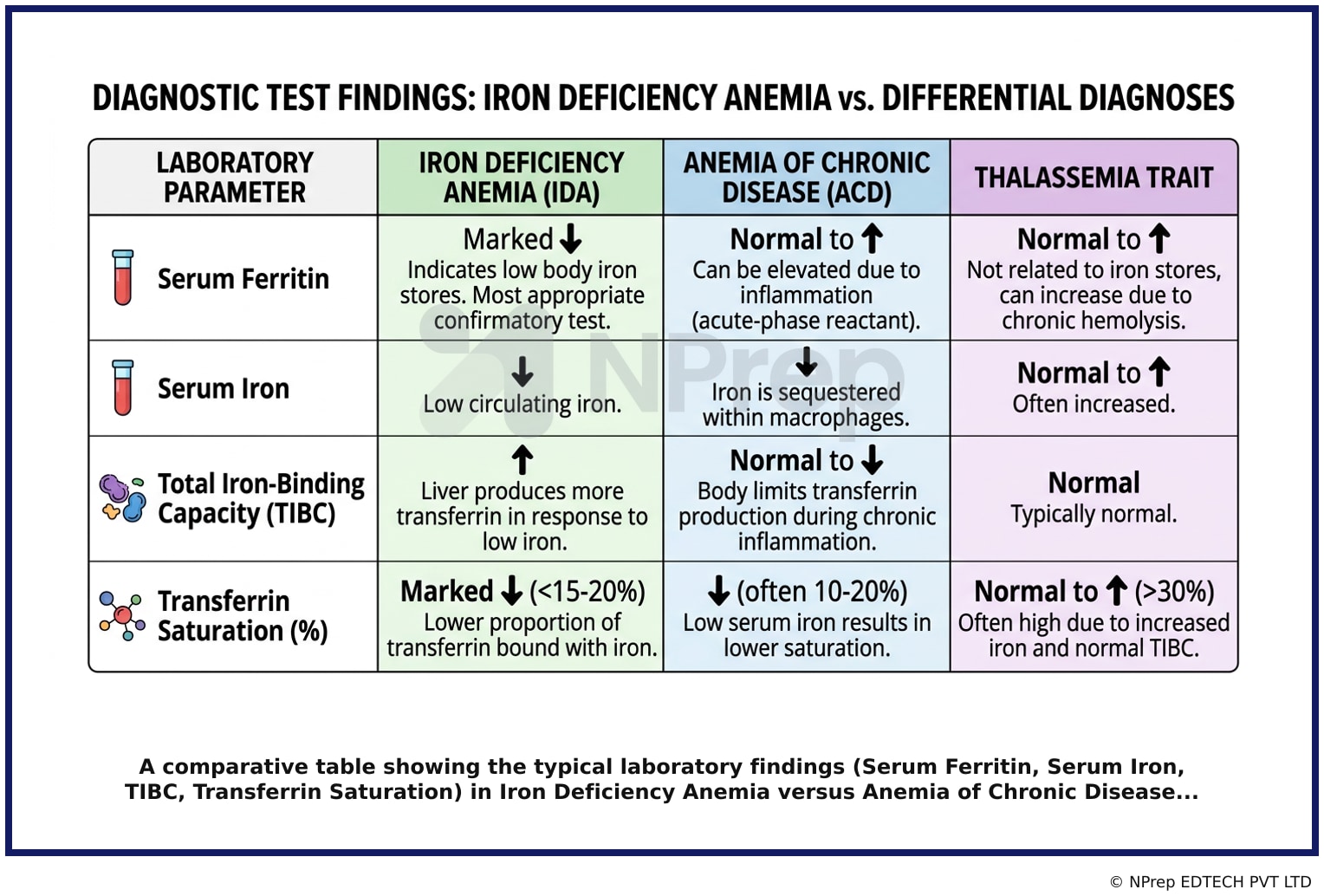
- Serum ferritin is a protein that stores iron within cells, and its concentration in the blood directly reflects the body's total iron stores.
- A low serum ferritin level is the most sensitive and specific non-invasive test to confirm a diagnosis of iron deficiency anemia.
- It is considered the most appropriate initial test because it is less invasive and more cost-effective than a bone marrow examination.
- Ferritin levels drop in the earliest stage of iron deficiency, even before anemia (low hemoglobin) develops.
Why Other Options Were Wrong
- Option A: The reticulocyte count measures the rate of new red blood cell production by the bone marrow. In untreated iron deficiency, the count is typically low or normal because there isn't enough iron to produce new cells.
- Option B: While a bone marrow examination with iron staining is the 'gold standard' for assessing iron stores, it is an invasive, painful, and costly procedure. It is not the 'most appropriate' initial test for a common condition like IDA.
- Option D: A red blood cell (RBC) count is a general measure and is not specific to iron deficiency. While the RBC count is often low in IDA, it can also be low in many other types of anemia (e.g., vitamin B12 deficiency) or normal/high in others (e.g., thalassemia trait).
Related Visual
Clinical Relevance
- Nursing practice connection: Knowing Diagnostic tests for Iron Deficiency Anemia helps nurses interpret findings accurately and avoid errors in routine assessment, medication administration, and patient teaching.
- Choosing the most appropriate test avoids unnecessary invasive procedures, reducing patient discomfort and healthcare costs.
- Accurate diagnosis of IDA is crucial as it guides treatment with iron supplementation and prompts investigation into the underlying cause, such as poor diet, malabsorption, or chronic blood loss.
- What if? If a patient with suspected IDA also has a chronic inflammatory condition (like rheumatoid arthritis or an infection), the serum ferritin level may be falsely normal or elevated because it is an acute-phase reactant. In this scenario, a low transferrin saturation (less than 20%) becomes a more reliable indicator of coexisting iron deficiency.
How to Approach the Question
- First, identify the core of the question: it asks for the 'most appropriate' test to 'confirm' iron deficiency anemia.
- The term 'most appropriate' suggests you must weigh the options based on factors like specificity, sensitivity, invasiveness, and practicality in a clinical setting.
- Evaluate each option's role. A Red Blood Cell count is a general part of a CBC. A Reticulocyte count assesses bone marrow response. A Bone Marrow examination is highly specific but very invasive.
- Recall that serum ferritin directly measures the body's iron storage levels.
- Compare the options: Serum ferritin is a highly specific, non-invasive blood test that directly assesses iron stores, making it the ideal choice for confirming a diagnosis before resorting to more invasive methods.
- Therefore, select serum ferritin as the best balance of diagnostic accuracy and clinical appropriateness.
Concept Tested & Keywords
- Concept Tested: Diagnostic tests for Iron Deficiency Anemia
- Stem keywords: iron deficiency anemia, clinical test, confirm
- Lead-in keywords: most appropriate
Question ID
Q5siM8L-SKZf2t6D5CtN0k
Reference Book
E6 Ghai Essential Pediatrics(pp 26-904 of 913) p. 354-356
E6 Medicine Harrison 22e Part 1 pp. 490-492, 488-490
Practise the full UPRVUNL - 2021
Attempt every question from this paper in a timed mock, then review the full solution for each one.
More Cardiovascular, Circulatory, and Hematologic Function Questions
- A patient is undergoing blood transfusion and suddenly shows complaints of transfusion reaction. What will be the priority nursing intervention?
- The following all are blood transfusion complications from; EXCEPT:
- Identify the use of following machine used in pneumatic compression device:
- In iron deficiency anemia, the fingernails become spoon shaped, this condition is referred to as:
- Which gauze cannula is commonly used for blood transfusion?
- If 'P' wave is absent in ECG rhythm, it is an indication of:
- Normal compression to ventilation ratio:
- Trans-illumination procedure is done with:
- A patient in the ward experiences sudden cardiac arrest. What is the most appropriate technique for opening the airway to facilitate endotracheal int…
- A patient experiences complications after a blood transfusion. Which of the following signs and symptoms is indicative of circulatory overload?
More UPRVUNL - 2021 Questions
- There is a swelling in a diffuse area. It is characterized by edema that appears at birth, disappears in several days, and crosses suture lines. This…
- The drug of choice for the treatment of manic episode is?
- The agent that causes smallpox is?
- Which of the following deficiency disease is also known as "rice eater's" disease?
- Illusion is a disorder of?
- Interstitial implantation of fertilized ovum is completed on the?
- Diaphragm is a/an?
- The bacteria that grow between 20 to 50 degrees Celsius temperature are called?
- The time period of pregnancy defined as the third trimester of pregnancy is?
- Which of the following was not discovered by Louis Pasteur?