
DHS 2018 shift 1st
Applied Psychology
Medium
Which of the following is not included in the definition of personality psychology?
Appeared in: DHS 2018 shift 1st
Explanation
- The question has a negative lead-in ('not included'), but the correct option confirms that all the preceding statements are, in fact, part of the definition of personality psychology.
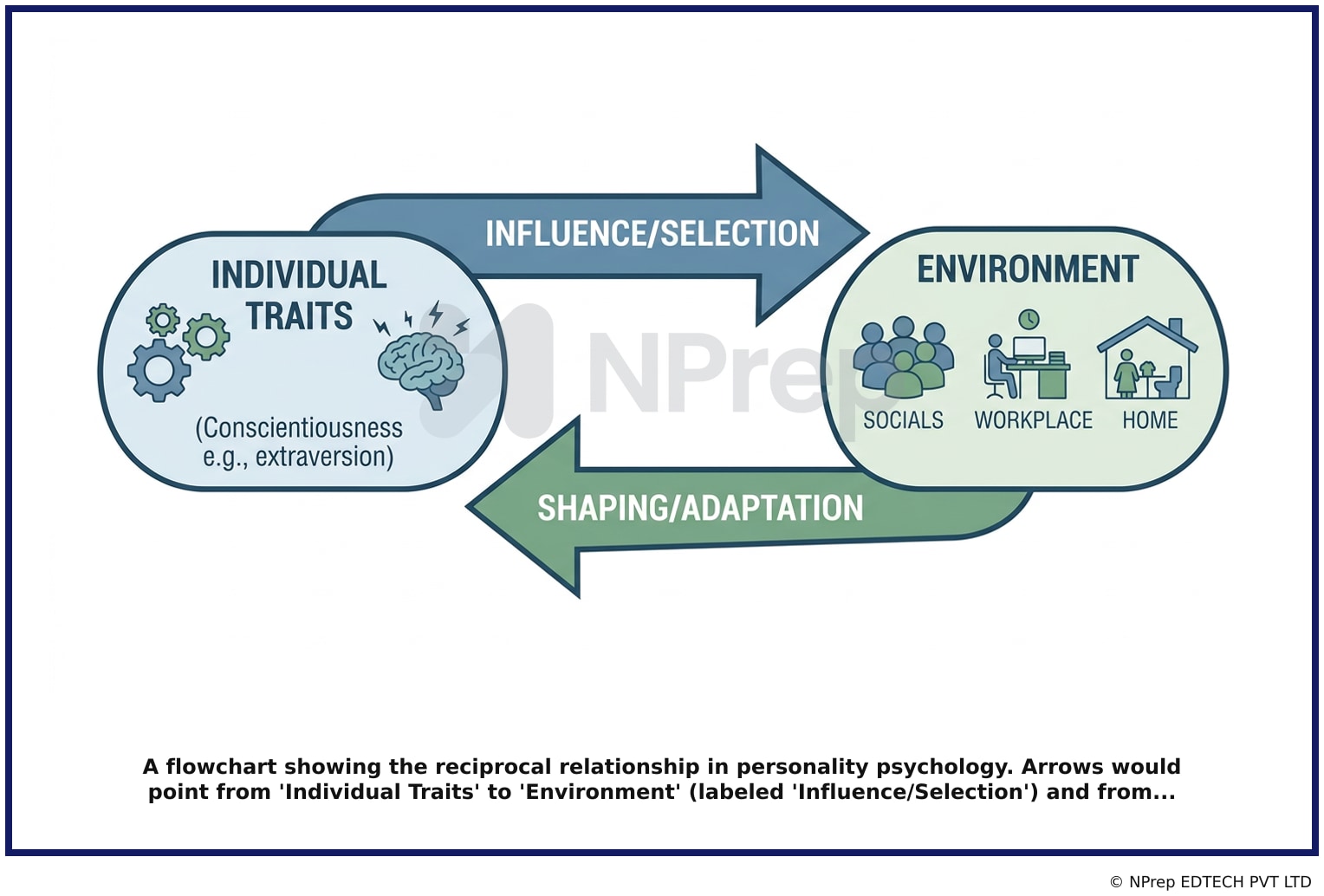
- Personality psychology is a comprehensive field that studies the complex and dynamic interplay between an individual and their environment.
- It examines how people adapt to their surroundings, how their traits influence their actions and the situations they create, and how the environment shapes their traits over time.
- Because the first three options are all core components of the field, the statement 'All of the above are included' is the correct response to the question's structure.
Why Other Options Were Wrong
- Option A: This is incorrect because studying how individuals make 'unique adjustments to his/her environment' is a key part of personality psychology, as highlighted in Gordon Allport's classic definition.
- Option B: This is incorrect. A major area of personality research is understanding how traits are not just passive qualities but active forces that lead people to select, modify, and create their environments.
- Option C: This is incorrect. The influence of the environment (nurture) on the development of personality traits (nature) is a fundamental topic in the field, explored by learning theories and behavior genetics.
Related Visual
Clinical Relevance
- Nursing practice connection: This is primarily an exam-oriented knowledge point with limited direct bedside application, so retain The definition and scope of personality psychology as background academic context rather than a clinical decision trigger.
- Understanding the scope of personality psychology helps nurses appreciate the complex factors behind a patient's behavior, coping mechanisms, and adherence to treatment.
- A patient's personality traits can influence how they interact with healthcare providers and adapt to the stress of illness. For example, a highly conscientious patient may be more likely to follow a complex medication regimen.
- What if a patient consistently misses appointments and disregards medical advice? A nurse who understands personality psychology might consider this behavior not just as 'non-compliance' but as a potential manifestation of personality traits (e.g., low conscientiousness, high impulsivity) or maladaptive coping, requiring a different approach to patient education and engagement.
How to Approach the Question
- First, identify the negative framing of the question: 'Which of the following is NOT included...'. This means you are looking for the statement that is false or does not belong.
- Next, evaluate each of the first three options (A, B, and C) based on the fundamental principles of psychology.
- Consider the core concept of personality: it's not just what's inside a person, but how those internal qualities interact with the external world.
- Recognize that 'adaptation to the environment', 'traits influencing the environment', and 'environment influencing traits' are all aspects of this interaction.
- Since statements A, B, and C are all true descriptions of what personality psychology studies, they are incorrect answers to the 'what is NOT included' question.
- Conclude that Option D, which states that all are included, is the logically correct answer that resolves the negative framing of the question.
Concept Tested & Keywords
- Concept Tested: The definition and scope of personality psychology.
- Stem keywords: personality psychology, definition, included
- Lead-in keywords: not
- Negative lead-in flag: The question asks what is NOT included, which requires careful evaluation of each option to find the one that falls outside the definition.
Question ID
QzzQKHMi7bVPcNPFQYRJF4
Reference Book
E6 Robert Boland, Marcia L. Verduin - Kaplan and Sadock's Comprehensive Text of Psychiatry-Wolters Kluwer Health (2024) (pp 1-16525 of 16525) pp. 7121-7123, 3185-3187
E6 Psychology Morgan King 9e Part 2 p. 166-168
Practise the full DHS 2018 shift 1st
Attempt every question from this paper in a timed mock, then review the full solution for each one.
More Personality Questions
- Rorschach Inkblot test, Thematic apperception test based on the phenomenon of
- All of the following are the tools of behavioral assessment; EXCEPT:
- Rorschach test is an example of:-
- According to Transactional Analysis, what are the 3 main ego states?
- Psychoanalysis was founded by
- Which among the following is referred to as the perfection principle?
- Prosocial behavior is intended to benefit others rather than one's self and is positively linked to personality traits which are?
- Individuals who do NOT make decisions until they are aware of all the facts pertaining to a certain situation are called?
- Which of the following is NOT a stage of socialization?
- According to Erikson's eight stages of development, initiative vs. guilt takes place at?
More DHS 2018 shift 1st Questions
- The client admitted with angina is given a prescription for nitroglycerine. The client should be instructed to?
- Area rank of Maharashtra in India?
- A doctor calls the nurse to obtain the daily laboratory results of a client who is receiving parenteral nutrition. Which is the most important labora…
- The nurse caring for a client with a closed head injury obtains an intracranial pressure (ICP) reading of 12 mmHg. The nurse recognizes that?
- While caring for a client with hypertension, the nurse notes the following vital signs, BP of 140/90 mm hg, pulse- 120, respirations-36, and temperat…
- What event occurring in the second trimester helps the expectant mother to accept the pregnancy?
- A nurse is assessing a client with Addison's disease for signs of hyperkalemia. The nurse expects to note which of the following if hyperkalemia is p…
- When administering a tuberculin skin test, the nurse should insert needle at a?
- If green's called 'white', 'white' is called yellow', 'yellow' is called 'blue', 'blue' is called 'pink' and 'pink' is called 'black', then what is t…
- Which finding is the best indication that a client with ineffective airway clearance needs suctioning?