
KGMU 2023
Medical & Surgical Nursing
Easy
Which of the following is a major risk factor for the development of atherosclerosis and peripheral vascular disease?
Appeared in: KGMU 2023
Explanation
- High levels of LDL cholesterol are a major and sufficient risk factor for initiating atherosclerotic lesions.
- LDL, known as "bad cholesterol," delivers cholesterol to peripheral tissues. Excess LDL accumulates in arterial walls, leading to the formation of plaques that narrow the arteries.
- The process involves LDL accumulation, oxidation, and uptake by macrophages to form foam cells, which are a key component of atherosclerotic plaques.
Why Other Options Were Wrong
- Option A: A low level of LDL cholesterol is desirable and protective against atherosclerosis, not a risk factor.
- Option B: While a high level of VLDL (which carries triglycerides) is a risk factor, high LDL is considered the primary and most directly atherogenic lipoprotein.
- Option D: A high level of HDL cholesterol is protective against atherosclerosis because it facilitates reverse cholesterol transport, removing cholesterol from arterial walls.
Related Visual
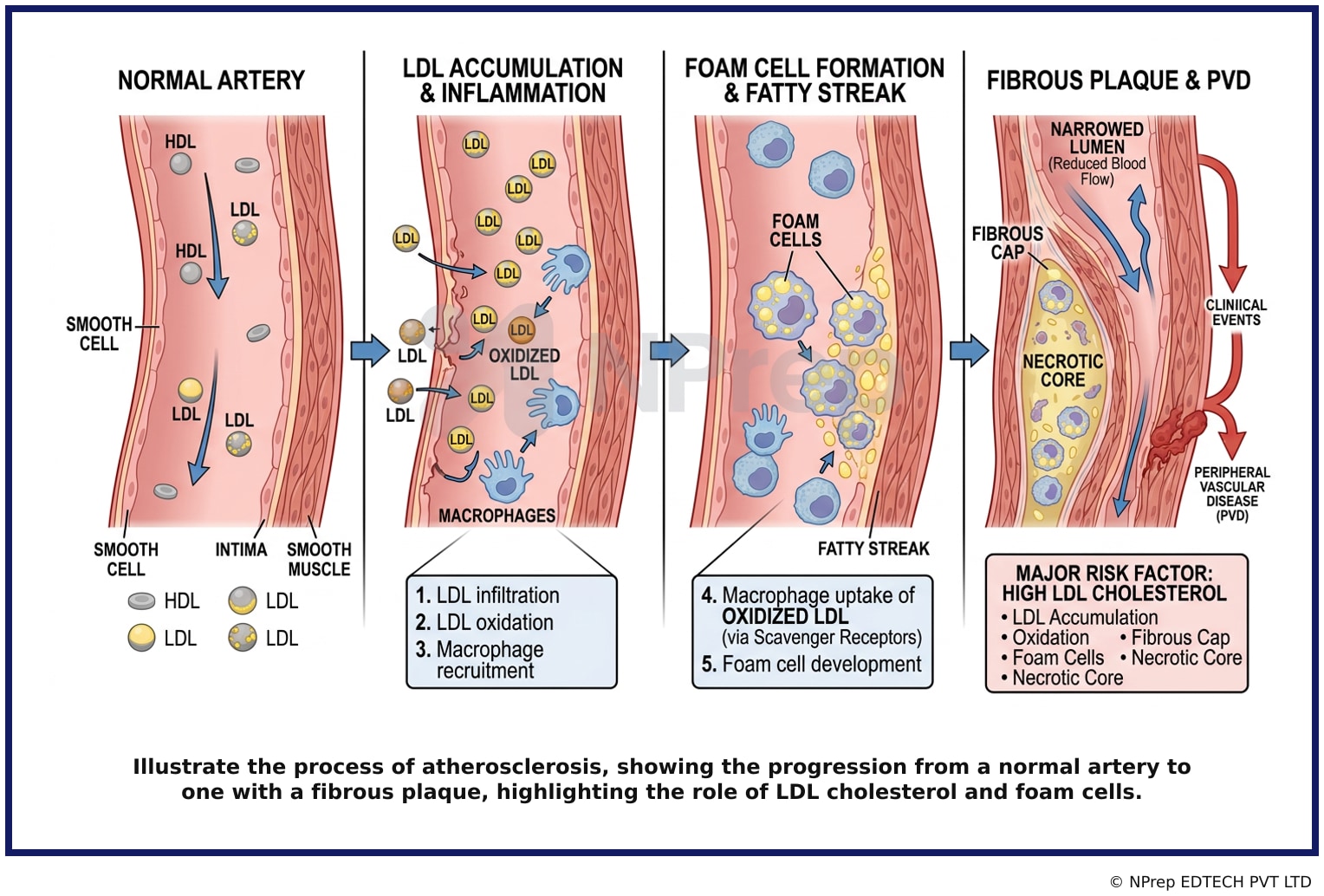
- Visual 1: Diagram - Illustrate the process of atherosclerosis, showing the progression from a normal artery to one with a fibrous plaque, highlighting the role of LDL cholesterol and foam cells.
- Visual 2: Flowchart - Depict the different roles of lipoproteins, showing LDL transporting cholesterol to arteries ('bad') and HDL transporting it away from arteries ('good').
Clinical Relevance
- Nursing practice connection: Knowing Risk Factors for Atherosclerosis and Peripheral Vascular Disease helps nurses interpret findings accurately and avoid errors in routine assessment, medication administration, and patient teaching.
- Nurses play a crucial role in educating patients about the importance of managing cholesterol levels through lifestyle modifications (diet, exercise) and adherence to prescribed medications like statins.
- Regular monitoring of a patient's lipid profile is essential for assessing cardiovascular risk and the effectiveness of interventions.
- What if a patient has a normal LDL level but a very low HDL level? This patient is still at an increased risk for cardiovascular disease. The ratio of total cholesterol to HDL, or LDL to HDL, is also an important predictor of risk, and a low HDL level is an independent risk factor.
How to Approach the Question
- Identify the core of the question: it asks for a major risk factor for atherosclerosis.
- Recall the basic functions of different types of cholesterol. A simple mnemonic is HDL = 'Healthy' (good) cholesterol and LDL = 'Lousy' (bad) cholesterol.
- Evaluate each option based on this understanding. A high level of 'lousy' cholesterol (LDL) would logically be a major risk factor.
- Differentiate between the roles of LDL and VLDL. While both are risk factors, recognize that LDL is the primary driver of plaque formation as stated in most pathology texts.
- Eliminate options that describe protective factors (high HDL) or desirable states (low LDL).
Concept Tested & Keywords
- Concept Tested: Risk Factors for Atherosclerosis and Peripheral Vascular Disease
- Stem keywords: atherosclerosis, peripheral vascular disease, risk factor, cholesterol
- Lead-in keywords: Which of the following
- Negative lead-in flag: false
Question ID
QEPly4SihOegn4LGOnaRf_
Practise the full KGMU 2023
Attempt every question from this paper in a timed mock, then review the full solution for each one.
More Cardiovascular, Circulatory, and Hematologic Function Questions
- A patient is undergoing blood transfusion and suddenly shows complaints of transfusion reaction. What will be the priority nursing intervention?
- The following all are blood transfusion complications from; EXCEPT:
- Identify the use of following machine used in pneumatic compression device:
- In iron deficiency anemia, the fingernails become spoon shaped, this condition is referred to as:
- Which gauze cannula is commonly used for blood transfusion?
- If 'P' wave is absent in ECG rhythm, it is an indication of:
- Normal compression to ventilation ratio:
- Trans-illumination procedure is done with:
- A patient in the ward experiences sudden cardiac arrest. What is the most appropriate technique for opening the airway to facilitate endotracheal int…
- A patient experiences complications after a blood transfusion. Which of the following signs and symptoms is indicative of circulatory overload?
More KGMU 2023 Questions
- The teacher scalded Aruna in front of her classmates during Project submission. Conclusion I: Aruna was not as popular as her other classmates. Concl…
- Aruna leaves and goes 8 meters in the North direction from a certain point. Then she turns right and travels for 12 meters. She again turns right and…
- Kiran is Sister of Raj. Raj is Son of Suresh and Vinita is Mother of Suresh then what is relation between Vinita and Kiran?
- A person who lives at the same time with another?
- Select the most appropriate meaning of the below idiom. A black sheep?
- The train has arrived...the station.
- A vendor sold 20 kg of potato at 18 Rs. per kg. He bought 2-liter milk at the rate of 46 Rs./liter, 2 kg sugar at the rate of 35 Rs./kg and 10 packet…
- Which one is the perfect square?
- A is the smallest. C is taller than B and D. E is neither the tallest nor the smallest. Find which one is the tallest?
- From an entrance, a person walks 28 meters left, then turns right and walks 13 meters. They turn right again and walk 12 meters, and then walk 16 met…