
MP CHO -2021 (Shift 1st)
Microbiology
Easy
What is the time interval from the entry of a microorganism into the body to the appearance of signs and symptoms called?
Appeared in: MP CHO -2021 (Shift 1st)
Explanation
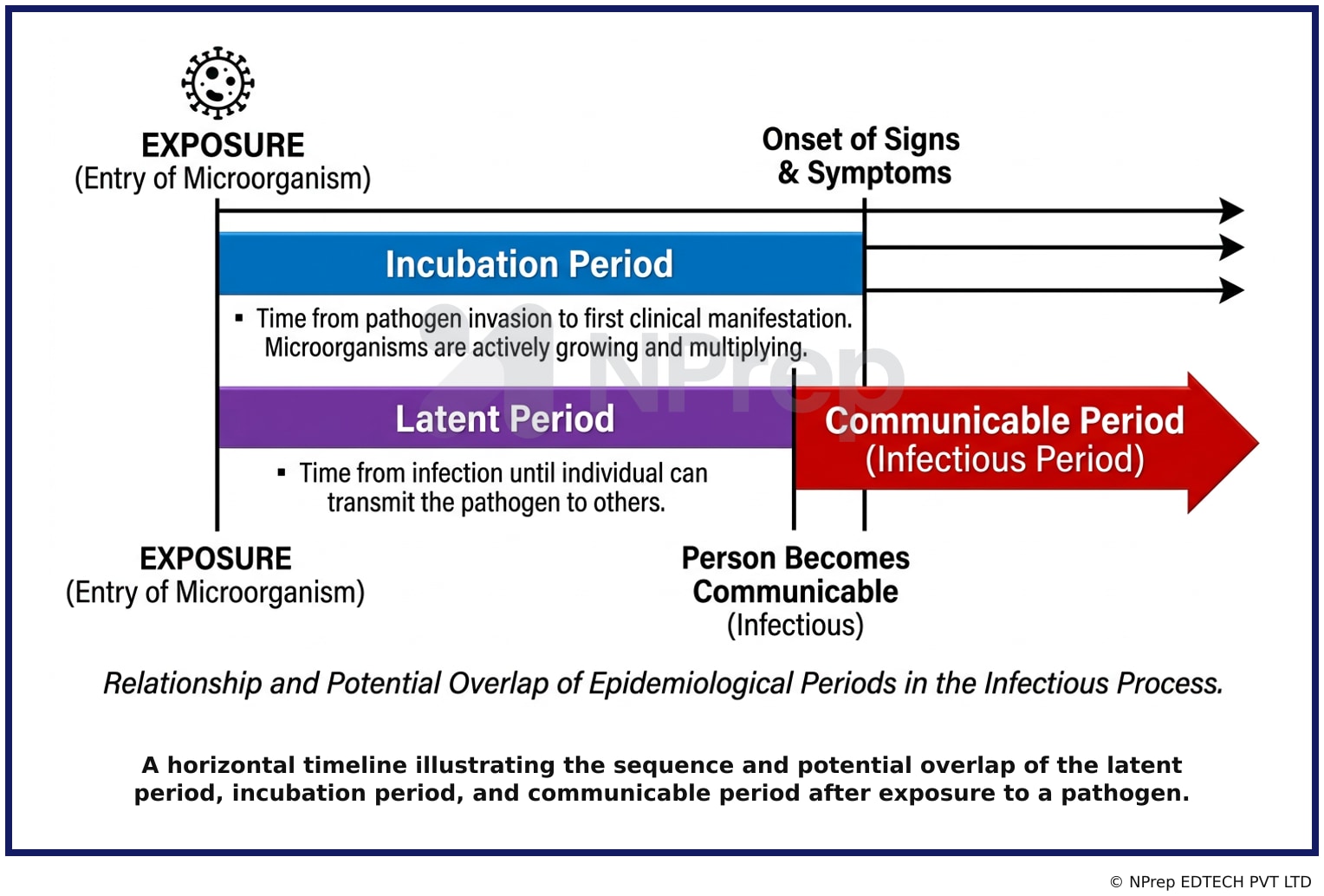
- The Incubation Period is the correct term for the interval between a pathogen's invasion of the body and the appearance of the first signs or symptoms of infection.
- During this stage, the microorganisms are actively growing and multiplying within the host.
- The length of the incubation period is characteristic of each disease and can vary from a few hours (e.g., food poisoning) to years (e.g., leprosy).
- This period ends when the pathogen population is large enough to cause tissue damage and elicit symptoms.
Why Other Options Were Wrong
- Option A: The Latent Period refers to the time from infection until a person becomes infectious to others. A person can be in the latent period (not yet infectious) but still be in the incubation period (not yet symptomatic).
- Option B: Quarantine is not a biological period within the host; it is a public health measure used to restrict the movement of individuals who have been exposed to an infectious agent to prevent further spread.
- Option D: Termination Period is not a standard, recognized term in epidemiology or infectious disease terminology.
Related Visual
Clinical Relevance
- Nursing practice connection: This is primarily an exam-oriented knowledge point with limited direct bedside application, so retain Stages of an infectious process and related epidemiological terms as background academic context rather than a clinical decision trigger.
- Understanding the incubation period is crucial for public health nurses to determine the appropriate duration for quarantine, which is typically based on the maximum known incubation period for a specific disease.
- It helps in contact tracing by allowing epidemiologists to work backward from the onset of symptoms to identify the likely period of exposure and source of infection.
- For some diseases like measles and chickenpox, a person can be contagious during the later part of the incubation period, before they even know they are sick. This knowledge informs infection control policies.
How to Approach the Question
- First, identify the core of the question, which is asking for the specific name of a time interval in the infection process.
- Read the definition provided in the stem carefully: 'time from entry of microorganism... to appearance of signs and symptoms'.
- Evaluate each option against this precise definition.
- Recall the standard terminology used in epidemiology and infection control.
- Differentiate between biological processes within a host (like incubation) and public health actions (like quarantine).
- Eliminate options that are incorrect definitions (Latent Period) or are not standard terms (Termination Period).
Concept Tested & Keywords
- Concept Tested: Stages of an infectious process and related epidemiological terms.
- Stem keywords: time interval, entry of microorganism, appearance of signs and symptoms
- Lead-in keywords: what is
Question ID
QI8iOI_Lb-S6Z5fexcNnWs
Reference Book
E6 Nursing Fundamentals Taylor p. 165-167
E6 Parks TextBook of Preventive & Social Medicine part 1 — Subpart A (pp 26-201 of 604) p. 92-94
Practise the full MP CHO -2021 (Shift 1st)
Attempt every question from this paper in a timed mock, then review the full solution for each one.
More Epidemiology Questions
- The proportion of clinical cases resulting in severe clinical manifestations is known as
- The mode of transmission of trachoma from one person to another is?
- The time interval between infection of a suspected person and the appearance of signs and symptoms of the disease is called?
- The number of new cases occurring in a defined population during a specified period of time is called?
- Which of the following terms describe new cases of a disease?
- Which one of the following is NOT a component of epidemiological triad?
- A cervical cancer screening was conducted in a rural community among 1000 adult population. During the survey it was found that 8 women already diagn…
- Epidemiological triad excludes?
- What does incubation period mean?
- In which of the following age groups do the incidents of Herpes Zoster infection mainly increase?
More MP CHO -2021 (Shift 1st) Questions
- What does Thrombocytopenia mean?
- What is the function of a Flame cell?
- Which of the following is a Bleeding Disorder?
- Where is the rate of Drug Absorption highest?
- Which of the following bones is called the Collar Bone?
- Which of the following glands is called the Master Gland?
- Which of the following allows air to enter the Lungs?
- Which membrane separates the Middle Ear from the Auditory Canal?
- What is the characteristic of the High Stationary Stage in the demographic cycle?
- Maternal Mortality Rate is expressed per which of the following?