
OSSSC Nursing Officer-2021
Medical & Surgical Nursing
Easy
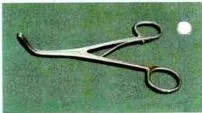
What is the instrument shown below?
Appeared in: OSSSC Nursing Officer-2021
Explanation
- The instrument shown is a Trousseau Tracheal Dilator, identified by its unique features.
- It has scissor-like handles, a ratchet lock to keep it open, and two short, blunt, outwardly curved blades.
- This design is specifically for gently opening and holding a tracheostomy stoma patent, preventing it from closing.
- It is an essential tool for emergency airway management in patients with a tracheostomy, particularly during accidental decannulation or tube changes.
Why Other Options Were Wrong
- Option A: Urethral dilators (or sounds) are long, thin, solid instruments used to stretch the urethra. They do not have the scissor-like, spreading blade mechanism seen in the image.
- Option C: An aneurysm needle is a fine, delicate instrument with a curved tip and an eyelet used for passing ligatures around blood vessels. Its appearance is completely different from the robust, dilating instrument shown.
- Option D: This option is incorrect because the instrument is clearly identifiable as a Tracheal Dilator based on its specific design and function.
Related Visual

Clinical Relevance
- Nursing practice connection: This is primarily an exam-oriented knowledge point with limited direct bedside application, so retain Identification of surgical instruments used in respiratory care as background academic context rather than a clinical decision trigger.
- A primary nursing responsibility is to ensure emergency tracheostomy equipment is always at the bedside. This includes a tracheal dilator, a spare tracheostomy tube of the same size, one size smaller, an obturator, suction equipment, and an Ambu bag.
- In the event of accidental decannulation, the nurse's immediate action is to use the tracheal dilator to maintain the stoma's patency, call for help, and prepare for reinsertion of the tracheostomy tube.
- What if? If a tracheal dilator is not available during an accidental decannulation, the stoma can quickly begin to close, making re-intubation difficult and potentially leading to a life-threatening loss of airway. The nurse may need to use a hemostat or even gloved fingers to attempt to keep the stoma open.
How to Approach the Question
- First, carefully examine the image of the instrument, paying close attention to its key components: the handles, the joint/lock, and the tips (blades).
- Note the scissor-like finger rings, the ratchet lock in the middle, and the short, blunt, curved tips designed to spread apart.
- Consider the function implied by this design. The blunt, spreading tips suggest a dilating function, and the lock suggests a need to hold something open.
- Evaluate each option against your visual analysis. 'Urethral dilator' and 'Aneurysm needle' describe instruments with very different structures and purposes.
- Conclude that the instrument's features are perfectly matched to the description and function of a 'Tracheal dilator'.
Concept Tested & Keywords
- Concept Tested: Identification of surgical instruments used in respiratory care.
- Stem keywords: instrument, shown
- Lead-in keywords: What is
Question ID
QRnZ1n6armbGn2mXoVSV8o
Reference Book
E6 Nursing Fundamentals Taylor p. 736-738
E6 Gynecology Williams p. 98-127
Practise the full OSSSC Nursing Officer-2021
Attempt every question from this paper in a timed mock, then review the full solution for each one.
More Gas Exchange and Respiratory Function Questions
- Which is the most relevant knowledge about oxygen administration to a client with COPD?
- Patient in emergency department diagnosed to have fluid and air present in lung. What is the above-mentioned condition known as?
- Patient is suffering from dyspnea. Which position will you provide for patient to relieve?
- Which of the following is not involved in chest physiotherapy?
- Respiration which is abnormally shallow for two or three breaths followed by irregular period of apnea is termed:
- Identify the following instrument which is used in diagnostic procedures:
- Identify the instrument shown in the following image:
- Identify the tube in the following image:
- A patient suddenly develops respiratory difficulties such as dyspnea, what is the first priority of the nursing officer?
- Which of the following method is used for high flow oxygen administration:
More OSSSC Nursing Officer-2021 Questions
- A man completed a journey in 10 hours. He travelled first half of the total distance at the rate of 21 km/hr and second half at the rate of 24 km/hr.…
- A person crosses a 600 metre long street in 5 minutes. What is his speed in kilometer per hour?
- What is the cube of -1 1/3?
- What is the ratio between 0.02 and 0.002?
- After 4 years the principal amount of Rs. 12000 grows into Rs. 14,400. Find out the rate of simple interest?
- What is the decimal of 9% ?
- If the marked price of an article is Rs. 400/- and its sale price is Rs. 340/-, Find out the percentage of discount.
- If three-fifth (3/5) of 60% of a number is 36, then what is the number?
- After 15 years, a man will be just four times as old as he was 15 years ago. What is his present age?