
DSSSB October 2024
Applied Microbiology & Infection control
Easy
What is the infection chain of Paragonimiasis?
Appeared in: DSSSB October 2024
Explanation
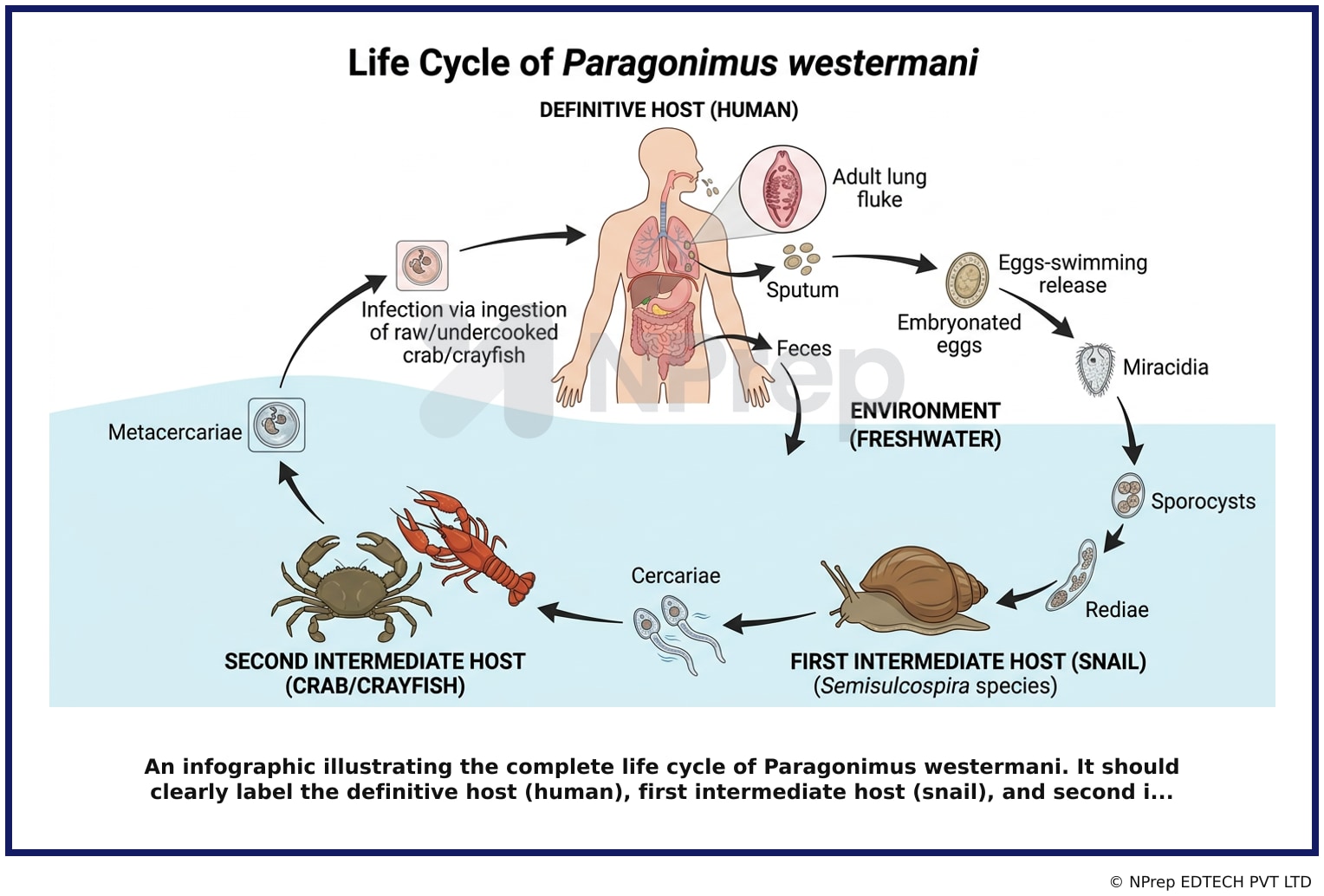
- Paragonimiasis is caused by the lung fluke Paragonimus westermani.
- The life cycle requires two intermediate hosts before infecting the definitive host (humans).
- The first intermediate host is a freshwater snail, and the second is a freshwater crustacean (crab or crayfish).
- Humans become infected by consuming raw or undercooked crabs or crayfish containing the parasite's metacercariae.
- This makes the correct infection chain Man-Snail-Crab-Man.
Why Other Options Were Wrong
- Option A: This chain lacks a second intermediate host. The parasite does not go directly from a snail back to a human.
- Option B: The second intermediate host for Paragonimiasis is a crab or crayfish, not a fish.
- Option C: The first intermediate host for Paragonimiasis is a snail, not a Cyclops (a type of copepod).
Related Visual
Clinical Relevance
- Nursing practice connection: Knowing Life cycle of Paragonimus westermani helps nurses interpret findings accurately and avoid errors in routine assessment, medication administration, and patient teaching.
- A key nursing intervention is obtaining a thorough dietary history from patients presenting with chronic cough and hemoptysis, especially if they have lived in or traveled to endemic areas.
- Paragonimiasis is often misdiagnosed as tuberculosis due to similar respiratory symptoms. A negative TB test in a patient with these symptoms and a relevant dietary history should raise suspicion for paragonimiasis.
- Patient education is crucial for prevention. Nurses should advise patients and communities in endemic areas about the dangers of eating raw or undercooked freshwater crabs and crayfish and teach proper cooking methods.
How to Approach the Question
- First, identify the key term in the question: 'Paragonimiasis'. This is a direct recall question about the life cycle of a specific parasite.
- Recall or deduce the type of organism. The '-iasis' suffix suggests a parasitic infection. 'Paragonimus' is a genus of trematode (fluke).
- Think about the general life cycles of trematodes. Many require one or two intermediate hosts, which are often mollusks (snails) and then another aquatic organism (fish, crustacean, or plant).
- Evaluate each option based on this knowledge:
- 'Man-Snail-Man' implies direct transmission from snail to human, which is typical for Schistosoma.
- 'Man-Snail-Fish-Man' is a common pattern for liver flukes like Clonorchis.
Concept Tested & Keywords
- Concept Tested: Life cycle of Paragonimus westermani
- Stem keywords: infection chain, Paragonimiasis
- Lead-in keywords: What is
- Negative lead-in flag: false
Question ID
QYoZLbxOGdohcGRZ9uo_Oj
Reference Book
E6 Medicine Harrison 22e Part 1 pp. 1872-1874, 1873-1875
E6 Medicine Davidson Principles Practice 24e p. 317-319
Practise the full DSSSB October 2024
Attempt every question from this paper in a timed mock, then review the full solution for each one.
More Pathogenic Organisms Questions
- An acid-fast bacillus which is pathogenic:
- Causative organism of infectious mononucleosis is:
- Which among the following is a Gram-positive organism?
- What is the causative organism for Syphilis?
- Who discovered virus in biology?
- Which vector causes Zika virus disease?
- All of the following diseases caused by viruses, except?
- What does SARS stand for?
- What is the name of the organism responsible for tuberculosis?
- What causes the spread of chickenpox?
More DSSSB October 2024 Questions
- What is the main indication of the flooding therapy?
- Which of the following is the correct sequence of general anaesthesia?
- Identify the article in the following image.
- A schizophrenic patient was asked how many members were there in his family. He replied, "Oh, maybe seven-since many people tell me because it is too…
- What is the size of the pink colour-coded IV cannula?
- Which is a chronic, progressive and degenerative disorder that occurs due to the destruction of myelin sheath?
- Which of the following programmes is known as the National Programme of Nutritional Support to Primary Education?
- Which of the following stages of psychosexual development is commonly characterised by the Electra complex and Oedipus complex?
- All of the following are the features of Reiter's syndrome, EXCEPT:
- Which article is shown in the given image?