
NORCET 9 Mains - 2025
Child Health Nursing (Pediatrics)
Easy
What is the expected decline in total serum bilirubin with effective phototherapy?
Appeared in: NORCET 9 Mains - 2025
Explanation
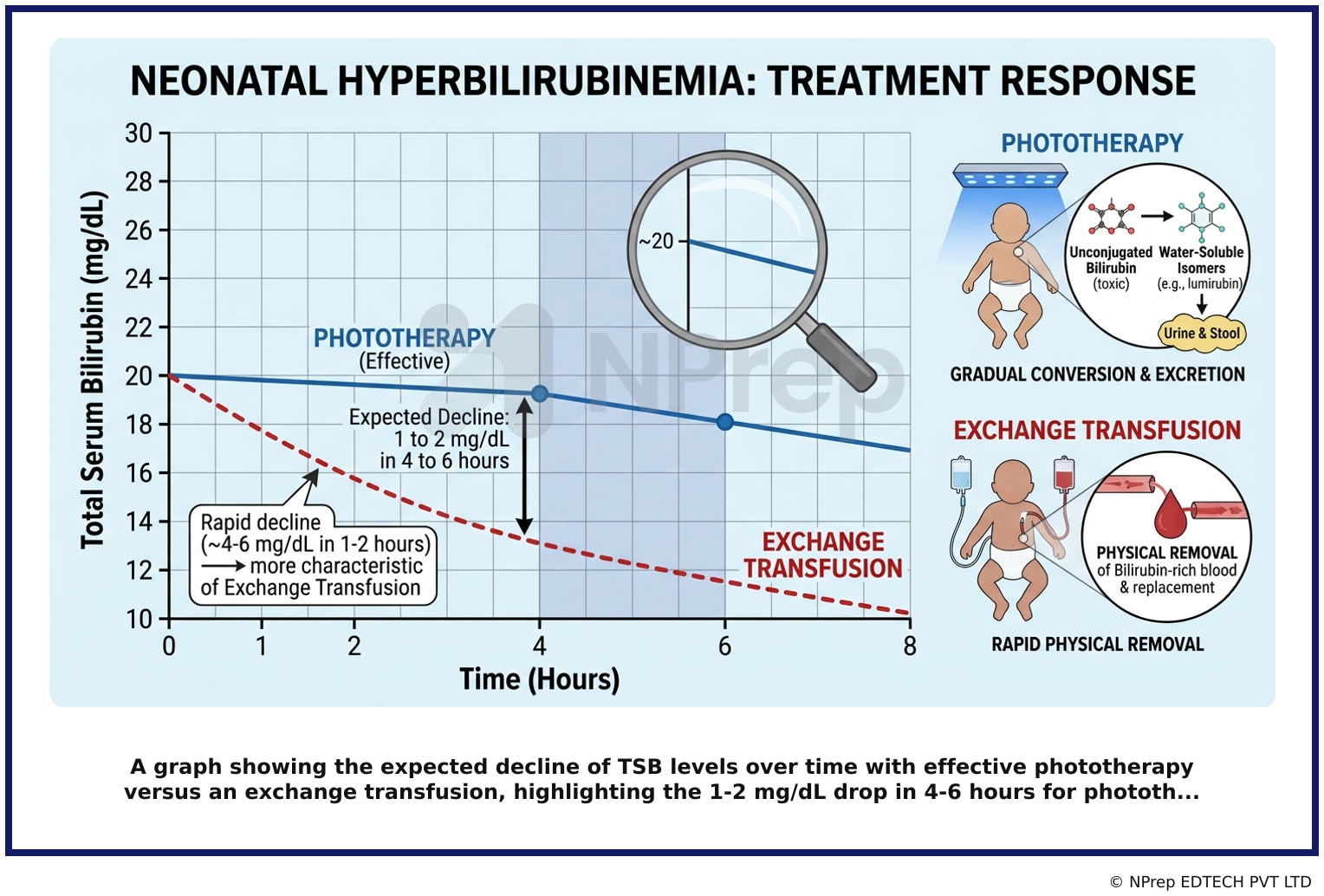
- Effective phototherapy is expected to decrease Total Serum Bilirubin (TSB) by 1 to 2 mg/dL over an initial 4 to 6-hour period.
- This rate confirms the treatment is successfully converting bilirubin into water-soluble isomers (like lumirubin) that can be excreted by the body through urine and stool.
- This initial response over 4-6 hours is a key clinical benchmark used to assess the efficacy of the treatment and guide further management decisions.
Why Other Options Were Wrong
- Option A: A decline of 4 to 6 mg/dL is too rapid for standard phototherapy.
- Option C: This rate of decline (4-6 mg/dL in 1-2 hours) is physiologically unachievable with phototherapy alone.
- Option D: While intensive phototherapy can cause a rapid drop, the standard timeframe for assessing the initial response is 4-6 hours, not 1-2 hours.
Related Visual
Clinical Relevance
- Nursing practice connection: This is primarily an exam-oriented knowledge point with limited direct bedside application, so retain Efficacy of Phototherapy in Neonatal Hyperbilirubinemia as background academic context rather than a clinical decision trigger.
- Nurses are responsible for monitoring the response to phototherapy by tracking TSB levels and ensuring the equipment (e.g., light intensity, distance) is used correctly.
- Failure to see the expected decline may indicate ineffective phototherapy or a more severe underlying condition, requiring the nurse to escalate care to the physician.
- What if? If the bilirubin level rises or fails to decline after 4-6 hours of phototherapy, the nurse must notify the provider immediately. This may indicate the need for intensive phototherapy, investigation for underlying causes (like hemolysis), or preparation for an exchange transfusion.
How to Approach the Question
- First, identify the core of the question: it's asking for a specific clinical value – the 'expected decline' of bilirubin with 'effective phototherapy'.
- Recognize that phototherapy is a gradual process. This allows you to immediately be skeptical of options suggesting a very large or very rapid drop.
- Evaluate the options by comparing the amount of decline (mg/dL) with the timeframe (hours).
- Eliminate the options with an extremely high rate of decline (4 to 6 mg/dL), as this is more characteristic of a different, more invasive procedure like exchange transfusion.
- Between the remaining options, consider the standard clinical practice for assessment. The initial response to phototherapy is typically evaluated over several hours (4-6), not just one or two.
- Select the option that reflects a moderate, clinically accepted rate of decline over a standard initial assessment period.
Concept Tested & Keywords
- Concept Tested: Efficacy of Phototherapy in Neonatal Hyperbilirubinemia
- Stem keywords: total serum bilirubin, effective phototherapy, expected decline
- Lead-in keywords: What is
Question ID
QOPc8qQU-KDAVbV7s4Ux2z
Reference Book
E6 Nelson Textbook of Pediatrics(2024) — Volume 1 p. 1124-1126
Practise the full NORCET 9 Mains - 2025
Attempt every question from this paper in a timed mock, then review the full solution for each one.
More Newborn Infants Questions
- When palpating the abdomen of hypertrophic pyloric stenosis infant, the Nurse finds:
- A pre-eclampsia woman's baby is lying with her mother. Neonate is born in 37 weeks. After 57 hours, when nurse is monitoring vital signs of baby, tem…
- Normally enteral feedings are flushed with water to open blocked tube and ease feeding. In which area it is done with air?
- A nurse is advised to give injection vitamin K for new born baby. The route and dose of Vitamin K is:
- Identify the following instrument used in hyperbilirubinemia monitoring based on the image:
- Which of the following equipment is used in Neonatal Resuscitation program?
- All of the following are the benefits of KMC (Kangaroo mother care); EXCEPT:
- Waxy or cheese like white substance found coating the skin of newborn human baby is known as:
- Identify 'at risk' infants from the following:-
- What is the normal length of the neonate body?
More NORCET 9 Mains - 2025 Questions
- A schizophrenia patient believes that the neighbor has installed a circuit inside his body. This is an example of which type of delusion?
- All medical test results are normal, but the patient persistently feels that something is abnormal in the body. This condition is known as:
- Bipolar I disorder is best characterized by:
- Bipolar II disorder is best characterized by:
- A patient taking antipsychotic medication develops extrapyramidal symptoms (EPS). What should be the management?
- A patient develops involuntary, continuous, restless movements after taking antipsychotics. This condition is known as:
- Which drug is the drug of choice in pre-eclampsia?
- PM POSHAN (Pradhan Mantri Poshan Shakti Nirman) scheme was started in which year?
- Which of the following is a killed vaccine?
- Family Planning Programme in India was first started in which year?