
RRB Nsg. Superintendent-20 July 2019 (Shift-3rd)
Biochemistry & Nutrition
Easy
What is also known as lipid that is necessary for normal transport and utilization of other lipids especially in the liver?
Appeared in: RRB Nsg. Superintendent-20 July 2019 (Shift-3rd)
Explanation
- Lecithin, also known as phosphatidylcholine, is a crucial phospholipid required for the synthesis of lipoproteins (like VLDL) in the liver.
- These lipoproteins are responsible for packaging and transporting triglycerides and other lipids out of the liver and into the bloodstream for use by other tissues.
- A deficiency of lecithin impairs this transport process, leading to an abnormal accumulation of fat within the liver, a condition known as fatty liver or hepatic steatosis. Therefore, it is considered a lipotropic factor.
- Lecithin is the most abundant phospholipid in cell membranes and also serves as the body's main storage form of choline.
Why Other Options Were Wrong
- Option A: Cardiolipin is a specialized phospholipid found almost exclusively in the inner mitochondrial membrane, where it is essential for the function of the electron transport chain and cellular energy production, not for transporting lipids from the liver.
- Option C: Cephalin, or phosphatidylethanolamine, is a structural component of cell membranes, particularly in nervous tissue, and also plays a role in the blood coagulation process. Its primary function is not lipid transport from the liver.
- Option D: Plasmogens are a type of phospholipid characterized by an ether linkage, which gives them antioxidant properties. They are abundant in the nervous, immune, and cardiovascular systems but are not the primary lipid involved in fat transport from the liver.
Related Visual
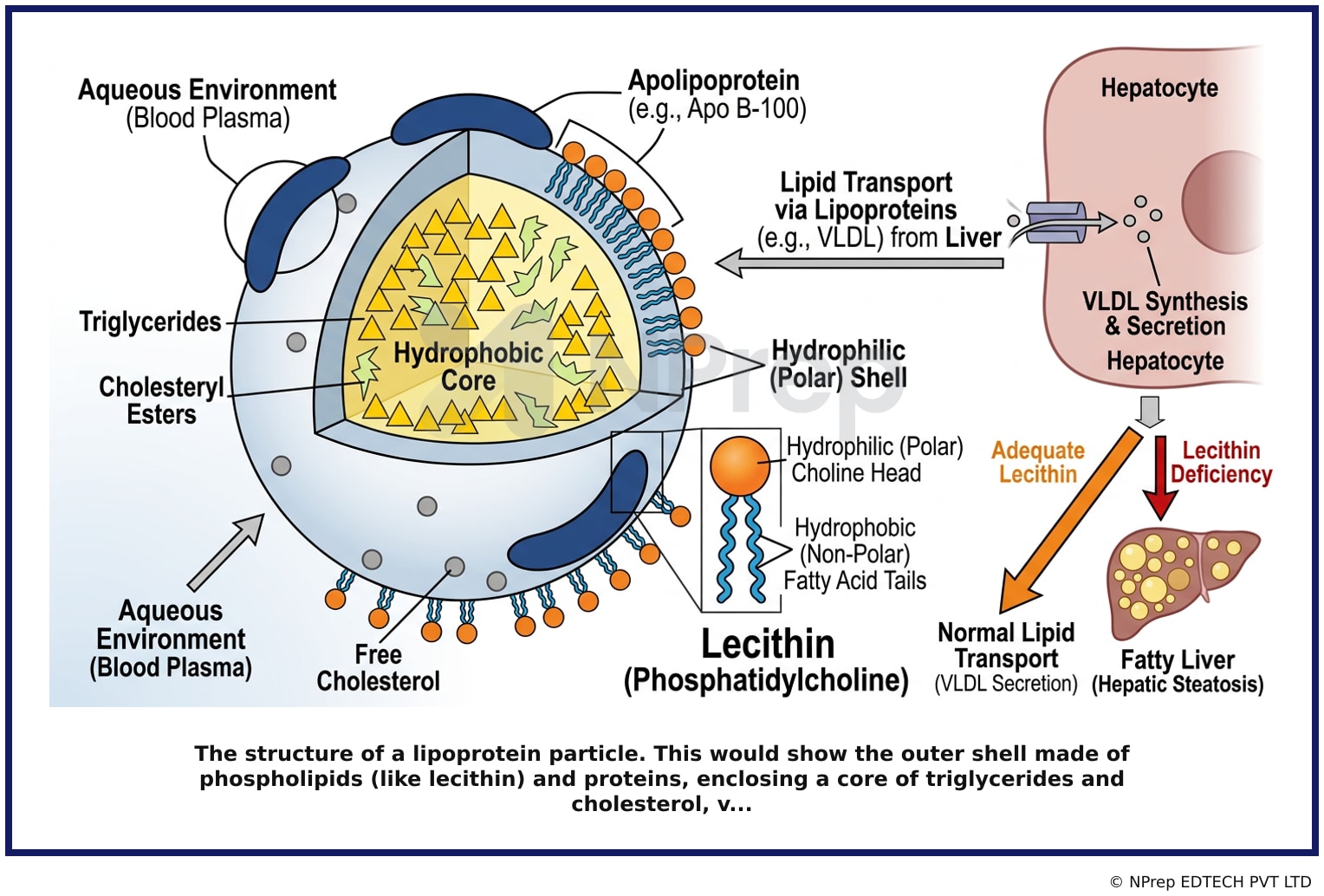
- Visual 1: Diagram - The structure of a lipoprotein particle. This would show the outer shell made of phospholipids (like lecithin) and proteins, enclosing a core of triglycerides and cholesterol, visually explaining how lecithin enables lipid transport in an aqueous environment.
- Visual 2: Flowchart - The pathway of VLDL (Very Low-Density Lipoprotein) synthesis in the liver and its secretion into the bloodstream. This would highlight the step where lecithin is incorporated, demonstrating its essential role in exporting fat from the liver.
Clinical Relevance
- Nursing practice connection: This is primarily an exam-oriented knowledge point with limited direct bedside application, so retain Role of phospholipids in lipid transport and metabolism as background academic context rather than a clinical decision trigger.
- A deficiency in lecithin or its precursor, choline, can lead to Non-Alcoholic Fatty Liver Disease (NAFLD). Nurses play a role in educating patients about dietary sources of choline and monitoring liver function tests (e.g., ALT, AST) in at-risk individuals.
- The Lecithin/Sphingomyelin (L/S) ratio in amniotic fluid is a critical test to assess fetal lung maturity. A high ratio (greater than 2.0) indicates mature lungs, as lecithin is a major component of lung surfactant.
- What if? - If a patient is on long-term Total Parenteral Nutrition (TPN) without adequate choline supplementation, they are at high risk for developing TPN-associated liver disease, which includes fatty liver. The nursing intervention would be to advocate for the inclusion of choline in the TPN formulation and closely monitor liver enzymes.
How to Approach the Question
- Step 1: Analyze the question to identify the core concept. The keywords are 'lipid', 'transport', and 'liver', which points to the process of moving fats out of the liver.
- Step 2: Recall the different types of complex lipids, specifically phospholipids, and their primary functions.
- Step 3: Evaluate each option. Lecithin (phosphatidylcholine) is widely known as a lipotropic agent, meaning it prevents fat accumulation in the liver by aiding in its transport.
- Step 4: Systematically eliminate the other options by matching them to their specific, distinct roles. Cardiolipin is mitochondrial, Cephalin is involved in membranes and clotting, and Plasmogens are antioxidants. This confirms that only Lecithin fits the description in the question.
Concept Tested & Keywords
- Concept Tested: Role of phospholipids in lipid transport and metabolism.
- Stem keywords: lipid, transport, utilization, liver
- Lead-in keywords: what is
- Clinical cues: especially in the liver
- Negative lead-in flag: false
Question ID
Q74LooM497JwroULxEGdTa
Practise the full RRB Nsg. Superintendent-20 July 2019 (Shift-3rd)
Attempt every question from this paper in a timed mock, then review the full solution for each one.
More Lipids Questions
- Ketone bodies are found in urine of patients with uncontrolled diabetes due to:
- Lipid profile does not include?
- Emulsification of lipids in the small intestine requires?
- Which of the following enzymes converts fats into fatty acids and glycerol?
- Identify an enzyme that is useful for digestion of fat?
- Ketone bodies are synthesized from?
- Transportation of triglycerides from liver to adipose tissues is the function of which of the following lipoproteins?
- Fatty acids linked to sugar molecules are called:
- Which of the following is considered an essential fatty acid?
- Ketone bodies appear in the blood and urine when fats are being oxidized in great amounts. The condition is associated with?
More RRB Nsg. Superintendent-20 July 2019 (Shift-3rd) Questions
- Where is oxytocin synthesized?
- What is the name of the muscle that extends from the sphenoid bone to the mandible?
- Complementary feeding should be initiated at the completion of \ \ \ \ \ \
- Where is kidney located?
- Psychosocial development stage for infants is \ \ \ \ \ \ \ \ \ \
- What immunization is given at birth?
- Functional nursing is a method of providing
- Which disease is the dementia associated with asymmetric atrophy of the frontal and temporal lobes?
- Thromboangiitis obliterans is also known as
- What is the other name of pyridoxine?