
NORCET 2 - 2021 (shift-1)
Medical & Surgical Nursing
Easy
What is a common clinical feature of Intestinal obstruction?
Appeared in: NORCET 2 - 2021 (shift-1)
Explanation
- Vomiting is one of the four cardinal signs of intestinal obstruction (along with pain, distension, and constipation).
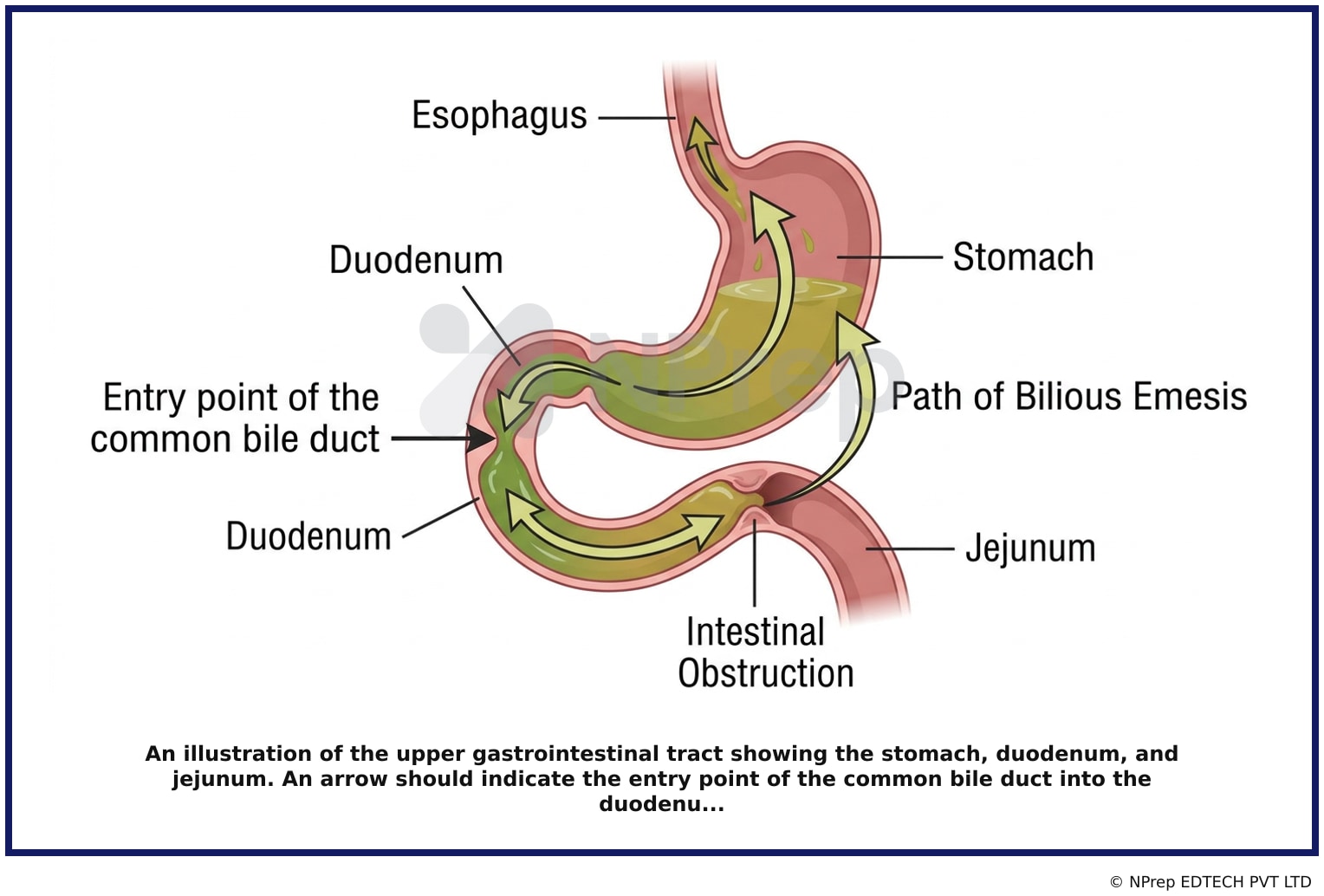
- When the obstruction is in the small intestine, distal to the ampulla of Vater where bile enters the duodenum, the vomitus becomes bile-stained (bilious).
- In high (proximal) small bowel obstruction, bilious vomiting occurs early and is a prominent feature.
- This symptom reflects the inability of gastrointestinal contents to pass the point of blockage, leading to retrograde movement and emesis.
Why Other Options Were Wrong
- Option B: Diarrhea is not a common feature of intestinal obstruction. The hallmark sign is the cessation of passing stool and flatus, known as absolute constipation or obstipation.
- Option C: Fever is not a typical initial sign of a simple intestinal obstruction. It is considered a warning sign of a serious complication.
- Option D: This option is incorrect because diarrhea and fever are not common clinical features of an uncomplicated intestinal obstruction.
Related Visual
Clinical Relevance
- Nursing practice connection: Knowing Clinical Manifestations of Intestinal Obstruction helps nurses interpret findings accurately and avoid errors in routine assessment, medication administration, and patient teaching.
- Recognizing the cardinal signs of intestinal obstruction, including the character of the vomitus, is crucial for early diagnosis and intervention to prevent life-threatening complications.
- Nurses play a key role in managing patients with suspected obstruction by maintaining NPO status, inserting and managing nasogastric tubes for decompression, administering IV fluids, and closely monitoring for signs of deterioration.
- Patient safety is paramount. The development of fever, tachycardia, or severe, constant pain in a patient with an obstruction requires immediate escalation to the physician, as it may signal bowel strangulation, a surgical emergency.
How to Approach the Question
- First, identify the core concept of the question, which is the 'common' clinical features of intestinal obstruction.
- Recall the four cardinal signs of intestinal obstruction: colicky abdominal pain, vomiting, abdominal distension, and absolute constipation.
- Evaluate each option based on these cardinal signs.
- Analyze 'Bilious vomiting'. Vomiting is a cardinal sign, and its bilious nature points to a small bowel location, which is a very common site for obstruction. This is a strong possibility.
- Analyze 'Diarrhea'. This is the opposite of constipation, which is a cardinal sign. Therefore, diarrhea is an unlikely common feature.
- Analyze 'Fever'. Fever is not one of the four cardinal signs and typically indicates a complication. It is not a common initial feature.
Concept Tested & Keywords
- Concept Tested: Clinical Manifestations of Intestinal Obstruction
- Stem keywords: Intestinal obstruction, clinical feature
- Lead-in keywords: common
Question ID
QS09YDTJbWuPz9GYniEokP
Reference Book
E6 Medicine Harrison 22e Part 2 p. 495-497
E6 Nelson Textbook of Pediatrics(2024) — Volume 2 pp. 62-64, 82-84
Practise the full NORCET 2 - 2021 (shift-1)
Attempt every question from this paper in a timed mock, then review the full solution for each one.
More Digestive and Gastrointestinal Function Questions
- Which condition is defined as the inflammation of the peritoeum?
- Which types of stools are seen in Gastric bleeding?
- A patient comes to the ED with 105°F fever and hypertension and bradycardia also having vomiting and diarrhea past one day and he also has loosening…
- A patient complains of right abdominal tenderness, pain at the right lower quadrants region, nausea, vomiting and too much restlessness. In X-ray fil…
- A postoperative patient requires which nutrient after ileostomy?
- Which of the following clinical features are seen in intestinal obstruction, except?
- A patient comes in the ED with hematemesis and mild splenomegaly. What would be the possible cause?
- Ranson score is used in which clinical finding?
- In which of the following consists with Charcot's triad, EXCEPT?
- Following a gastric resection, which of the following actions would the nurse reinforce with the client in order to alleviate the distress from dumpi…
More NORCET 2 - 2021 (shift-1) Questions
- Which type of bandage used in ankle injury?
- A nurse knows that under the National Family Health Program, the duration of Copper T 380A is?
- Which diet should be avoided in acute renal failure disease?
- What was the first indigenous vaccine in India?
- Which bone is known as the breast bone?
- What is the most common type of episiotomy performed during labor?
- A child comes to the emergency room with acute bronchospasm after a bee sting. What is the most preferred route of adrenaline administration?
- What is the chemical name of Baking soda?
- Which solution is used in the COVID area for disinfection?
- A client is scheduled for a total gastrectomy. The on-duty nursing officer knows that after surgery, this client may be at risk for what condition?