
DSSSB - 29 August 2019 (Shift-1)
Applied Physiology
Easy
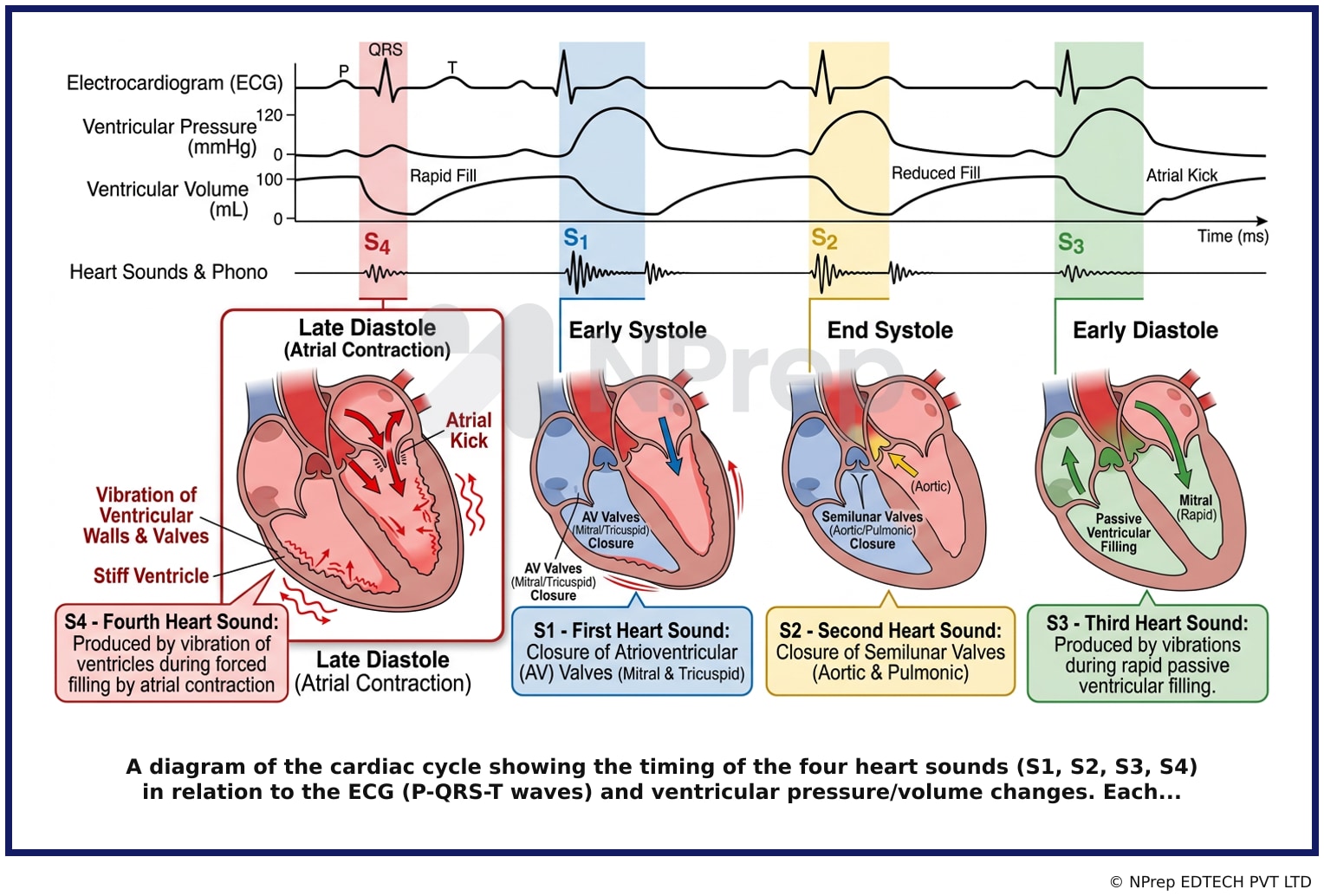
The vibration of valves and ventricular walls during the second phase of ventricular filling when the atria contracts, produces the?
Appeared in: DSSSB - 29 August 2019 (Shift-1)
Explanation
- The fourth heart sound (S4) is a low-frequency sound that occurs in late diastole, just before S1.
- It is generated by the forceful contraction of the atria (the 'atrial kick') pushing blood into a non-compliant or stiff ventricle.
- This forceful movement of blood causes vibrations in the ventricular walls and valves, which are heard as the S4 sound.
- S4 is often referred to as an 'atrial gallop' and is typically considered an abnormal finding in adults, often indicating underlying cardiac pathology like ventricular hypertrophy or ischemia.
Why Other Options Were Wrong
- Option B: The second heart sound (S2) is a high-pitched sound caused by the closure of the aortic and pulmonic (semilunar) valves at the end of ventricular systole, not by atrial contraction.
- Option C: The first heart sound (S1) is caused by the closure of the mitral and tricuspid (atrioventricular) valves at the beginning of ventricular systole.
- Option D: The third heart sound (S3) is caused by the rapid, passive filling of the ventricles in early diastole. It is not associated with atrial contraction, which happens later in diastole.
Related Visual
Clinical Relevance
- Nursing practice connection: This is primarily an exam-oriented knowledge point with limited direct bedside application, so retain Physiology of Heart Sounds as background academic context rather than a clinical decision trigger.
- Auscultating for an S4 is a key nursing assessment skill. Its presence can be an early indicator of serious cardiac conditions like uncontrolled hypertension, aortic stenosis, or heart failure, prompting the need for further evaluation and intervention.
- Nurses must be able to differentiate S4 from other sounds like S3 or a split S1, as the underlying cause and management differ. S4 is a low-pitched sound best heard with the bell of the stethoscope at the cardiac apex with the patient in the left lateral decubitus position.
- What if? If the patient was a young, healthy athlete, an S4 sound would still be considered abnormal and require investigation. This contrasts with an S3 sound, which can sometimes be a normal physiological finding ('physiological S3') in children and trained athletes.
How to Approach the Question
- First, identify the key physiological events described in the question: 'vibration of... ventricular walls' and 'when the atria contracts'.
- This points to an event driven by the 'atrial kick'.
- Next, recall the causes of the four main heart sounds.
- S1 ('lub') is from the closure of the atrioventricular (AV) valves at the start of systole.
- S2 ('dub') is from the closure of the semilunar valves at the end of systole.
- S3 is associated with rapid, passive ventricular filling in early diastole.
Concept Tested & Keywords
- Concept Tested: Physiology of Heart Sounds
- Stem keywords: vibration, ventricular walls, ventricular filling, atria contracts
- Lead-in keywords: produces the
Question ID
QAeQdGSMftAdsSaXrk2vAl
Reference Book
E6 Physiology Guyton 4SAE Part 2A p. 12-13
E6 Medicine Harrison 22e Part 1 p. 1906-1908
Practise the full DSSSB - 29 August 2019 (Shift-1)
Attempt every question from this paper in a timed mock, then review the full solution for each one.
More Circulatory & Lymphatic system Questions
- Symptoms of acute blood loss are:
- Which among the following statements is correct regarding first heart sound?
- What is the action of vagus nerve stimulation on heart rate?
- Excessively high heart rate ( 170) can ?
- Difference between systolic and diastolic blood pressure is called?
- Difference between systolic and diastolic blood pressure is called?
- In a healthy individual, weighing 70 kg at rest, the stroke volume is about?
- The site of pulse in the neck is called?
- Pulse rate more than 100 bpm is called as?
- ECG is used for the assessment/functioning of .... Organ?
More DSSSB - 29 August 2019 (Shift-1) Questions
- Find the missing number in the following number series. -12, -6, \ \ , 9, 18
- Which of the following cubes in the answer figures CANNOT be made based on the unfold cube in the question figure?
- Out of the given options, three are similar in a certain manner. However, one option is NOT like the other three. Select the option which is differen…
- Which two numbers should be interchanged to make the below equation mathematically correct? 7 + 16 / 4 \ 3 - 5 \= 10
- Select the option that is related to the third number on the same basis as the second number is related to the first number. 0.14 : -7.143 :: 0.17 : ?
- A person walks 6 km towards north, then turns towards west and walks 3 km. He then turns left and walks 4 km, and then again turns left and walks for…
- Which two signs should be interchanged to make the below equation mathematically correct? 7 \ 3 + 12 / 2 - 4 \= 23
- If in a certain code language AC means 'Party is amazing', DEC means 'amazing and fun', DF means 'fun loving', then what is the code for 'and'?
- Two numbers are 40% and 60% respectively more than a third number. What is the ratio of the first number to the second number?
- Read the given statement and conclusions carefully. Assuming that the information in the statement is true, even if they appear to be in variance wit…