
RRB Nsg. Superintendent-21 July 2019 (Shift-2nd)
Child Health Nursing (Pediatrics)
Easy
The primary purpose of administering corticosteroids to the child with nephrotic syndrome is ?
Appeared in: RRB Nsg. Superintendent-21 July 2019 (Shift-2nd)
Explanation
- The hallmark of nephrotic syndrome is massive proteinuria due to increased glomerular permeability.
- Corticosteroids are the primary therapy aimed at restoring the integrity of the glomerular filtration barrier.
- The direct therapeutic goal and measure of success (remission) is the reduction and eventual cessation of protein loss in the urine.
- By decreasing proteinuria, other clinical manifestations like edema and hypoalbuminemia begin to resolve.
Why Other Options Were Wrong
- Option A: Increasing blood pressure is a potential adverse effect of corticosteroid therapy, not a therapeutic goal. The goal is to manage the kidney disease, not alter blood pressure upwards.
- Option C: Corticosteroids suppress the immune system, which increases the risk of infection. This is a significant concern and a monitored side effect, not a benefit.
- Option D: While corticosteroids do have anti-inflammatory effects, this is a general mechanism. The most specific and primary therapeutic objective in nephrotic syndrome is to stop the protein leakage, making 'decrease proteinuria' the more precise answer.
Related Visual
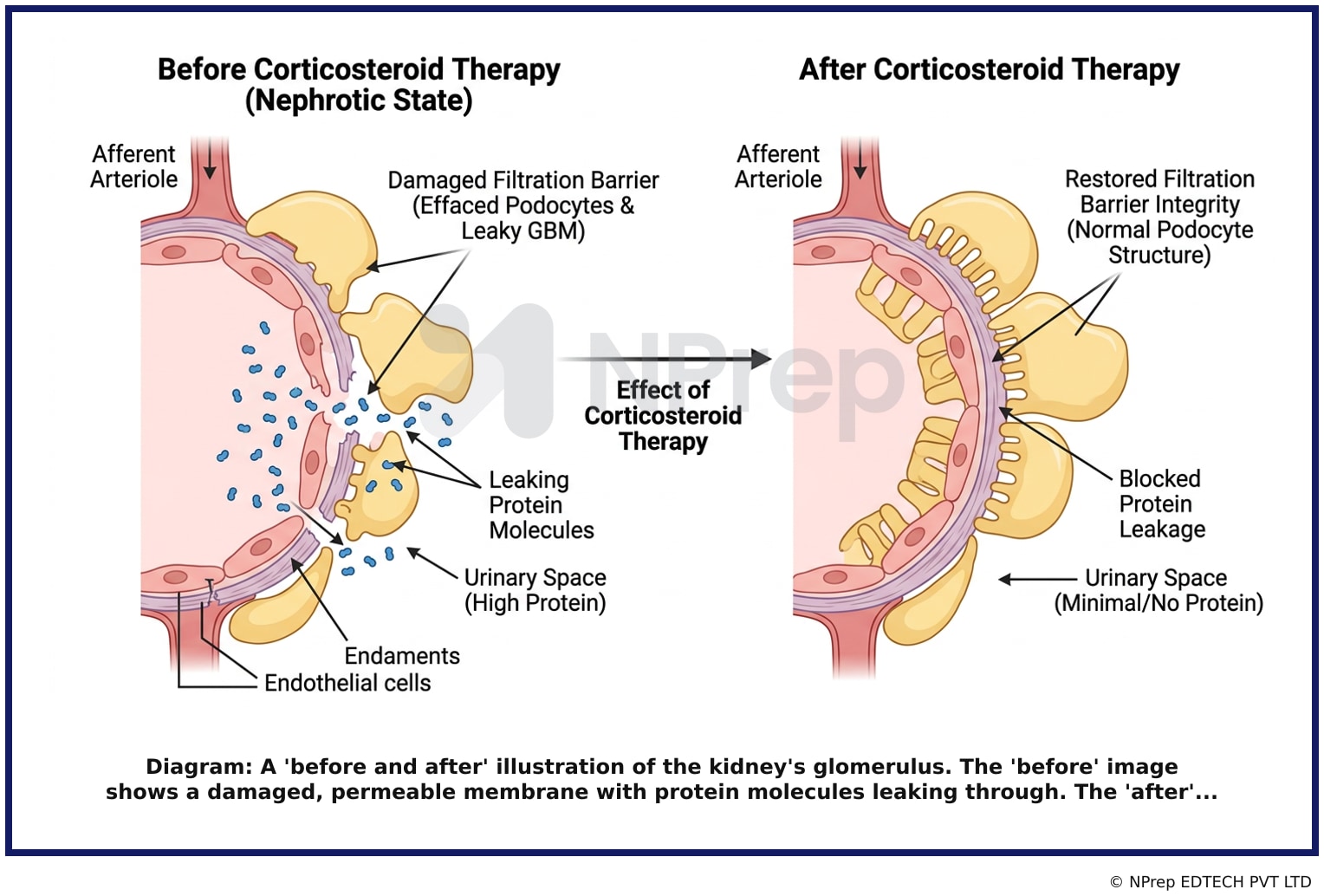
- Visual 1: Diagram: A 'before and after' illustration of the kidney's glomerulus. The 'before' image shows a damaged, permeable membrane with protein molecules leaking through. The 'after' image shows how corticosteroids help restore the membrane's integrity, blocking protein leakage.
- Visual 2: Flowchart: A simple flowchart showing the pathophysiology: Immune dysfunction → Glomerular damage → Proteinuria → Edema & Hypoalbuminemia. Then show how Corticosteroids interrupt this process at 'Immune dysfunction'.
Clinical Relevance
- Nursing practice connection: Use the key finding related to Pharmacological management of pediatric nephrotic syndrome to guide bedside assessment, documentation, and the next nursing action.
- A key nursing role is educating the family on how to test the child's urine for protein at home using dipsticks. This is crucial for monitoring remission and detecting relapses early.
- Nurses must diligently monitor for the side effects of corticosteroid therapy, including signs of infection (fever, cough), hypertension, hyperglycemia, and cushingoid features (moon face, weight gain).
- Patient safety is paramount. Families must be taught to seek immediate medical attention if the child develops a fever or is exposed to infections like chickenpox, as their suppressed immune system puts them at high risk.
How to Approach the Question
- First, identify the core pathology of the disease mentioned in the question. For nephrotic syndrome, the defining feature is massive proteinuria.
- Next, analyze the drug class provided: corticosteroids. Recall their primary actions and common side effects.
- Evaluate each option by linking the drug's action to the disease's core pathology.
- The correct answer will be the option that describes the primary therapeutic goal of the drug for that specific disease.
- Eliminate options that describe side effects (increasing blood pressure), opposite effects (preventing infection), or less specific mechanisms (reducing inflammation) when a more direct therapeutic outcome is available (decreasing proteinuria).
Concept Tested & Keywords
- Concept Tested: Pharmacological management of pediatric nephrotic syndrome
- Stem keywords: corticosteroids, child, nephrotic syndrome
- Lead-in keywords: primary purpose
- Clinical cues: Age/sex group narrows the expected diagnosis, intervention, or normal reference range.
Question ID
QdgP3eeSmrwCV-8DgJlMv8
Practise the full RRB Nsg. Superintendent-21 July 2019 (Shift-2nd)
Attempt every question from this paper in a timed mock, then review the full solution for each one.
More Disorders of Kidney and Urinary Tract Questions
- Additional defects associated with exstrophy of bladder is:
- A 4-month-old with meningococcal meningitis has just been admitted to the pediatric unit. Which nursing intervention has the highest priority?
- The child with acute glomerulonephritis is under treatment in a ward. The nurse should look for the following as an indicator for acute renal failure?
- A child is being discharged from the emergency with a diagnosis of acute glomerulonephritis. Which of the following measures would a nurse include in…
- Enuresis is?
- Epispadias means?
- A client is admitted with exstrophy of the bladder. What is the nursing action if the bladder is exposed outside the cavity?
- A child with recurrent urinary tract infections is most likely to show?
- In the Shakir tape method for assessing nutritional status in children, what does the red color zone indicate?
- A 15-month-old, non-toilet-trained child requires a sterile urine sample for culture and sensitivity. Which method is the most appropriate for obtain…
More RRB Nsg. Superintendent-21 July 2019 (Shift-2nd) Questions
- The most common cause of embolism is ?
- Myopia is corrected by using?
- The normal human body temperature is maintained by& x20;
- \ \ \ \ \ \ denotes one who never completed a pregnancy to the stage of& x20;
- The process involved in the development of a mature ovum is called & x20;
- The larynx is closed during swallowing by: & x20;
- How are ECG changes presented in ischemia and myocardial infarction? & x20;
- What information the nurse should consider while collecting the history of a child with suspected rheumatic fever?& x20;
- The storage form of carbohydrates in animals is& x20;
- Paedophilia is a form of