
Combined AIIMS - 2020 (Jodhpur, Bhopal, Patna, Raipur)
Medical & Surgical Nursing
Easy
The condition presented below is caused due to:
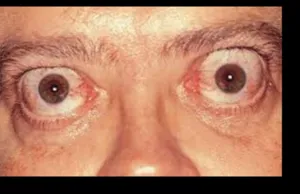
Appeared in: Combined AIIMS - 2020 (Jodhpur, Bhopal, Patna, Raipur)
Explanation
- The image shows exophthalmos, the forward protrusion of the eyeballs, which is a classic sign of Graves' ophthalmopathy.
- Graves' disease is the most common cause of hyperthyroidism, an autoimmune condition where antibodies stimulate the thyroid gland.
- The mechanism involves inflammation and accumulation of fluid and glycosaminoglycans in the retro-orbital tissues (muscles and fat), which pushes the eyeballs forward.
- Other signs of hyperthyroidism include heat intolerance, weight loss, tachycardia, and nervousness.
Why Other Options Were Wrong
- Option A: Glaucoma is characterized by increased intraocular pressure that damages the optic nerve. It does not cause the eyeballs to protrude.
- Option C: Hypothyroidism (underactive thyroid) typically causes periorbital edema (puffiness around the eyes) due to myxedema, not the distinct forward bulging (proptosis) seen in the image.
- Option D: Hypopituitarism is a deficiency of pituitary hormones. While it can cause a wide range of symptoms, it is not associated with exophthalmos.
Related Visual

Clinical Relevance
- Nursing practice connection: This is primarily an exam-oriented knowledge point with limited direct bedside application, so retain Pathophysiology of Endocrine Disorders and Associated Clinical Signs as background academic context rather than a clinical decision trigger.
- Nurses must recognize exophthalmos as a key sign of hyperthyroidism, prompting further assessment and referral. Patient education on eye care is critical.
- Nursing interventions for exophthalmos include administering artificial tears to prevent corneal drying, advising the use of sunglasses to reduce photophobia, and suggesting sleeping with the head of the bed elevated to decrease periorbital edema.
- Patient safety is paramount. The nurse must assess for incomplete lid closure (lagophthalmos), which increases the risk of corneal abrasion and infection. Any changes in vision must be reported immediately.
How to Approach the Question
- First, carefully analyze the image to identify the primary clinical sign. In this case, the key finding is the prominent bulging of the eyes.
- Identify the medical term for this sign, which is exophthalmos or proptosis.
- Next, review the provided options, which are all endocrine or ophthalmologic conditions.
- Systematically evaluate each option by recalling its typical signs and symptoms. Ask yourself, 'Which of these conditions is known to cause exophthalmos?'
- Correlate your medical knowledge with the visual evidence. Hyperthyroidism (specifically Graves' disease) is the classic cause of exophthalmos. The other options (Glaucoma, Hypothyroidism, Hypopituitarism) do not present with this sign.
- Select the option that provides the most direct and well-known causal link to the visual finding.
Concept Tested & Keywords
- Concept Tested: Pathophysiology of Endocrine Disorders and Associated Clinical Signs
- Stem keywords: condition presented, caused due to
- Lead-in keywords: caused due to
- Clinical cues: Image showing bilateral exophthalmos (protruding eyes) with scleral show, which is a hallmark sign of thyroid eye disease.
Question ID
QUTyt7BLR6CDeVOMzon0NR
Reference Book
E6 Physiology Essentials Sembulingam 10e Part 2 p. 44-46
E6 Medicine Harrison 22e Part 1 p. 274-276
E6 Medicine Davidson Principles Practice 24e p. 1191-1193
Practise the full Combined AIIMS - 2020 (Jodhpur, Bhopal, Patna, Raipur)
Attempt every question from this paper in a timed mock, then review the full solution for each one.
More Metabolic and Endocrine Function Questions
- What is the characteristic feature of biliary colic?
- What is minimum distance between insulin injection site?
- Graves' Disease is:-
- A 45-year-old patient undergoes a total thyroidectomy and is admitted to the post-anesthesia care unit (PACU) for monitoring. Shortly after arrival,…
- Cut point of fasting blood sugar level indicates Diabetic Mellitus?
- A patient suffering from liver cirrhosis is admitted to the ward. Which of the following represents that hepatic Encephalopathy observable in patient…
- Early signs of hypoglycemia are the following?
- After liver biopsy which complication should be monitored?
- Features of hypothyroidism except?
- A client is scheduled for a subtotal Thyroidectomy. Iodine solution (Lugol solution, potassium iodide solution) is prescribed. A nurse prepares to ad…
More Combined AIIMS - 2020 (Jodhpur, Bhopal, Patna, Raipur) Questions
- The position used for most of the gynecological procedures?
- Thyroid eye disease (TED) is also known as:
- How many items are included in the WHO surgical safety checklist: SITOSO?
- In iron deficiency anemia, the fingernails become spoon shaped, this condition is referred to as:
- Which of the following code is associated with cardiac arrest during medical emergency?
- How is blood loss measured in Post-partum hemorrhage?
- The traction used for cervical spine injury:
- In operation theater during cauterization, the electric current passing from a single electrode is called:
- Tracheostomy is done in which tracheal ring?
- The instrument used for measuring fetal heart rate (FHR):