
RML MAINS 2025
Medical & Surgical Nursing
Easy
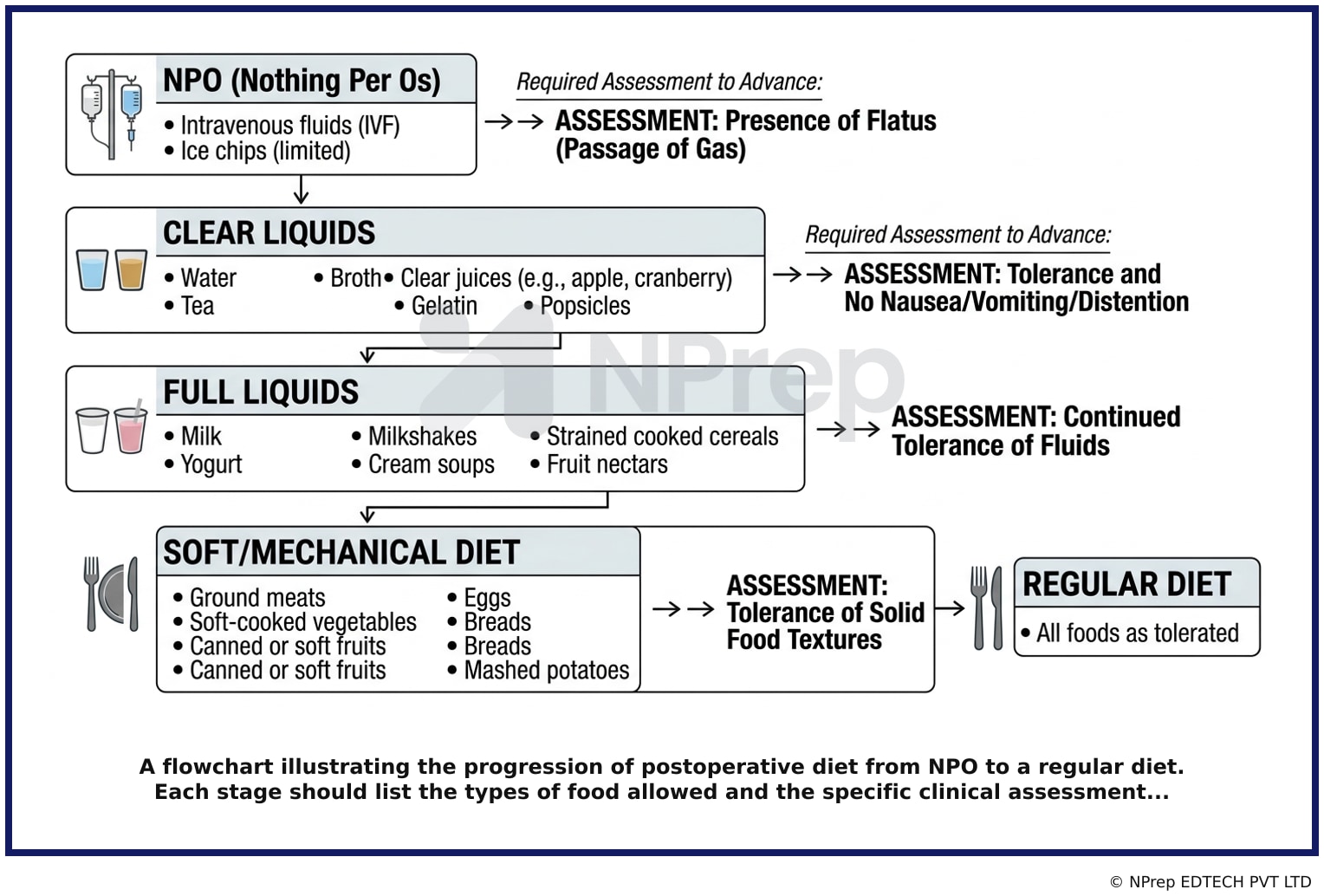
The client's postoperative orders state to advance the diet as tolerated. The client has been NPO; the nurse will advance the client's diet to clear liquids based on which assessment:
Appeared in: RML MAINS 2025
Explanation
- The most reliable indicator of returned gastrointestinal (GI) motility after surgery is the passage of flatus (gas).
- Anesthesia and surgical manipulation often cause a temporary, functional halt of the bowel, known as postoperative paralytic ileus.
- Advancing a diet before peristalsis returns can lead to complications such as nausea, vomiting, abdominal distention, and potential aspiration.
- The presence of flatus confirms that the intestines are once again moving and can propel contents forward, making it safe to introduce clear liquids.
Why Other Options Were Wrong
- Option A: Pain control is essential for patient comfort and to facilitate activities like deep breathing and ambulation, but it is not a physiological indicator of bowel function.
- Option B: Ambulation is a therapeutic intervention used to promote the return of peristalsis. It is an action, not an assessment finding that confirms bowel function has returned.
- Option C: A patient's subjective feeling of hunger is unreliable. It can be present even when the bowels are not yet motile.
Related Visual
Clinical Relevance
- Nursing practice connection: Use the key finding related to Postoperative Assessment for Dietary Advancement to guide bedside assessment, documentation, and the next nursing action.
- A primary nursing responsibility in postoperative care is to prevent complications. Advancing a diet based on accurate assessment of bowel function is a critical patient safety measure to prevent paralytic ileus, vomiting, and aspiration.
- Nurses must educate patients that while ambulation is encouraged to 'wake up the bowels,' the definitive sign the nurse is looking for is passing gas.
- What if? If a patient has audible bowel sounds but has not yet passed flatus, the nurse should proceed with caution. Bowel sounds can return before effective peristalsis. The nurse might offer ice chips or small sips of water and monitor the patient's tolerance closely for any signs of distention or nausea before advancing further.
How to Approach the Question
- First, identify the core of the question: it asks for the specific assessment finding that justifies advancing the diet from NPO to clear liquids after surgery.
- Recall the effects of general anesthesia on the body, specifically that it causes the gastrointestinal system to slow down or stop (paralytic ileus).
- The key to answering is to find the option that provides direct, objective evidence that the GI tract has 'woken up' and is functioning again.
- Evaluate each option: Is it an objective sign of GI motility, a subjective feeling, or an intervention?
- Option A (pain) is about comfort. Option B (ambulation) is an intervention to help recovery. Option C (hunger) is a subjective feeling.
- Option D (passing flatus) is the only direct, objective evidence that peristalsis has returned. Therefore, it is the correct basis for advancing the diet.
Concept Tested & Keywords
- Concept Tested: Postoperative Assessment for Dietary Advancement
- Stem keywords: postoperative, advance diet, NPO, clear liquids, assessment
- Lead-in keywords: based on which
Question ID
Q9dzmPnfldTtBf-cmTWUNo
Reference Book
E6 Nursing Fundamentals Potter Perry 12e Part 6 p. 203-205
E6 Nursing Brunner Adult Health 3SA Vol 1 Part 1 p. 123-125
Practise the full RML MAINS 2025
Attempt every question from this paper in a timed mock, then review the full solution for each one.
More Perioperative Concepts and Nursing Management Questions
- The nurse is informed that a client with a large surgical incision is being transferred from the intensive care unit to the surgical unit. What medic…
- Why it is necessary to remove dark coloured nail paint before surgery?
- A patient planned for surgery advised to remove Jewellery because:
- Vicryl 3-0 is:
- All of the following are correct regarding stoma formation; EXCEPT:
- A surgeon is going to give a skin incision on patient. Which of the following is to be done?
- Following is the picture of sterile sponge used in emergency. It has a blue colour thread. What is the purpose of this colour thread?
- How many items are included in the WHO surgical safety checklist: SITOSO?
- In operation theater during cauterization, the electric current passing from a single electrode is called:
- Which position is given to a client by nursing officer, who has been brought from OT after craniotomy surgery?
More RML MAINS 2025 Questions
- What is the minimum birth weight considered as low birth weight in Americans?
- Which one of the following statements is false about sterile gloves?
- Which one of the following measures are not recommended to prevent pressure ulcer?
- Which of the following statements indicates the nurse has the right understanding of the drug Digoxin while explaining its action to the patient?
- Which of the following drugs is commonly administered for a patient with supraventricular tachycardia which also has a short half-life?
- Complementary feeding for a 6-month-old baby includes:
- Causative agent of Chickenpox is:
- Why is an unconscious patient placed in the left lateral position?
- A nurse is preparing to collect a throat swab for culture from a child with suspected pharyngitis, from which site should the specimen be collected?
- Nursing notes are written: