
DSSSB 6 September 2024
Medical & Surgical Nursing
Easy
Select the option that correctly mentions the instrument shown in the following image.
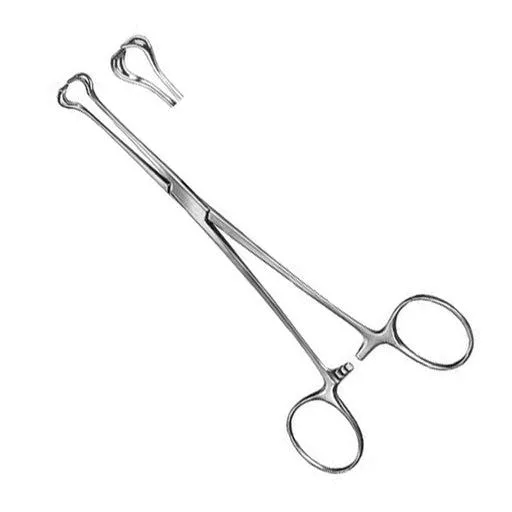
Appeared in: DSSSB 6 September 2024
Explanation
- The instrument shown is a Babcock forceps, identified by its unique tip.
- As seen in the image, the tips are fenestrated (have a hole), flared, and atraumatic (non-crushing).
- It features a ratchet lock to hold tissue gently but securely.
- This design is ideal for grasping delicate tubular structures like the fallopian tubes, appendix, or intestines without causing damage.
Why Other Options Were Wrong
- Option A: Hegar's dilators are solid, curved metal rods used for dilating the cervix; they are not forceps and do not have jaws or handles like the instrument shown.
- Option B: Ovum forceps have larger, spoon-shaped or cup-like fenestrated tips and typically lack a ratchet (catch). The instrument in the image has more delicate, flared tips and a clear ratchet mechanism.
- Option C: Vulsellum forceps are traumatic instruments with sharp, interlocking teeth or hooks at the tips. The instrument in the image has smooth, atraumatic tips designed to prevent tissue injury.
Related Visual

Clinical Relevance
- Nursing practice connection: This is primarily an exam-oriented knowledge point with limited direct bedside application, so retain Identification of common surgical instruments used in general surgery and gynecology as background academic context rather than a clinical decision trigger.
- Using the correct instrument is critical for patient safety. Using a traumatic forceps like an Allis or Vulsellum on a delicate structure like the bowel could cause perforation, leading to peritonitis.
- The atraumatic design of Babcock forceps minimizes tissue damage, reduces postoperative pain, and promotes better healing.
- What if? If a surgeon needed to remove products of conception after an incomplete abortion, they would use Ovum forceps, not Babcock forceps. The Ovum forceps' larger, non-locking, cup-like jaws are designed to remove tissue fragments without crushing them, which is essential for complete evacuation.
How to Approach the Question
- This is an image-based identification question, which requires visual recognition of medical equipment.
- First, carefully examine the key features of the instrument in the image. Pay close attention to the tip, the handles, and whether it has a locking mechanism (ratchet).
- Observe the tip: it is fenestrated (has a window), is flared outwards, and appears smooth and atraumatic (no teeth).
- Observe the handle: it has finger rings and a ratchet lock.
- Mentally compare these features to the known characteristics of the instruments listed in the options.
- Eliminate options that do not match. Hegar's is a dilator (rod), not forceps. Vulsellum has teeth. Ovum forceps have larger, cup-like tips and usually no lock. The features perfectly match those of a Babcock forceps.
Concept Tested & Keywords
- Concept Tested: Identification of common surgical instruments used in general surgery and gynecology.
- Stem keywords: instrument, image, forceps
- Lead-in keywords: Select the option that correctly mentions
- Negative lead-in flag: false
Question ID
QRgX9_eD_Zxs0jHHwzyEUJ
Reference Book
E6 Nursing Brunner Adult Health 3SA Vol 1 Part 1 p. 78-80
E6 Midwifery Obstetrics and Gynecology Nursing Sandeep Kaur p. 49-57
Practise the full DSSSB 6 September 2024
Attempt every question from this paper in a timed mock, then review the full solution for each one.
More Perioperative Concepts and Nursing Management Questions
- The nurse is informed that a client with a large surgical incision is being transferred from the intensive care unit to the surgical unit. What medic…
- Why it is necessary to remove dark coloured nail paint before surgery?
- A patient planned for surgery advised to remove Jewellery because:
- Vicryl 3-0 is:
- All of the following are correct regarding stoma formation; EXCEPT:
- A surgeon is going to give a skin incision on patient. Which of the following is to be done?
- Following is the picture of sterile sponge used in emergency. It has a blue colour thread. What is the purpose of this colour thread?
- How many items are included in the WHO surgical safety checklist: SITOSO?
- In operation theater during cauterization, the electric current passing from a single electrode is called:
- Which position is given to a client by nursing officer, who has been brought from OT after craniotomy surgery?
More DSSSB 6 September 2024 Questions
- Which of the following is NOT a primitive defence mechanism?
- After taking lithium drug for one month, a patient checked their serum lithium level and found it to be 1.0 mEq/L. The nurse checked the report and n…
- Select the option that correctly describes the condition being shown in the following image.
- Turbid, cloudy CSF is commonly associated with:
- According to the Mental Health Act, 1987, who from the following make(s) the application for admission under special circumstances?
- Which of the following types of schizophrenia is commonly characterised by excitement and stupor?
- What is the action of the Sitagliptin?
- Which gas is most commonly used for daily work in the wards and operation theatres?
- Sickle cell RBCs are also known as:
- Glimepiride is an example of a \ \ \ \ \ \ .