
RRB Nsg. Superintendent-20 July 2019 (Shift-3rd)
Medical & Surgical Nursing
Easy
Removal of an entire lung is known as___
Appeared in: RRB Nsg. Superintendent-20 July 2019 (Shift-3rd)
Explanation
- Pneumonectomy is the correct medical term for the surgical removal of an entire lung.
- This procedure is indicated for diseases that affect the whole lung, such as extensive lung cancer or severe bronchiectasis, where conserving lung tissue is not possible.
- It is a major thoracic surgery with significant impact on respiratory function, as the patient is left with only one lung.
Why Other Options Were Wrong
- Option A: Pleurectomy involves the removal of the pleura (the lining around the lung), not the lung tissue itself.
- Option C: Bulbectomy is a neurosurgical procedure for removing an olfactory bulb in the brain and is completely unrelated to the respiratory system.
- Option D: Lobectomy is the removal of only one lobe of the lung, not the entire lung. The right lung has three lobes and the left has two.
Related Visual
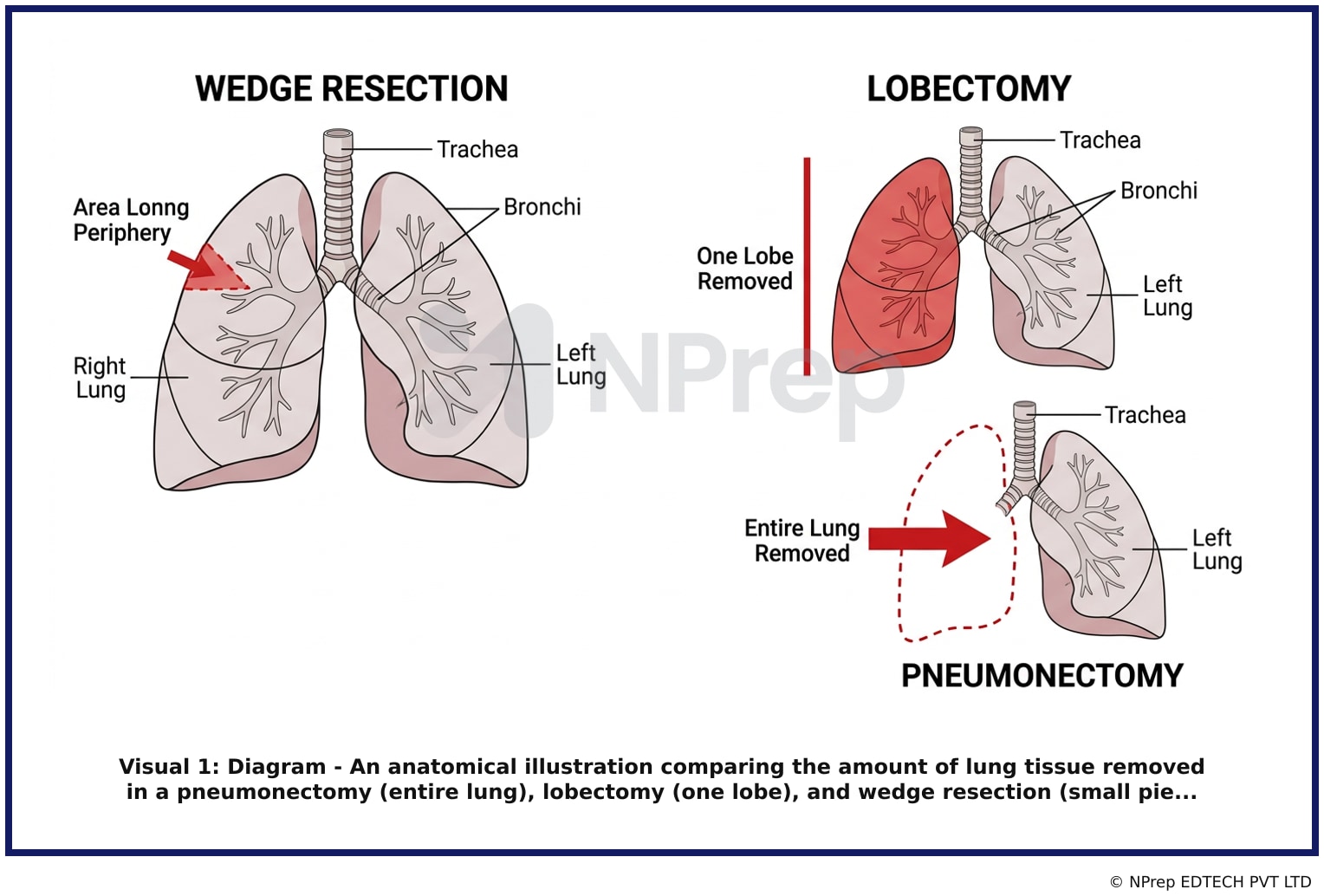
- Visual 1: Visual 1: Diagram - An anatomical illustration comparing the amount of lung tissue removed in a pneumonectomy (entire lung), lobectomy (one lobe), and wedge resection (small piece). This visual helps differentiate the extent of each surgical procedure.
Clinical Relevance
- Nursing practice connection: This is primarily an exam-oriented knowledge point with limited direct bedside application, so retain Terminology of Thoracic Surgical Procedures as background academic context rather than a clinical decision trigger.
- Post-pneumonectomy care is critical. Nurses must monitor for complications like mediastinal shift, where the remaining lung and heart shift into the empty space, which can compromise cardiac output and ventilation. Patients are often positioned on their operative side to facilitate expansion of the remaining lung.
- A key nursing responsibility is managing the patient's respiratory status, including oxygen saturation, breath sounds over the remaining lung, and signs of respiratory distress. Pain management is also crucial to allow for effective coughing and deep breathing.
- What if? If the patient had a lobectomy instead of a pneumonectomy, chest tubes would be placed to drain fluid and air, and to help the remaining lobes of that lung re-expand. In a pneumonectomy, the pleural space is left to fill with serous fluid, and chest tubes are generally not used in the same way, if at all.
How to Approach the Question
- First, identify the key terms in the question: 'removal' and 'entire lung'.
- Break down the medical terminology in the options. The suffix '-ectomy' means 'surgical removal'.
- Consider the prefixes. 'Pneumo-' relates to the lungs or air. 'Lobe-' relates to a lobe. 'Pleuro-' relates to the pleura.
- Combine the prefix and suffix. 'Pneumonectomy' logically means the removal of a lung.
- Differentiate this from 'lobectomy', which would be the removal of a lobe—a part of the lung, not the 'entire' lung as specified in the question.
Concept Tested & Keywords
- Concept Tested: Terminology of Thoracic Surgical Procedures
- Stem keywords: removal, entire lung
- Lead-in keywords: known as
Question ID
Qe-TmBjxSyAbEzUkpGn0r7
Practise the full RRB Nsg. Superintendent-20 July 2019 (Shift-3rd)
Attempt every question from this paper in a timed mock, then review the full solution for each one.
More Gas Exchange and Respiratory Function Questions
- Which is the most relevant knowledge about oxygen administration to a client with COPD?
- Patient in emergency department diagnosed to have fluid and air present in lung. What is the above-mentioned condition known as?
- Patient is suffering from dyspnea. Which position will you provide for patient to relieve?
- Which of the following is not involved in chest physiotherapy?
- Respiration which is abnormally shallow for two or three breaths followed by irregular period of apnea is termed:
- Identify the following instrument which is used in diagnostic procedures:
- Identify the instrument shown in the following image:
- Identify the tube in the following image:
- A patient suddenly develops respiratory difficulties such as dyspnea, what is the first priority of the nursing officer?
- Which of the following method is used for high flow oxygen administration:
More RRB Nsg. Superintendent-20 July 2019 (Shift-3rd) Questions
- Where is oxytocin synthesized?
- What is the name of the muscle that extends from the sphenoid bone to the mandible?
- Complementary feeding should be initiated at the completion of \ \ \ \ \ \
- Where is kidney located?
- Psychosocial development stage for infants is \ \ \ \ \ \ \ \ \ \
- What immunization is given at birth?
- Functional nursing is a method of providing
- Which disease is the dementia associated with asymmetric atrophy of the frontal and temporal lobes?
- Thromboangiitis obliterans is also known as
- What is the other name of pyridoxine?