
UPUMS Nsg.Officer-2024
Pediatric Nursing
Easy
One of the following is true about Vitamin K in the newborn period.
Appeared in: UPUMS Nsg.Officer-2024
Explanation
- The statement that Vitamin K is a fat-soluble vitamin is a correct nutritional fact.
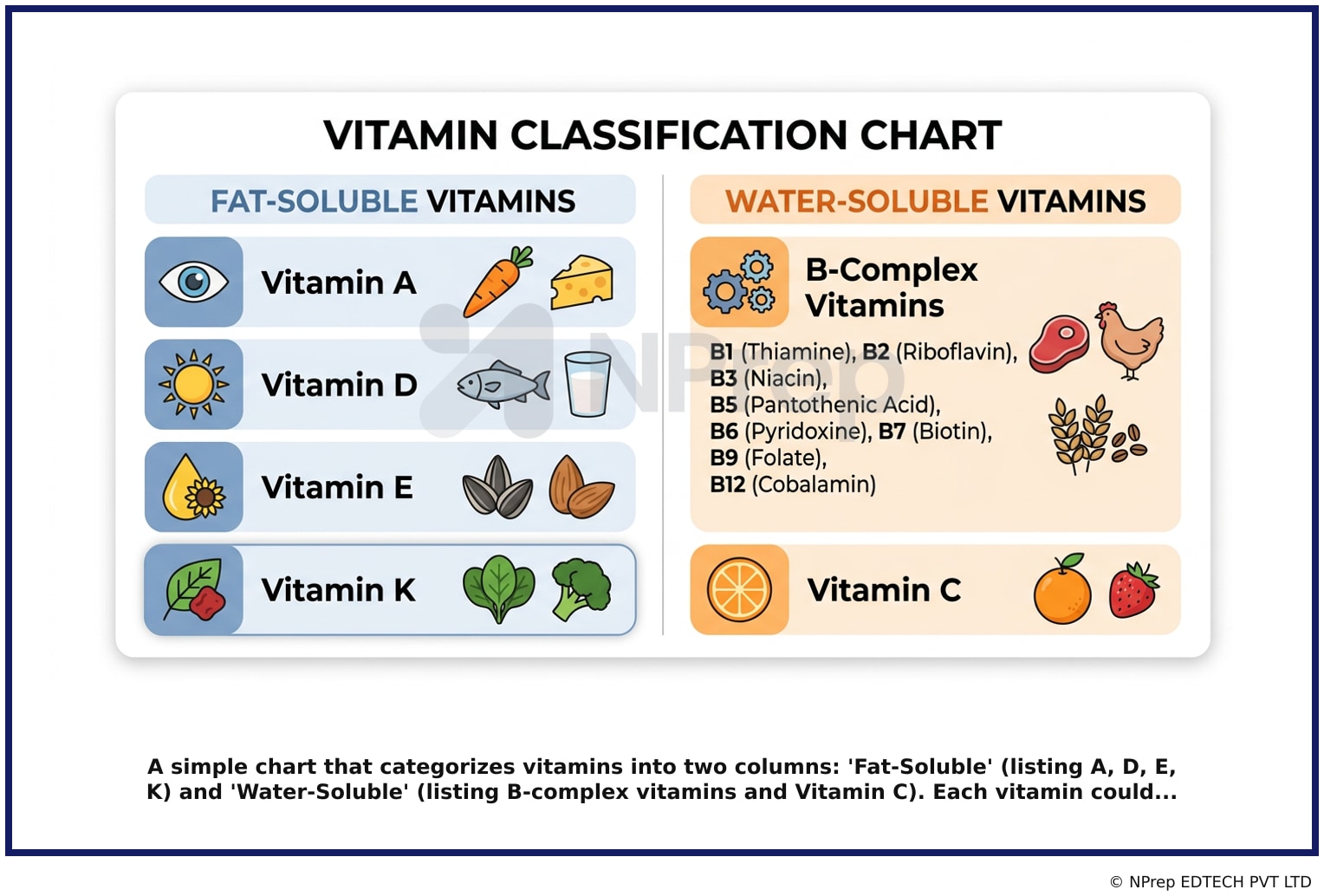
- Vitamins are classified into two main groups: fat-soluble and water-soluble.
- The fat-soluble vitamins are A, D, E, and K.
- These vitamins are absorbed along with fats in the diet and are stored in the body's fatty tissue and liver.
Why Other Options Were Wrong
- Option A: An excess of Vitamin K does not cause bleeding; a deficiency does. Vitamin K is crucial for the synthesis of clotting factors. Toxicity, though rare, is associated with hemolysis and jaundice.
- Option B: Newborns have a sterile gut and cannot effectively synthesize or absorb Vitamin K. Intramuscular (IM) injection bypasses the gut, ensuring a reliable dose is delivered to prevent bleeding. The IM route provides a depot effect for sustained release.
- Option C: Prophylactic Vitamin K is recommended for ALL newborns. While breastfed infants are at a higher risk due to the low Vitamin K content in breast milk, all infants are born with low stores and are susceptible to Vitamin K Deficiency Bleeding (VKDB).
Related Visual
Clinical Relevance
- Nursing practice connection: This is primarily an exam-oriented knowledge point with limited direct bedside application, so retain Properties and prophylactic administration of Vitamin K in newborns as background academic context rather than a clinical decision trigger.
- A nurse's primary role is to administer a single intramuscular dose of Vitamin K (phytonadione) to all newborns shortly after birth as a standard prophylactic measure.
- This intervention is critical to prevent Vitamin K Deficiency Bleeding (VKDB), a potentially life-threatening condition that can cause intracranial hemorrhage and permanent neurologic damage.
- What if a parent refuses the Vitamin K injection for their newborn? The nurse must first educate the parents about the serious risks of VKDB, including brain damage and death. If they still refuse, the nurse must carefully document the refusal in the medical record and ensure the parents have signed a refusal form, per hospital policy.
How to Approach the Question
- First, identify the core subject of the question, which is Vitamin K in the newborn period.
- The question asks for a 'true' statement, so you must evaluate each option for its factual accuracy.
- Recall the basic classification of vitamins. Remember the mnemonic 'ADEK' for the fat-soluble vitamins.
- Evaluate Option D: 'Vitamin K is a fat soluble vitamin.' This is a fundamental fact. Keep it as a likely correct answer.
- Evaluate the other options based on your knowledge of neonatal physiology and care.
- Option A: Think about the function of Vitamin K (clotting). Deficiency causes bleeding, so excess would not. This is incorrect.
Concept Tested & Keywords
- Concept Tested: Properties and prophylactic administration of Vitamin K in newborns.
- Stem keywords: Vitamin K, newborn period, true
- Lead-in keywords: true
- Negative lead-in flag: false
Question ID
QSVdqaQXy7xyVdXh5EWpQL
Reference Book
E6 Nelson Textbook of Pediatrics(2024) — Volume 1 pp. 527-529, 1138-1140
Practise the full UPUMS Nsg.Officer-2024
Attempt every question from this paper in a timed mock, then review the full solution for each one.
More Newborn Infants Questions
- When palpating the abdomen of hypertrophic pyloric stenosis infant, the Nurse finds:
- A pre-eclampsia woman's baby is lying with her mother. Neonate is born in 37 weeks. After 57 hours, when nurse is monitoring vital signs of baby, tem…
- Normally enteral feedings are flushed with water to open blocked tube and ease feeding. In which area it is done with air?
- A nurse is advised to give injection vitamin K for new born baby. The route and dose of Vitamin K is:
- Identify the following instrument used in hyperbilirubinemia monitoring based on the image:
- Which of the following equipment is used in Neonatal Resuscitation program?
- All of the following are the benefits of KMC (Kangaroo mother care); EXCEPT:
- Waxy or cheese like white substance found coating the skin of newborn human baby is known as:
- Identify 'at risk' infants from the following:-
- What is the normal length of the neonate body?
More UPUMS Nsg.Officer-2024 Questions
- Any event that is not consistent with routine patient care and is used when patient care is not consistent with facility or national standards of exp…
- How many compressions and breaths should you do for each cycle of CPR?
- A 23-year-old white male who is otherwise in good health noted a sudden shower of flashing lights before his left eye a few hours ago. He has never h…
- The nurse asked the client to read the Snellen chart. Which of the following is tested?
- All India Institute of Speech and Hearing (AIISH), recently seen in the news, is inaugurated at which city of Uttar Pradesh?
- The nurse is checking the placement of a nasogastric tube prior to giving medication and a feeding. Which of the following is the preferred and most…
- A dynamic and purposeful relationship between two people who approaches a mutually defined problems with mutual consideration of each other, is known…
- How do you recognize the signs of a heart attack?
- A client complains of difficulty of swallowing, when the nurse try to administer capsule medication. Which of the following measures the nurse should…
- What should you do when someone suffers swelling from a head injury?