
In which of the following clinical condition high flow oxygen cannot be given?
Explanation
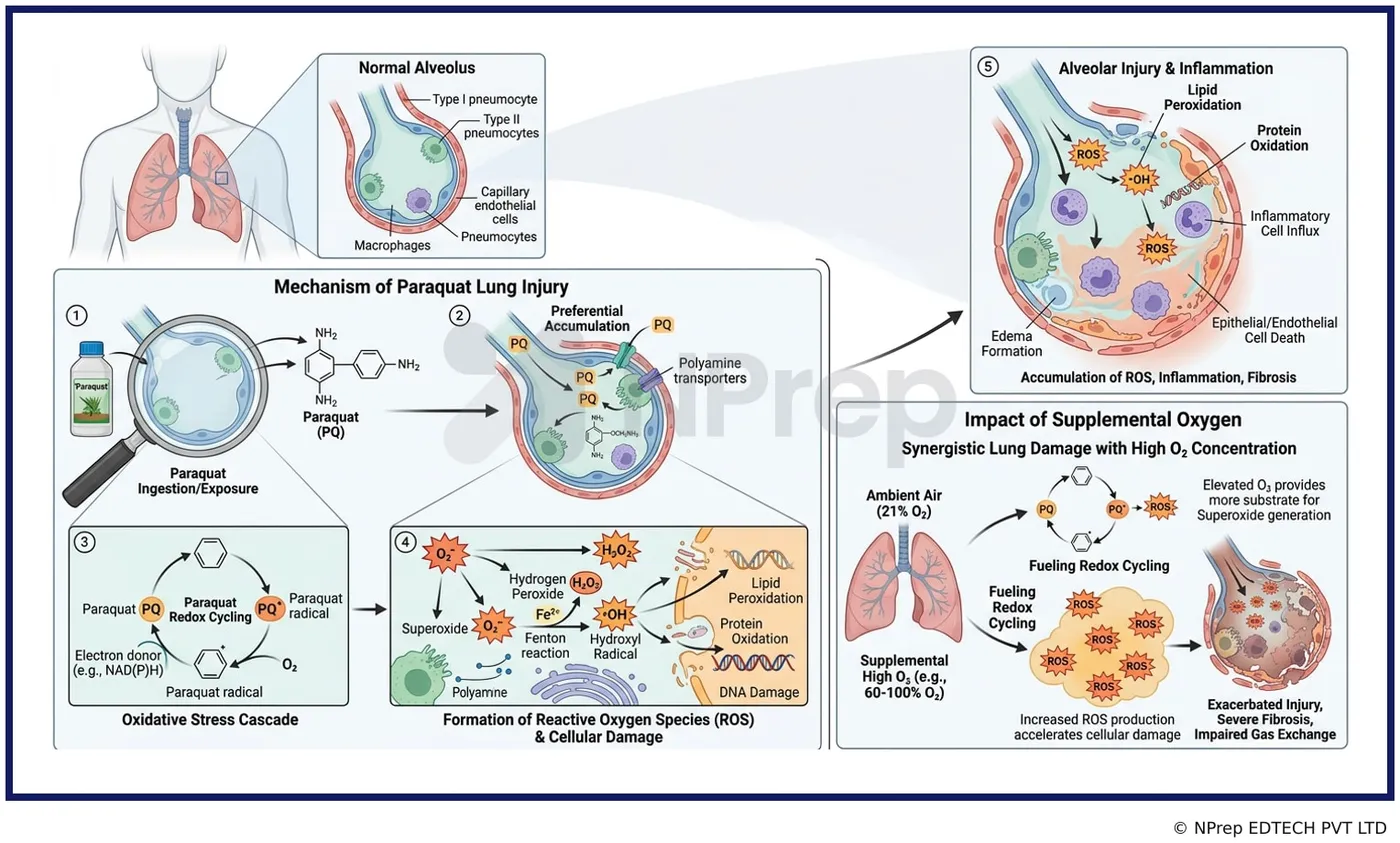
Paraquat poisoning causes severe oxidative injury to the lungs. Administration of high concentrations of oxygen can increase oxidative stress and worsen pulmonary injury.
Therefore, high-concentration oxygen should generally be avoided unless significant hypoxemia is present.
If hypoxemia develops, oxygen should be administered according to the patient’s clinical condition.
Why Other Options Were Wrong
- Option A: In pneumonia, the lungs' air sacs (alveoli) are filled with fluid and pus, impairing gas exchange and causing hypoxemia. High-flow oxygen is a primary treatment to improve blood oxygen levels.
- Option B: During an acute asthma attack, airways narrow, leading to difficulty breathing and hypoxemia. High-flow oxygen is used to correct low oxygen levels. The warm, humidified gas can also soothe irritated airways and reduce the work of breathing.
- Option D: Acute Respiratory Distress Syndrome (ARDS) is characterized by severe, widespread lung inflammation and fluid leakage into the alveoli, causing profound hypoxemia. High-flow oxygen, often with high levels of PEEP, is a cornerstone of ARDS management to open collapsed alveoli and improve oxygenation.
Related Visual
Clinical Relevance
Nursing practice connection: Understanding oxygen therapy precautions helps nurses administer oxygen safely and recognize situations in which excessive oxygen exposure may worsen tissue injury.
In suspected paraquat poisoning, the nurse should monitor SpO₂, respiratory status, ABG findings, and signs of progressive respiratory failure while avoiding unnecessary high-concentration oxygen.
What if? If the patient develops significant hypoxemia due to paraquat-induced lung injury, oxygen should not be withheld. It should be administered according to the patient’s clinical condition because maintaining adequate oxygenation takes priority.
How to Approach the Question
- First, identify the core of the question: it asks for a contraindication to high-flow oxygen, meaning a situation where it would be harmful.
- Analyze each option's pathophysiology. Think about why a patient with that condition would need or not need oxygen.
- Recall the basic principles of oxygen therapy: it's used to treat hypoxemia (low blood oxygen).
- Paraquat poisoning: High-concentration oxygen can worsen oxidative pulmonary injury and should generally be avoided unless significant hypoxemia is present.
- Confirm that for the other respiratory conditions (Pneumonia, Asthma, ARDS), hypoxemia is a primary problem, and oxygen is a standard treatment.
Concept Tested & Keywords
- Concept Tested: Contraindications for High-Flow Oxygen Therapy
- Stem keywords: high flow oxygen, cannot be given, clinical condition
- Lead-in keywords: cannot
- Negative lead-in flag: The question asks for a condition where high-flow oxygen CANNOT be given, which is a negative framing.
Question ID
Q4hTlPBaMvQD2skSmoelEo
Reference Book
E6 Ghai Essential Pediatrics(pp 26-904 of 913) p. 424-426
E6 Medicine Harrison 22e Part 2 p. 210-212
Practise the full NORCET -4 , 2023
Attempt every question from this paper in a timed mock, then review the full solution for each one.
More Gas Exchange and Respiratory Function Questions
- Which is the most relevant knowledge about oxygen administration to a client with COPD?
- Patient in emergency department diagnosed to have fluid and air present in lung. What is the above-mentioned condition known as?
- Patient is suffering from dyspnea. Which position will you provide for patient to relieve?
- Which of the following is not involved in chest physiotherapy?
- Respiration which is abnormally shallow for two or three breaths followed by irregular period of apnea is termed:
- Identify the following instrument which is used in diagnostic procedures:
- Identify the instrument shown in the following image:
- Identify the tube in the following image:
- A patient suddenly develops respiratory difficulties such as dyspnea, what is the first priority of the nursing officer?
- Which of the following method is used for high flow oxygen administration:
More NORCET -4 , 2023 Questions
- A pregnant client comes to the office for her first prenatal examination at 10 weeks. She has been pregnant twice before, the first delivery produced…
- A client is admitted to the hospital for an induction of labor owing to a gestation of 42 weeks confirmed by dates and ultrasound. When she is dilate…
- Which of the following step is not included in surgical safety checklist?
- All of the following are correct about WHO 5 hand hygiene movement, EXCEPT?
- After liver biopsy, the patient should be placed in?
- What is the best position to keep a 12-year-old child after a lumbar puncture to assess CSF?
- When teaching a mother of a 4-month-old with diarrhoea about the importance of preventing dehydration, the nurse would inform the mother about the im…
- Prior to administration of antibiotics there is need to sensitivity test. Which of the following antibiotic is not required sensitivity test?
- A client with a cervical spine fracture at C, level has just arrived in the emergency room. The primary nursing intervention would be?
- A client is being discharged with albuterol and beclomethasone dipropionate to be administered via inhalation three times a day and at bedtime. Clien…