
AIIMS Delhi NO - 2018
Medical & Surgical Nursing
Easy
In the image below, what is the puncture site used for?
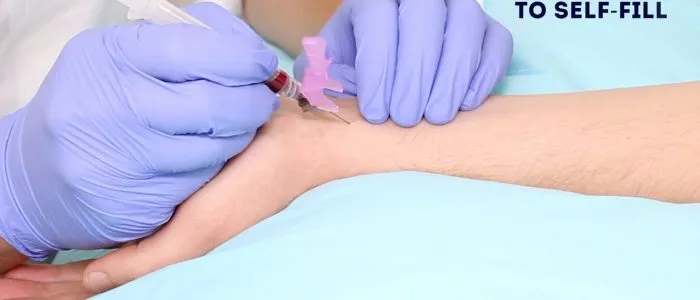
Appeared in: AIIMS Delhi NO - 2018
Explanation
- The image shows a needle inserted into the inner wrist, which is the location of the radial artery.
- The radial artery is the most common and preferred site for Arterial Blood Gas (ABG) sampling.
- ABG analysis is a crucial diagnostic tool used to evaluate a patient's gas exchange (oxygen and carbon dioxide levels) and acid-base balance (pH).
- This procedure is distinct from routine venous blood draws in terms of site, technique, and purpose.
Why Other Options Were Wrong
- Option B: Routine blood sampling is typically performed via venipuncture (accessing a vein), not an arterial puncture. The most common site is the median cubital vein in the antecubital fossa (the bend of the elbow).
- Option C: Cerebrospinal fluid (CSF) sampling is obtained through a lumbar puncture (spinal tap), a procedure where a needle is inserted into the spinal canal in the lower back.
- Option D: AST (Aspartate Aminotransferase) is a type of blood test, not a procedure site. The blood sample required for an AST test is collected via routine venipuncture, just like other common blood tests.
Related Visual

Clinical Relevance
- Nursing practice connection: This is primarily an exam-oriented knowledge point with limited direct bedside application, so retain Identification of the purpose of a medical procedure based on the anatomical puncture site as background academic context rather than a clinical decision trigger.
- A critical nursing responsibility before performing a radial artery puncture is to conduct the Allen's test. This assesses for patent collateral circulation from the ulnar artery, ensuring the hand will remain perfused if the radial artery is damaged during the procedure.
- After the sample is collected, the nurse must apply firm, direct pressure to the site for at least 5 minutes (or longer for patients on anticoagulants) to prevent hematoma formation and ensure hemostasis.
- What if? If the Allen's test is negative (indicating inadequate collateral flow), the nurse must not proceed with the puncture on that wrist. An alternative site, such as the contralateral wrist (if its Allen's test is positive) or the brachial artery, must be chosen.
How to Approach the Question
- First, carefully examine the image to identify the anatomical location of the puncture. The site is clearly the inner aspect of the wrist.
- Recall the major blood vessels in this area, primarily the radial artery.
- Consider the common procedures performed at this specific site. An arterial puncture at the radial artery is standard for ABG collection.
- Evaluate the given options. 'ABG sampling' directly corresponds to an arterial puncture at the wrist.
- Eliminate the other options by identifying their correct procedures or locations: routine sampling is venous, CSF sampling is lumbar, and AST testing is a lab test on a venous sample.
Concept Tested & Keywords
- Concept Tested: Identification of the purpose of a medical procedure based on the anatomical puncture site.
- Stem keywords: image, puncture site
- Lead-in keywords: what is... used for
- Clinical cues: Puncture at the inner wrist, consistent with the location of the radial artery.
Question ID
Q6OaHTULswrb2nqkK-F7L8
Reference Book
E6 Nursing Fundamentals Potter Perry 12e Part 5 p. 79-81
E6 textbook of Applied Biochemistry and Nutrition & DieteticsHarbans Lal (pp 26-464 of 479) p. 217-219
Practise the full AIIMS Delhi NO - 2018
Attempt every question from this paper in a timed mock, then review the full solution for each one.
More Gas Exchange and Respiratory Function Questions
- Which is the most relevant knowledge about oxygen administration to a client with COPD?
- Patient in emergency department diagnosed to have fluid and air present in lung. What is the above-mentioned condition known as?
- Patient is suffering from dyspnea. Which position will you provide for patient to relieve?
- Which of the following is not involved in chest physiotherapy?
- Respiration which is abnormally shallow for two or three breaths followed by irregular period of apnea is termed:
- Identify the following instrument which is used in diagnostic procedures:
- Identify the instrument shown in the following image:
- Identify the tube in the following image:
- A patient suddenly develops respiratory difficulties such as dyspnea, what is the first priority of the nursing officer?
- Which of the following method is used for high flow oxygen administration:
More AIIMS Delhi NO - 2018 Questions
- Another tentative diagnosis made for the client is Wernicke's Encephalopathy. If the client has this, the nurse anticipates that the first physician'…
- A 35-year-old man was in an automobile accident with an admitting diagnosis of a head injury. He has a Glasgow Coma Scale score of 4. Upon MRI and CT…
- A 28-year-old male client is admitted to the hospital for a suspected brain tumor. While assessing this client, the nurse would keep in mind that the…
- Following admission to the hospital, a diagnosis of increasing intracranial pressure was made. The nursing intervention appropriate in the care of th…
- The nurse has orders to administer phenytoin (Dilantin) 100 mg IV as an anticoagulant. The priority action while administering this drug is to:
- The client is to take lithium regularly after she is discharged from the hospital. The nursing care plan includes discharge planning. The most import…
- A patient is taking a proper diet as prescribed for bulimia nervosa, but the patient's weight is not gaining. Which nursing action is appropriate?
- Identify the size of the cannula shown here?& x20;
- Identify the following image? & x20;
- Identify the instrument below?& x20;