
NORCET 6 Prelims -2024
Medical & Surgical Nursing
Easy
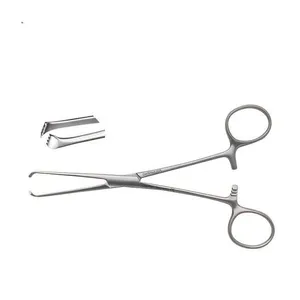
Identify this instrument:
Appeared in: NORCET 6 Prelims -2024
Explanation
- The instrument presented is an Allis forceps, a common tool in surgical settings.
- Its most distinct feature, clearly visible in the image, is the presence of short, sharp, interlocking teeth at the tips of the jaws.
- This specific design is intended for firmly grasping and holding dense or slippery tissues, such as fascia or breast tissue, during procedures.
- The instrument also includes finger rings for handling and a ratchet mechanism to lock the jaws in place, which allows the surgeon to maintain a grip on the tissue without continuous manual pressure.
Why Other Options Were Wrong
- Option B: Vulsellum forceps are characterized by one or more sharp, pointed hooks at the end of each jaw. The instrument in the image has a row of small teeth, not large hooks.
- Option C: Cheattle forceps are very long, heavy instruments without a locking mechanism. They are designed for transferring sterile items, not for grasping tissue.
- Option D: Kocher's forceps have a unique design with a single, large, transverse tooth at the tip of one jaw that interdigitates with grooves on the opposite jaw. This is different from the multiple small teeth of the Allis forceps.
Related Visual

Clinical Relevance
- Nursing practice connection: This is primarily an exam-oriented knowledge point with limited direct bedside application, so retain Surgical Instrument Identification as background academic context rather than a clinical decision trigger.
- Accurate identification of surgical instruments is a critical skill for scrub nurses and operating room technicians to ensure the smooth progression of a surgical procedure.
- Handing the surgeon the correct instrument promptly prevents delays and allows the surgeon to maintain focus on the patient.
- Using the wrong instrument can lead to patient harm. For example, using a traumatic forceps like a Kocher's on delicate tissue when an atraumatic one like a Babcock is needed can cause unnecessary tissue damage.
How to Approach the Question
- First, carefully observe the entire instrument shown in the image, paying special attention to its functional end—the jaws or tip.
- Identify the key characteristics: the shape of the jaws, the type of serrations or teeth, and the presence of a locking mechanism (ratchet) and finger rings.
- In this image, the defining feature is the row of small, sharp, interlocking teeth at the tip of the jaws.
- Mentally review the characteristics of the forceps listed in the options.
- Compare your observations with the definitions: Vulsellum has hooks, Cheattle is for sterile handling, and Kocher's has a single large tooth.
- Conclude that the instrument with multiple small, interlocking teeth for grasping tissue is an Allis forceps.
Concept Tested & Keywords
- Concept Tested: Surgical Instrument Identification
- Stem keywords: Identify, instrument
- Lead-in keywords: Identify
Question ID
Q9CRpN4Y8ChmWAr7qYto8g
Reference Book
E6 Nursing Brunner Adult Health 3SA Vol 1 Part 1 pp. 78-80, 79-81
Practise the full NORCET 6 Prelims -2024
Attempt every question from this paper in a timed mock, then review the full solution for each one.
More Perioperative Concepts and Nursing Management Questions
- The nurse is informed that a client with a large surgical incision is being transferred from the intensive care unit to the surgical unit. What medic…
- Why it is necessary to remove dark coloured nail paint before surgery?
- A patient planned for surgery advised to remove Jewellery because:
- Vicryl 3-0 is:
- All of the following are correct regarding stoma formation; EXCEPT:
- A surgeon is going to give a skin incision on patient. Which of the following is to be done?
- Following is the picture of sterile sponge used in emergency. It has a blue colour thread. What is the purpose of this colour thread?
- How many items are included in the WHO surgical safety checklist: SITOSO?
- In operation theater during cauterization, the electric current passing from a single electrode is called:
- Which position is given to a client by nursing officer, who has been brought from OT after craniotomy surgery?
More NORCET 6 Prelims -2024 Questions
- Normal compression to ventilation ratio:
- A 45-year-old patient presents with a severe head injury. Which of the following is a contraindication for the insertion of a nasopharyngeal airway i…
- A mechanically ventilated patient is placed on high-flow ventilation to manage acute respiratory distress. Suddenly, the patient's oxygen saturation…
- A patient presents to the emergency department with a serum pH of 7.25, pCO2 of 40 mmHg, HCO3 of 22 mEq/L, sodium of 150 mEq/L, and chloride of 100 m…
- A 75-year-old patient, intubated and mechanically ventilated, becomes acutely distressed during a routine suctioning procedure. The patient's oxygen…
- A 65-year-old patient is admitted to the hospital with a serum sodium level of 132 mmol/L. Despite being asymptomatic at admission, the patient begin…
- A 45-year-old patient undergoes a total thyroidectomy and is admitted to the post-anesthesia care unit (PACU) for monitoring. Shortly after arrival,…
- A patient presents to the emergency department with the following vital signs: blood pressure 120/66 mmHg, pulse rate 88 beats per minute, respirator…
- A 30-year-old patient presents to the emergency department with a body temperature of 104°F (40°C). The patient’s additional vital signs are as follo…
- During a routine assessment, you notice that a 60-year-old patient's radial pulse is weak and difficult to palpate. The patient's other vital signs a…