
NORCET 2 - 2021 (shift-1)
Medical & Surgical Nursing
Easy
Identify the number of the surgical blade denoted in the image. 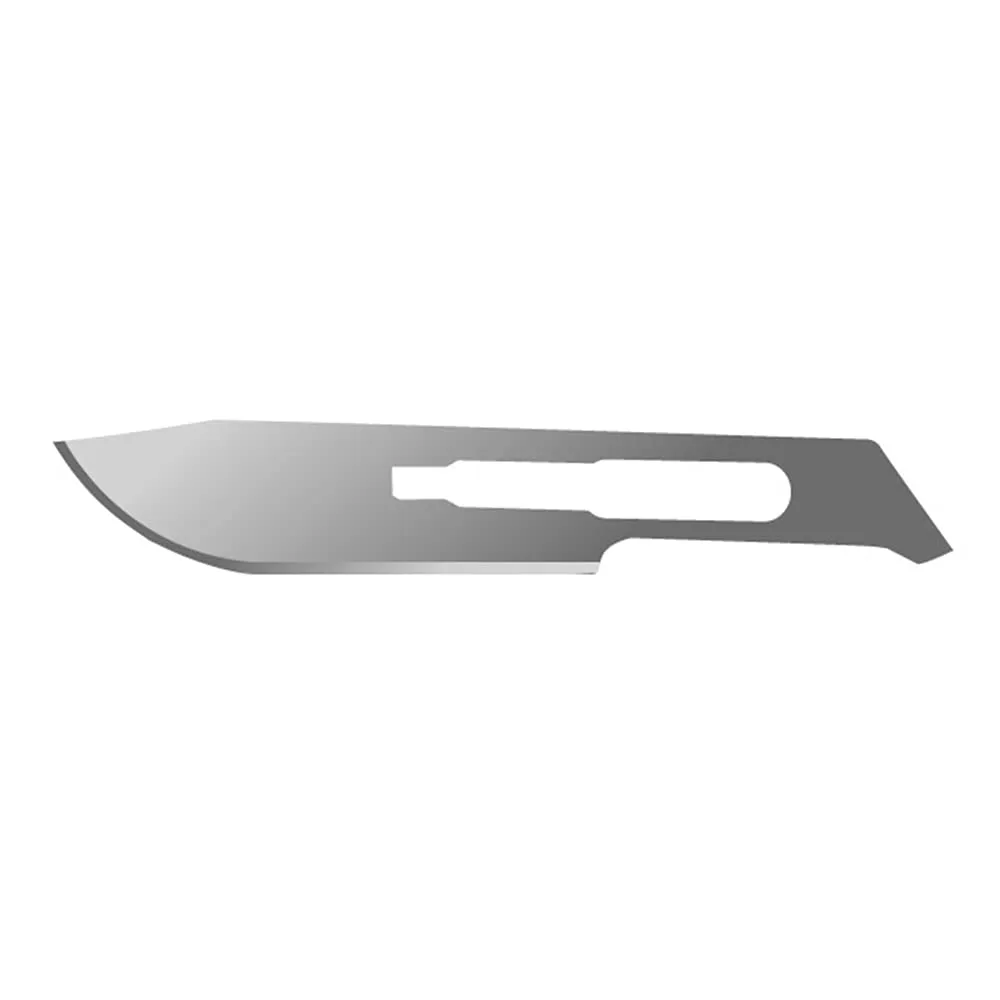
Appeared in: NORCET 2 - 2021 (shift-1)
Explanation
- The image displays a surgical blade with a large, leaf-like shape and a prominent, long, curved cutting edge.
- This morphology is characteristic of a No. 22 surgical blade.
- The No. 22 blade is designed for making long, sweeping incisions, particularly in skin and muscle, such as during a laparotomy.
- It fits onto a No. 4 series scalpel handle, which is used for larger blades.
Why Other Options Were Wrong
- Option A: A No. 11 blade has a long, triangular shape with a sharply pointed tip, resembling a spearhead. It does not have the large, curved belly seen in the image.
- Option B: A No. 15 blade is much smaller and has a short, rounded cutting edge. It is not large and leaf-shaped like the blade in the image.
- Option C: A No. 21 blade is similar in shape to a No. 22 blade but is generally smaller and has a less pronounced curve. The blade in the image has a very broad, prominent curve, making it a better match for a No. 22.
Related Visual

Clinical Relevance
- Nursing practice connection: This is primarily an exam-oriented knowledge point with limited direct bedside application, so retain Identification of surgical instruments, specifically surgical blades as background academic context rather than a clinical decision trigger.
- A nurse's ability to correctly identify surgical instruments is critical for anticipating the surgeon's needs, ensuring procedural efficiency, and maintaining patient safety.
- Proper blade handling, including mounting, removal, and disposal, is a fundamental aspect of sharps safety to prevent percutaneous injuries to the surgical team.
- The scrub nurse is responsible for counting all sharps, including scalpel blades, before, during, and at the end of a surgical procedure to prevent retained surgical items.
How to Approach the Question
- First, carefully examine the image of the surgical blade, paying close attention to its overall shape, size, and the curvature of the cutting edge.
- Note the key features: Is it large or small? Is the tip pointed or curved? Is the cutting edge long and curved (like a leaf) or short and straight?
- The blade in the image is large with a distinct, long, curved cutting edge (a prominent 'belly').
- Recall or look up the characteristics of the blades listed in the options.
- Compare your observations with the descriptions: A No. 11 is triangular/pointed, a No. 15 is small and curved, and a No. 21/22 are large and leaf-shaped.
- Differentiate between No. 21 and No. 22. The No. 22 is known for its particularly large, broad, leaf-like shape, which matches the image perfectly. This confirms it as the correct answer.
Concept Tested & Keywords
- Concept Tested: Identification of surgical instruments, specifically surgical blades.
- Stem keywords: surgical blade, identify, image
- Lead-in keywords: identify the number
Question ID
QLf-eW9YXvSfTsb3P0V6oZ
Reference Book
E6 Gynecology Williams p. 428-434
E6 Nursing Brunner Adult Health 3SA Vol 1 Part 1 p. 80-82
Practise the full NORCET 2 - 2021 (shift-1)
Attempt every question from this paper in a timed mock, then review the full solution for each one.
More Perioperative Concepts and Nursing Management Questions
- The nurse is informed that a client with a large surgical incision is being transferred from the intensive care unit to the surgical unit. What medic…
- Why it is necessary to remove dark coloured nail paint before surgery?
- A patient planned for surgery advised to remove Jewellery because:
- Vicryl 3-0 is:
- All of the following are correct regarding stoma formation; EXCEPT:
- A surgeon is going to give a skin incision on patient. Which of the following is to be done?
- Following is the picture of sterile sponge used in emergency. It has a blue colour thread. What is the purpose of this colour thread?
- How many items are included in the WHO surgical safety checklist: SITOSO?
- In operation theater during cauterization, the electric current passing from a single electrode is called:
- Which position is given to a client by nursing officer, who has been brought from OT after craniotomy surgery?
More NORCET 2 - 2021 (shift-1) Questions
- Which type of bandage used in ankle injury?
- A nurse knows that under the National Family Health Program, the duration of Copper T 380A is?
- Which diet should be avoided in acute renal failure disease?
- What was the first indigenous vaccine in India?
- Which bone is known as the breast bone?
- What is the most common type of episiotomy performed during labor?
- A child comes to the emergency room with acute bronchospasm after a bee sting. What is the most preferred route of adrenaline administration?
- What is the chemical name of Baking soda?
- Which solution is used in the COVID area for disinfection?
- A client is scheduled for a total gastrectomy. The on-duty nursing officer knows that after surgery, this client may be at risk for what condition?