
AIIMS Delhi NO - 2018
Medical & Surgical Nursing
Easy
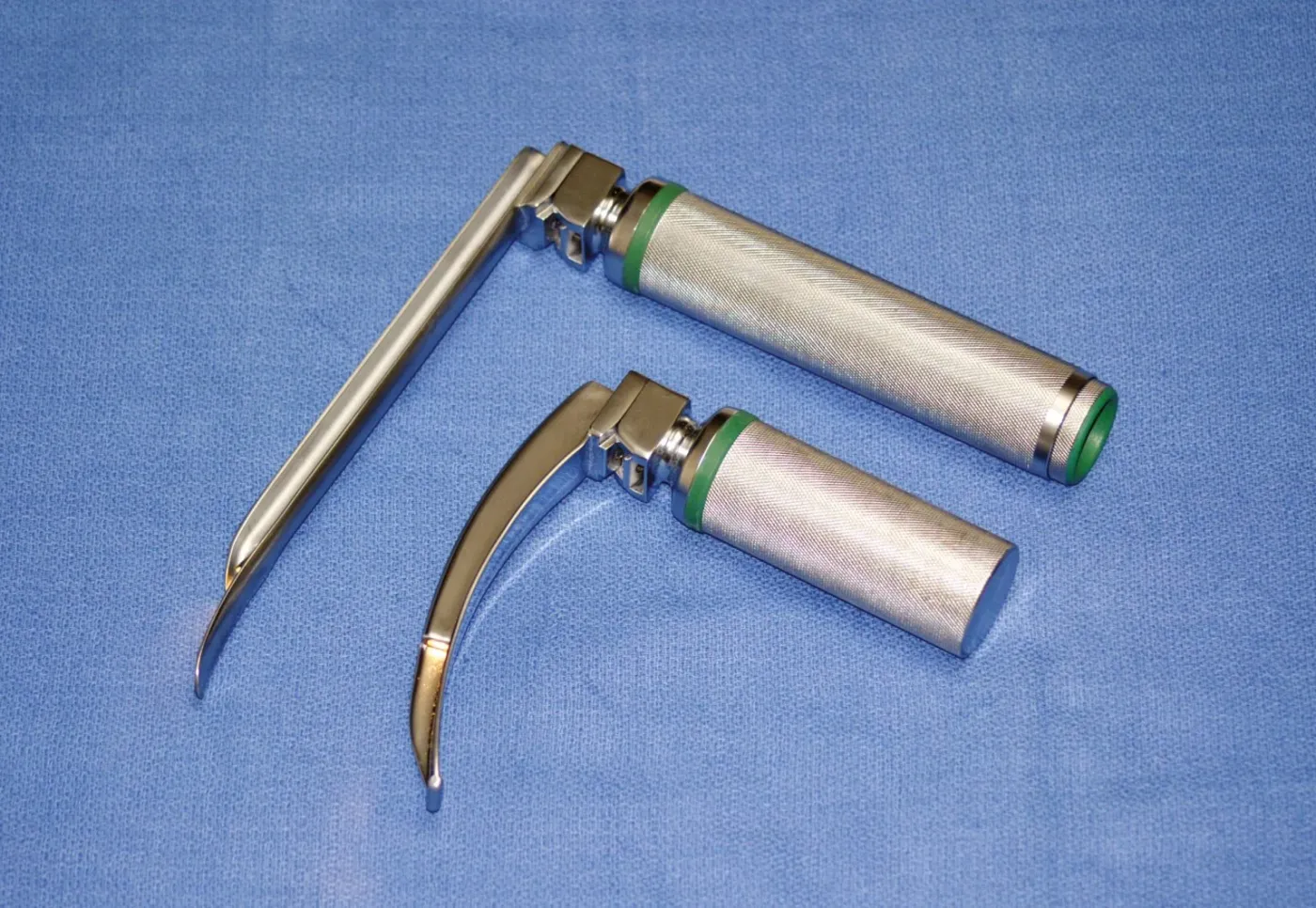
Identify the instrument shown in the picture below?
Appeared in: AIIMS Delhi NO - 2018
Explanation
- The instrument shown is a laryngoscope, used to visualize the larynx and facilitate endotracheal intubation.
- It consists of a handle (containing batteries) and a detachable blade with a light source at the tip.
- The image correctly displays two common types of blades: the curved Macintosh blade and the straight Miller blade.
- The primary function is to displace the tongue and soft tissues to get a clear view of the vocal cords before inserting an endotracheal tube.
Why Other Options Were Wrong
- Option A: A bronchoscope is a long, thin, flexible or rigid tube designed to be passed through the airway into the bronchi for visualization or procedures within the lungs. The instrument in the image is short, rigid, and designed for upper airway visualization only.
- Option C: A sigmoidoscope is an instrument used for examining the lower part of the large intestine (the sigmoid colon). It is used in gastroenterology and is structurally and functionally completely different from the airway instrument shown.
- Option D: A colonoscope is a very long, flexible instrument used to visualize the entire colon. Its length and flexibility are its key features, which are absent in the rigid, handheld instrument in the picture.
Related Visual

Clinical Relevance
- Nursing practice connection: This is primarily an exam-oriented knowledge point with limited direct bedside application, so retain Identification of common medical instruments used in airway management as background academic context rather than a clinical decision trigger.
- Nurses play a crucial role in airway management by ensuring all necessary equipment is ready and functional. Before an intubation, the nurse should check the laryngoscope light to ensure it is 'white, bright, and tight'.
- Assisting during intubation may involve tasks like applying cricoid pressure (Sellick's maneuver) to prevent aspiration and improve laryngeal view, or preparing suction to clear secretions.
- Patient safety is paramount. The nurse must monitor the patient's oxygen saturation and heart rate continuously during the intubation attempt and alert the provider if desaturation occurs.
How to Approach the Question
- First, carefully observe the instrument in the image. Note its distinct components: a handle and a blade attached at a right angle.
- Analyze the features of the components. The handle is for gripping, and the blades (one straight, one curved) have a specific shape designed for insertion into a body cavity.
- Consider the function implied by the instrument's design. The shape is optimized for navigating the anatomy of the mouth and throat to lift tissues and provide a clear view.
- Evaluate the given options based on your analysis. A 'laryngo-scope' is for viewing the larynx, a 'broncho-scope' for the bronchi, and 'sigmoido-'/'colo-' scopes for the colon. The instrument's shape is consistent with viewing the larynx.
- Eliminate the other options. Bronchoscopes and colonoscopes are much longer and more flexible to navigate deeper into the body, which does not match the instrument shown.
Concept Tested & Keywords
- Concept Tested: Identification of common medical instruments used in airway management.
- Stem keywords: instrument, picture, identify
- Lead-in keywords: Identify
Question ID
Q4rmjOiAthIp-eQm1rX8OP
Reference Book
E6 Nelson Textbook of Pediatrics(2024) — Volume 2 pp. 308-310, 309-311
Practise the full AIIMS Delhi NO - 2018
Attempt every question from this paper in a timed mock, then review the full solution for each one.
More Gas Exchange and Respiratory Function Questions
- Which is the most relevant knowledge about oxygen administration to a client with COPD?
- Patient in emergency department diagnosed to have fluid and air present in lung. What is the above-mentioned condition known as?
- Patient is suffering from dyspnea. Which position will you provide for patient to relieve?
- Which of the following is not involved in chest physiotherapy?
- Respiration which is abnormally shallow for two or three breaths followed by irregular period of apnea is termed:
- Identify the following instrument which is used in diagnostic procedures:
- Identify the instrument shown in the following image:
- Identify the tube in the following image:
- A patient suddenly develops respiratory difficulties such as dyspnea, what is the first priority of the nursing officer?
- Which of the following method is used for high flow oxygen administration:
More AIIMS Delhi NO - 2018 Questions
- Another tentative diagnosis made for the client is Wernicke's Encephalopathy. If the client has this, the nurse anticipates that the first physician'…
- A 35-year-old man was in an automobile accident with an admitting diagnosis of a head injury. He has a Glasgow Coma Scale score of 4. Upon MRI and CT…
- A 28-year-old male client is admitted to the hospital for a suspected brain tumor. While assessing this client, the nurse would keep in mind that the…
- Following admission to the hospital, a diagnosis of increasing intracranial pressure was made. The nursing intervention appropriate in the care of th…
- The nurse has orders to administer phenytoin (Dilantin) 100 mg IV as an anticoagulant. The priority action while administering this drug is to:
- The client is to take lithium regularly after she is discharged from the hospital. The nursing care plan includes discharge planning. The most import…
- A patient is taking a proper diet as prescribed for bulimia nervosa, but the patient's weight is not gaining. Which nursing action is appropriate?
- Identify the size of the cannula shown here?& x20;
- Identify the following image? & x20;
- Identify the instrument below?& x20;