
AIIMS Delhi NO - 2017
Obstetrics and Midwifery Nursing
Easy
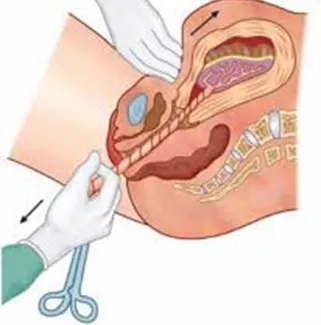
Identify the following procedure?
Appeared in: AIIMS Delhi NO - 2017
Explanation
- The image clearly shows the two key components of Controlled Cord Traction (CCT): one hand applying suprapubic counter-pressure to the uterus and the other hand applying gentle downward traction to the umbilical cord.
- This procedure is a standard part of the active management of the third stage of labor, performed after signs of placental separation are evident.
- The purpose of CCT is to facilitate the delivery of the placenta while preventing uterine inversion and minimizing blood loss.
- The upward pressure on the uterus (counter-traction) stabilizes it, preventing it from being pulled down into the vagina along with the placenta.
Why Other Options Were Wrong
- Option A: This describes the Credé maneuver, which involves squeezing or pushing down on the uterine fundus. The image shows upward counter-pressure, not downward fundal pressure.
- Option C: Fundal massage is performed after the placenta has been delivered to ensure the uterus contracts firmly and to prevent postpartum hemorrhage (PPH). The image shows the placenta is still in the process of being delivered.
- Option D: The primary goal of fundal massage is to stimulate uterine contractions to prevent hemorrhage, not for pain relief. While a well-contracted uterus might be less uncomfortable than an atonic one, pain management is not its main purpose.
Related Visual

Clinical Relevance
- Nursing practice connection: This is primarily an exam-oriented knowledge point with limited direct bedside application, so retain Management of the Third Stage of Labor as background academic context rather than a clinical decision trigger.
- Controlled Cord Traction is a critical skill for nurses and midwives to prevent postpartum hemorrhage (PPH), a leading cause of maternal death.
- A key nursing responsibility is to ensure that traction is only applied when the uterus is well-contracted (after a uterotonic is given) and signs of placental separation are present. Pulling on an unseparated placenta can cause uterine inversion, a life-threatening emergency.
- What if? If signs of placental separation (gush of blood, cord lengthening) are absent after 30 minutes despite a contracted uterus, the nurse should not continue traction. This is now a 'retained placenta,' and manual removal by a skilled provider under anesthesia may be required.
How to Approach the Question
- First, carefully analyze the image provided. Observe the actions being performed by both hands of the healthcare provider.
- Note the direction of the forces indicated by the arrows: one hand is pushing the uterus upward from above the pubic bone, while the other is pulling the umbilical cord downward.
- Read each option and compare the description with your visual analysis of the image.
- Option A describes fundal pressure, which is pushing down on the top of the uterus. This is the opposite of what is shown.
- Option B describes controlled cord traction with counter-pressure, which perfectly matches the actions in the image.
- Options C and D describe fundal massage, which is a different maneuver typically performed after the placenta is out. The image clearly shows the placenta is still being delivered.
Concept Tested & Keywords
- Concept Tested: Management of the Third Stage of Labor
- Stem keywords: procedure, placenta, delivery
- Lead-in keywords: Identify
- Clinical cues: Image shows one hand applying suprapubic pressure and the other pulling the umbilical cord.
Question ID
Qar-Mb4bSdvjnvuhdPX9U8
Reference Book
E6 Comprehensive Textbook of Community Health Nursing for BSc Nursing Students Part 2 — Subpart A (pp 1-275 of 550) p. 222-224
E6 Obstetrics Williams p. 55-74
Practise the full AIIMS Delhi NO - 2017
Attempt every question from this paper in a timed mock, then review the full solution for each one.
More Normal Labor Questions
- Which is a primary sign of labor?
- Which stage of labour starts from full dilatation of the cervix and ends with expulsion of the fetus from birth canal?
- Complete dilation of cervix to birth of a baby is staged as:
- Which is the ideal time for episiotomy? I. When perineum is bulged and thin, II. Just prior to crowning, III. During relaxation, IV. All of the above
- What is show?
- When the occipital prominence escapes under the symphysis pubis and the head no longer recedes between uterine contractions, it is called?
- What is the average duration of the first stage of labour in primigravidae?
- What is the term for when the baby's head becomes fully visible at the vaginal opening, often with an intense burning or stinging sensation as the ba…
- During assessment, a midwife observes a blood-tinged mucus discharge, known as the 'show,' in a pregnant woman. What is the significance of this find…
- Eutocia means:
More AIIMS Delhi NO - 2017 Questions
- Which is a live attenuated vaccine?
- The injection haloperidol is given intramuscularly by which technique?
- One of the most initial things that should be done by a nurse while going to a home visit?
- Most common type of shock in a trauma patient?
- Most common cause of hypotension in trauma patients?
- CSF draining from the nose and ear occurs in which type of skull fracture?
- Allen test should be performed before?
- See the following image and identify this?& x20;
- Identify the appropriate action based on the Vaccine Vial Monitor (VVM) shown in the image.
- Identify the following image?