
NORCET 2 - 2021 (shift-1)
Medical & Surgical Nursing
Medium
Identify the following instrument that denote in image?
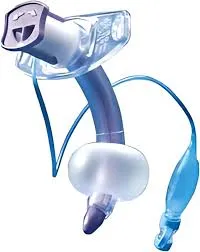
Appeared in: NORCET 2 - 2021 (shift-1)
Explanation
- The instrument in the image is a Tracheostomy tube, identified by its characteristic features designed for insertion into a surgical airway (stoma) in the neck.
- The presence of a flange (neck plate) is a key differentiator. This part rests on the patient's neck and is used to secure the tube with ties.
- The tube has a short, curved cannula, which is distinct from the longer, more flexible endotracheal tube.
- An inflatable cuff is visible around the distal end, and its corresponding pilot balloon is also present. This indicates it is a cuffed tube used to seal the airway for ventilation and prevent aspiration.
Why Other Options Were Wrong
- Option A: An Endotracheal (ET) tube is much longer and is inserted through the mouth or nose, passing through the vocal cords. It does not have a large neck flange like the device shown.
- Option C: A Laryngeal Mask Airway (LMA) is a supraglottic airway device. It features a large, soft, inflatable mask at the distal end that seals around the larynx, but it does not enter the trachea itself.
- Option D: A Guedel tube, or oropharyngeal airway, is a simple, uncuffed, rigid plastic device designed to keep the tongue from obstructing the pharynx. It lacks a cuff, pilot balloon, and flange.
Related Visual

Clinical Relevance
- Nursing practice connection: This is primarily an exam-oriented knowledge point with limited direct bedside application, so retain Identification of Airway Management Devices as background academic context rather than a clinical decision trigger.
- A cuffed tracheostomy tube is essential for patients requiring mechanical ventilation as it seals the airway, ensuring delivered breaths go to the lungs and preventing aspiration of oral or gastric secretions.
- Nurses must monitor the cuff pressure regularly (typically every 8 hours) to keep it within a safe range (usually 20-30 cm H2O) to prevent tracheal wall injury, such as ischemia, necrosis, or tracheoesophageal fistula.
- What if the pilot balloon was cut or damaged? The cuff would deflate, leading to an air leak, loss of ventilation, and increased aspiration risk. The entire tracheostomy tube would need to be replaced immediately.
How to Approach the Question
- First, carefully observe the image provided, paying close attention to the key features of the medical device.
- Identify the main components: What is its shape? Does it have a cuff, a flange, or any connectors? In this case, note the neck plate, curved tube, and pilot balloon.
- Systematically evaluate each option against your visual analysis.
- Option A (ET Tube): Recall that ET tubes are long and lack a neck flange. This doesn't match.
- Option B (Tracheostomy tube): Recall that these have a neck flange, a short curve, and often a cuff. This matches the image perfectly.
- Option C (LMA): Recall that LMAs have a large mask at the end. This doesn't match.
Concept Tested & Keywords
- Concept Tested: Identification of Airway Management Devices
- Stem keywords: instrument, image, identify
- Lead-in keywords: Identify
Question ID
QEe_6YbpQeGlJhfg3o_JzU
Reference Book
E6 Nursing Fundamentals Taylor p. 736-738
E6 Nursing Brunner Adult Health 3SA Vol 2 Part 3 p. 115-117
Practise the full NORCET 2 - 2021 (shift-1)
Attempt every question from this paper in a timed mock, then review the full solution for each one.
More Gas Exchange and Respiratory Function Questions
- Which is the most relevant knowledge about oxygen administration to a client with COPD?
- Patient in emergency department diagnosed to have fluid and air present in lung. What is the above-mentioned condition known as?
- Patient is suffering from dyspnea. Which position will you provide for patient to relieve?
- Which of the following is not involved in chest physiotherapy?
- Respiration which is abnormally shallow for two or three breaths followed by irregular period of apnea is termed:
- Identify the following instrument which is used in diagnostic procedures:
- Identify the instrument shown in the following image:
- Identify the tube in the following image:
- A patient suddenly develops respiratory difficulties such as dyspnea, what is the first priority of the nursing officer?
- Which of the following method is used for high flow oxygen administration:
More NORCET 2 - 2021 (shift-1) Questions
- Which type of bandage used in ankle injury?
- A nurse knows that under the National Family Health Program, the duration of Copper T 380A is?
- Which diet should be avoided in acute renal failure disease?
- What was the first indigenous vaccine in India?
- Which bone is known as the breast bone?
- What is the most common type of episiotomy performed during labor?
- A child comes to the emergency room with acute bronchospasm after a bee sting. What is the most preferred route of adrenaline administration?
- What is the chemical name of Baking soda?
- Which solution is used in the COVID area for disinfection?
- A client is scheduled for a total gastrectomy. The on-duty nursing officer knows that after surgery, this client may be at risk for what condition?