
NORCET-7 Mains-2024
Obstetrics & Gynaecology
Medium
Identify the following image? 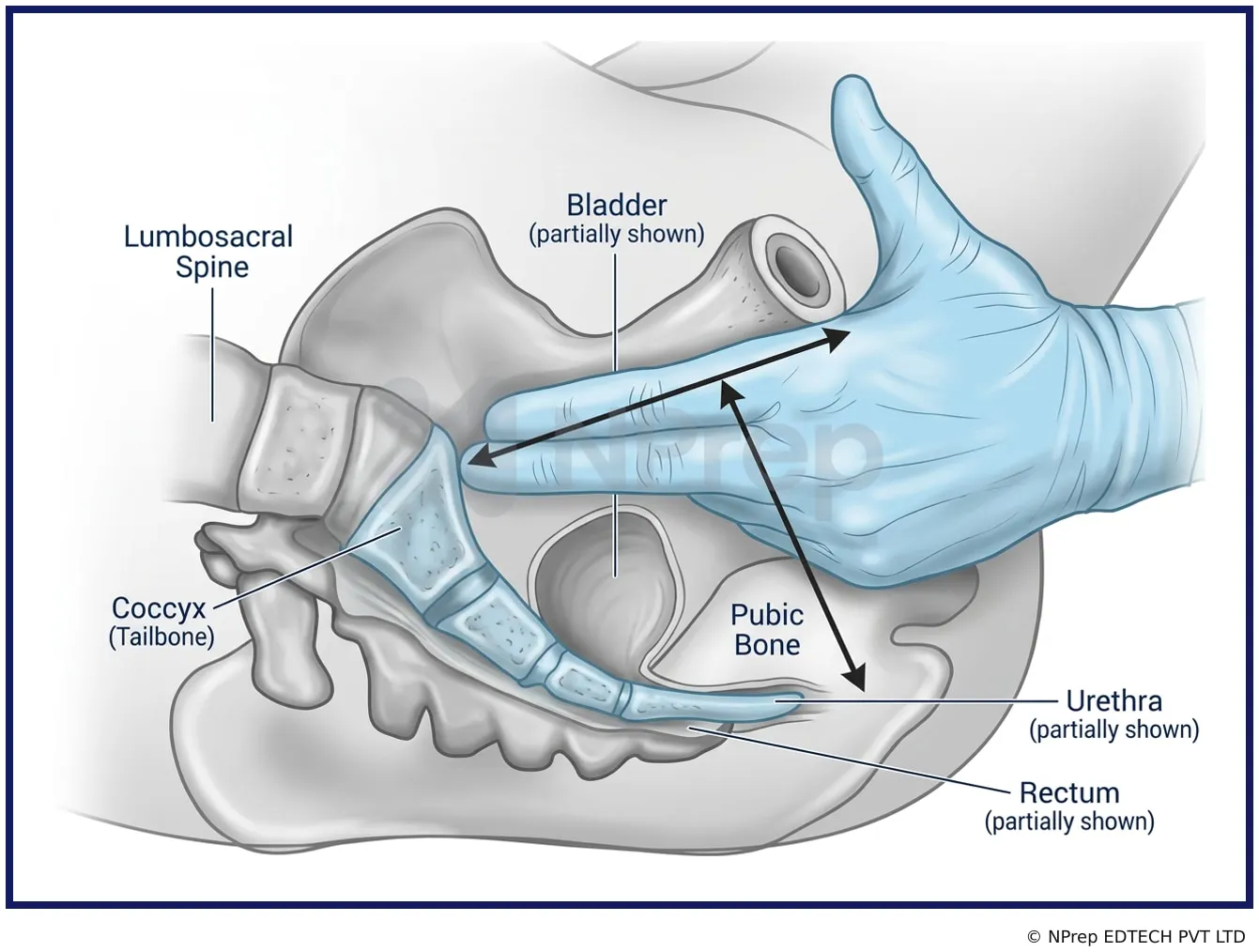
Appeared in: NORCET-7 Mains-2024
Explanation
- The image clearly illustrates a manual vaginal examination where the examiner's fingers are measuring the distance between two specific anatomical landmarks.
- The measurement is taken from the lower border of the symphysis pubis to the sacral promontory.
- This specific measurement is the definition of the diagonal conjugate.
- The diagonal conjugate is clinically significant because it is the only anteroposterior (AP) diameter of the pelvic inlet that can be physically measured by an examiner.
Why Other Options Were Wrong
- Option B: The true conjugate is measured from the upper border of the symphysis pubis to the sacral promontory. This measurement cannot be performed clinically because the upper border of the symphysis pubis is not accessible during a vaginal exam.
- Option C: The obstetric conjugate is the shortest AP diameter, measured from the posterior surface of the symphysis pubis to the sacral promontory. It cannot be measured directly but is estimated by subtracting 1.5-2 cm from the diagonal conjugate.
- Option D: The term 'False conjugate' is not a standard anatomical or obstetrical term for a pelvic diameter. The pelvis is divided into a 'false pelvis' (the part above the pelvic brim) and a 'true pelvis' (the part below the brim), but there is no measurement called the false conjugate.
Related Visual

- Visual 1: Diagram - A sagittal view of the female pelvis clearly labeling the three anteroposterior diameters (True, Obstetric, and Diagonal) with distinct lines to show their different start and end points relative to the symphysis pubis and sacral promontory. This helps differentiate them visually.
- Visual 2: Animation - A short animation showing the steps of performing a clinical pelvimetry to measure the diagonal conjugate, followed by the calculation to estimate the obstetric conjugate.
Clinical Relevance
- Nursing practice connection: This is primarily an exam-oriented knowledge point with limited direct bedside application, so retain Anteroposterior diameters of the female pelvis as background academic context rather than a clinical decision trigger.
- Measuring the diagonal conjugate is a fundamental skill in clinical pelvimetry, used to assess the adequacy of the maternal pelvis for vaginal delivery.
- An adequate pelvic inlet is crucial for the engagement of the fetal head. An estimated obstetric conjugate of less than 10 cm may indicate cephalopelvic disproportion (CPD), a potential complication of labor.
- During the examination, if the examiner's fingers cannot reach the sacral promontory, it is generally considered a sign of an adequate pelvis, as the diagonal conjugate is sufficiently long.
How to Approach the Question
- First, carefully analyze the image to identify the procedure being performed and the anatomical landmarks involved. Notice the sagittal view of the pelvis and the placement of the examiner's gloved hand.
- Identify the start and end points of the measurement indicated by the arrow. The arrow starts at the lower border of the pubic bone (symphysis pubis) and ends at the prominent anterior edge of the sacrum (sacral promontory).
- Recall the definitions of the different anteroposterior (AP) diameters of the pelvic inlet: Diagonal, True, and Obstetric conjugates.
- Compare the measurement shown in the image with the definitions. The image depicts the measurement from the lower border of the symphysis pubis to the sacral promontory.
- This matches the definition of the Diagonal Conjugate. Recognize that this is the only one of the three AP diameters that can be measured clinically via a vaginal exam.
- Eliminate the other options based on their definitions: True conjugate (from the upper border) and Obstetric conjugate (from the posterior surface) are not directly measurable clinically. 'False conjugate' is not a standard term.
Concept Tested & Keywords
- Concept Tested: Anteroposterior diameters of the female pelvis
- Stem keywords: Identify the image, pelvic measurement, vaginal examination
- Lead-in keywords: Identify
- Clinical cues: The image shows a manual examination, which is a key clue that the measurement must be one that is clinically obtainable.
Question ID
Qc_CIk5uqBNSKAuHGhIy0m
Practise the full NORCET-7 Mains-2024
Attempt every question from this paper in a timed mock, then review the full solution for each one.
More Fetal Skull and Maternal Pelvis Questions
- What type of pelvis is good for child bearing?
- The smallest diameter of the true pelvis is?
- A client is admitted to the labor unit. On vaginal examination, the presenting part in a cephalic presentation was at station plus two. Station +2 me…
- The type of pelvis most suited for delivery is?
- Incidence of gynecoid pelvis in females is about?
- Identify the conjugate denoted in the image?& x20;
- Which of the following is a heart-shaped pelvis?
- A nurse is assessing the fetal position of a pregnant woman in labor. The fetal heart tones are best heard in the left lower quadrant of the abdomen.…
- The relation between the fetal presenting part and maternal pelvis is known as?
- Identify the conjugate measured in the picture?& x20;
More NORCET-7 Mains-2024 Questions
- What is the correct statement regarding pre-oxygenation in children before intubation?
- A pregnant woman is ready for caesarean section and transferred to labor room. Which is the best position for the woman during caesarean section?
- A woman comes in labor room with 3 cm cervical dilation, 80% effacement and energetic and excited. The women in which phase of labor?
- The ambient temperature of the labor room should maintain?
- The recommended dose of iron and folic acid for adolescent girls under Weekly Iron & Folic Acid Supplementation (WIFS) program?
- A 14-week Rh-negative pregnant woman presents with mild vaginal bleeding and abdominal pain. Ultrasound shows a viable intrauterine pregnancy. Her hu…
- A new newborn care unit is inaugurated in the hospital. The child health nurse known about iKMC. What mean I in iKMC?
- A nurse teaching to a woman regarding breast feeding. Which statement is incorrect about breast feeding?
- Swenson and Duhamel procedure used to correction of?
- Cohort study also known as?