
NORCET 2 - 2021 (shift-1)
Medical & Surgical Nursing
Easy
Identify the following denoted image.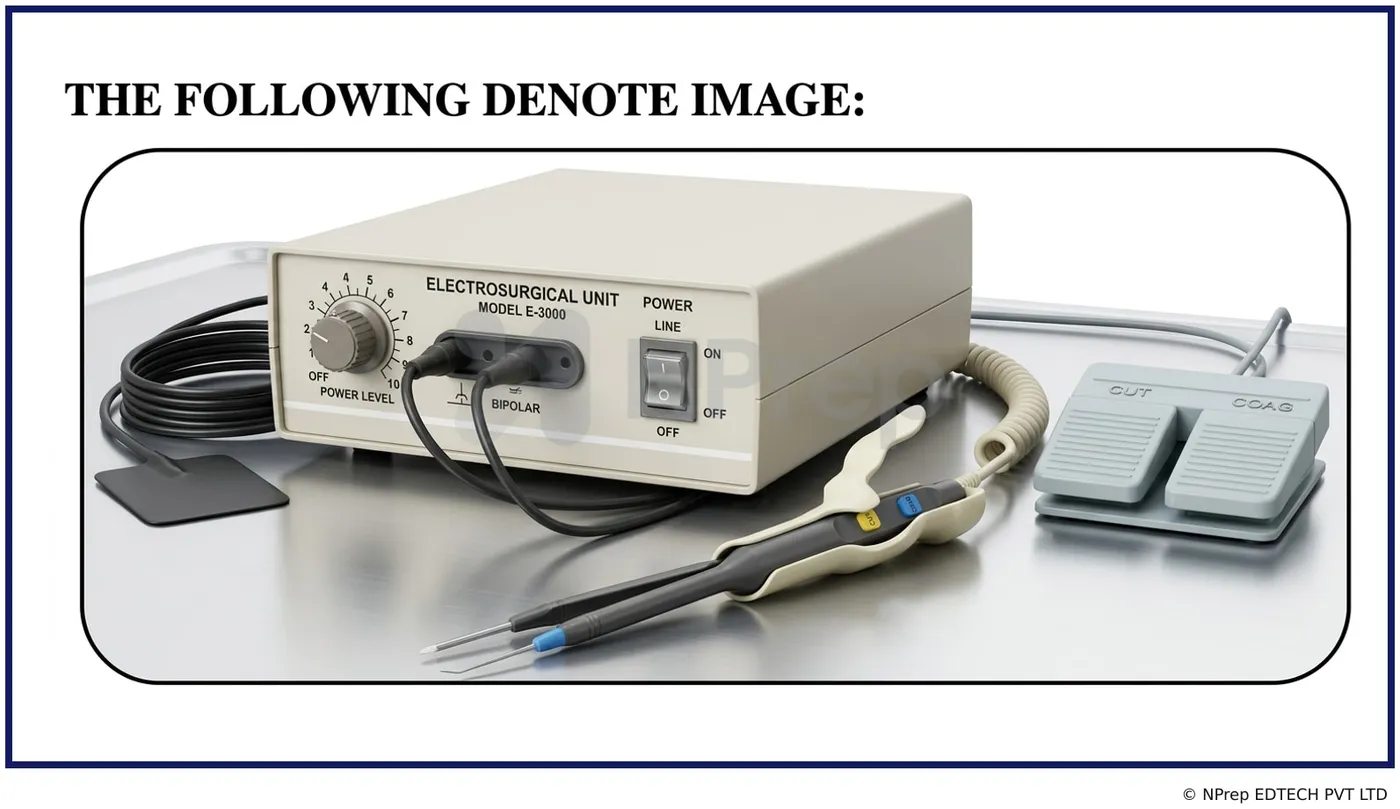
Appeared in: NORCET 2 - 2021 (shift-1)
Explanation
- The image displays an electrosurgical unit (ESU) with a connected instrument.
- The instrument is a tweezer-like forceps, which is characteristic of bipolar cautery.
- The port on the ESU where the instrument is connected is explicitly labeled "BIPOLAR".
- In bipolar cautery, the electrical current is confined between the two tips of the forceps, allowing for precise hemostasis with minimal damage to adjacent tissues.
Why Other Options Were Wrong
- Option B: Monopolar cautery uses a pencil-like instrument with a single active electrode and requires a separate patient return electrode (grounding pad) for the circuit to be completed through the patient's body. The instrument shown is a two-tipped forceps.
- Option C: LigaSure is a specific brand of advanced bipolar vessel-sealing device. Its handpiece typically resembles a larger clamp or scissors, designed to seal larger blood vessels, which looks different from the fine-tipped forceps shown.
- Option D: An Automated External Defibrillator (AED) is a device used to treat life-threatening cardiac arrhythmias. It consists of a portable box and two large chest pads and looks completely different from the surgical equipment shown.
Related Visual

Clinical Relevance
- Nursing practice connection: This is primarily an exam-oriented knowledge point with limited direct bedside application, so retain Identification of Surgical Instruments as background academic context rather than a clinical decision trigger.
- Nurses must be able to differentiate between monopolar and bipolar cautery to ensure patient safety. For monopolar cautery, correct placement of the grounding pad is critical to prevent patient burns.
- Bipolar cautery is preferred for procedures near delicate structures like nerves or in patients with pacemakers, as the electrical current is contained and does not pass through the patient's body.
- What if? If the patient had a cardiac pacemaker, using monopolar cautery could interfere with the device's function. In this case, using bipolar cautery would be the safer and mandatory choice to prevent adverse cardiac events.
How to Approach the Question
- First, carefully examine the entire image, including all components and any text or labels visible.
- Identify the main components: a generator box (ESU), a hand-held instrument, and a foot pedal.
- Look for specific labels on the equipment. In this image, the generator is clearly labeled "ELECTROSURGICAL UNIT" and has a port marked "BIPOLAR".
- Analyze the shape and features of the instrument itself. It is a tweezer-like forceps with two tips, which is the classic design for bipolar cautery.
- Compare these observed features with the definitions of the options provided.
- Conclude that the combination of the bipolar forceps and the 'BIPOLAR' label on the ESU definitively identifies the device as a bipolar cautery system.
Concept Tested & Keywords
- Concept Tested: Identification of Surgical Instruments
- Stem keywords: Identify, denoted image, Electrosurgical unit
- Lead-in keywords: Identify
- Clinical cues: Image shows an electrosurgical unit labeled 'BIPOLAR'
- Clinical cues: Tweezer-like instrument connected to the bipolar port
Question ID
QuV3E92P6XKx4b1t_y4fsv
Reference Book
E6 Gynecology Williams pp. 28-53, 1-11
Practise the full NORCET 2 - 2021 (shift-1)
Attempt every question from this paper in a timed mock, then review the full solution for each one.
More Perioperative Concepts and Nursing Management Questions
- The nurse is informed that a client with a large surgical incision is being transferred from the intensive care unit to the surgical unit. What medic…
- Why it is necessary to remove dark coloured nail paint before surgery?
- A patient planned for surgery advised to remove Jewellery because:
- Vicryl 3-0 is:
- All of the following are correct regarding stoma formation; EXCEPT:
- A surgeon is going to give a skin incision on patient. Which of the following is to be done?
- Following is the picture of sterile sponge used in emergency. It has a blue colour thread. What is the purpose of this colour thread?
- How many items are included in the WHO surgical safety checklist: SITOSO?
- In operation theater during cauterization, the electric current passing from a single electrode is called:
- Which position is given to a client by nursing officer, who has been brought from OT after craniotomy surgery?
More NORCET 2 - 2021 (shift-1) Questions
- Which type of bandage used in ankle injury?
- A nurse knows that under the National Family Health Program, the duration of Copper T 380A is?
- Which diet should be avoided in acute renal failure disease?
- What was the first indigenous vaccine in India?
- Which bone is known as the breast bone?
- What is the most common type of episiotomy performed during labor?
- A child comes to the emergency room with acute bronchospasm after a bee sting. What is the most preferred route of adrenaline administration?
- What is the chemical name of Baking soda?
- Which solution is used in the COVID area for disinfection?
- A client is scheduled for a total gastrectomy. The on-duty nursing officer knows that after surgery, this client may be at risk for what condition?