
NORCET 2 -2021 (Shift-2)
Pathology & Genetics
Hard
Identify the disorder shown in this pedigree chart?
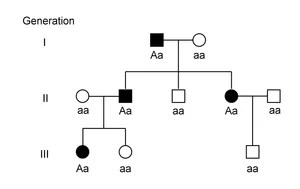
Appeared in: NORCET 2 -2021 (Shift-2)
Explanation
- The pedigree shows a vertical transmission pattern, with the disorder appearing in all three generations (I, II, and III), which is characteristic of dominant inheritance.
- Both males and females are affected, indicating the gene is likely on an autosome rather than a sex chromosome.
- There is clear male-to-male transmission from the father in Generation I to his son in Generation II. This definitively rules out any form of X-linked inheritance.
- Affected individuals (genotype Aa) have a 50% chance of passing the trait to their children when mating with an unaffected partner (genotype aa), which is consistent with the offspring ratios seen in the chart.
- Unaffected individuals (genotype aa) do not pass the trait to their offspring, as seen throughout the pedigree.
Why Other Options Were Wrong
- Option B: Autosomal recessive disorders typically skip generations, as affected individuals (aa) are often born to unaffected carrier parents (Aa). This pedigree shows the trait in every generation.
- Option C: X-linked recessive inheritance is ruled out because there is male-to-male transmission (Generation I to II). Also, affected females are present, which is less common in X-linked recessive traits.
- Option D: X-linked dominant inheritance is definitively ruled out by the presence of male-to-male transmission. A father passes his Y chromosome to his son, so he cannot pass an X-linked trait to him.
Related Visual

- Visual 1: Diagram - A comparative flowchart showing the key decision points for analyzing a pedigree: 1. Does it skip generations? (Dominant vs. Recessive). 2. Are males/females affected differently? (Autosomal vs. X-linked). 3. Is there male-to-male transmission? (Rules out X-linked).
- Visual 2: Infographic - Four mini-pedigree charts, each illustrating a classic example of Autosomal Dominant, Autosomal Recessive, X-linked Dominant, and X-linked Recessive inheritance for easy comparison.
Clinical Relevance
- Nursing practice connection: Use the key finding related to Pedigree analysis and identification of Mendelian inheritance patterns to guide bedside assessment, documentation, and the next nursing action.
- Understanding pedigree analysis is a fundamental skill for nurses in genetic counseling, risk assessment, and patient education.
- By identifying the mode of inheritance, nurses can help families understand their risk of passing on a genetic condition and make informed decisions about family planning and genetic testing.
- Examples of autosomal dominant disorders include Huntington's disease, Marfan syndrome, and neurofibromatosis type 1.
How to Approach the Question
- Step 1: Examine the pedigree to see if the trait appears in every generation. If it does, it is likely a dominant trait. If it skips generations, it is likely recessive.
- Step 2: Observe if both males and females are affected. If they are affected in roughly equal numbers, the trait is likely autosomal. If it affects one sex significantly more than the other, consider X-linked inheritance.
- Step 3: Specifically look for male-to-male transmission (an affected father passing the trait to his son). If present, this definitively rules out X-linked inheritance and strongly suggests autosomal inheritance.
- Step 4: Check if affected parents have unaffected children. In dominant inheritance, if an affected parent is heterozygous (like 'Aa' here), they can have unaffected ('aa') children.
- Step 5: Synthesize these clues. The presence of the trait in every generation plus male-to-male transmission points directly to an autosomal dominant pattern.
Concept Tested & Keywords
- Concept Tested: Pedigree analysis and identification of Mendelian inheritance patterns.
- Stem keywords: pedigree chart, disorder, generation, inheritance
- Lead-in keywords: Identify
- Clinical cues: Trait appears in every generation
- Clinical cues: Male-to-male transmission is present
Question ID
Q4vHCEAihdgNNp5KxdvWOm
Practise the full NORCET 2 -2021 (Shift-2)
Attempt every question from this paper in a timed mock, then review the full solution for each one.
More Genetics Questions
- Eugenics means:
- The genetic material, deoxyribonucleic acid (DNA) is contained in:
- Which is the mode of inheritance of cystic fibrosis?
- Karyotype of Klinefelter syndrome is?
- Same allele group also called as?
- Haemophilia is associated with?
- Eugenics means?
- Which causes Klinefelter syndrome?
- Down syndrome is also known as?
- Who introduced the principle of inheritance?
More NORCET 2 -2021 (Shift-2) Questions
- Preferred route of tranexamic acid drug administration is?
- Parts of the fallopian tube, except?
- After thyroidectomy the patient complains for hoarseness of voice that occurs due to injury in?
- Highest source of vitamin-C?
- After the RTA, a patient was brought to the emergency department. After Massive blood transfusion, which electrolyte imbalance occurs in the patient?
- A patient suffering from shock is receiving normal saline (NS). What is the normal osmolarity of Na\ in NS?
- A patient is unconscious nurse is going to take the sterile urine sample for culture from the urinary catheter. What technique is to be used by the n…
- Covid face shield is sterilized by?
- Which reflex should check when death of the brain stem occurs, except?
- Which is an example of a tocolytic agent?