
WCL Staff Nurse - 2019
Medical & Surgical Nursing
Easy
During CPR the correct hand placement over the chest for chest compressions? 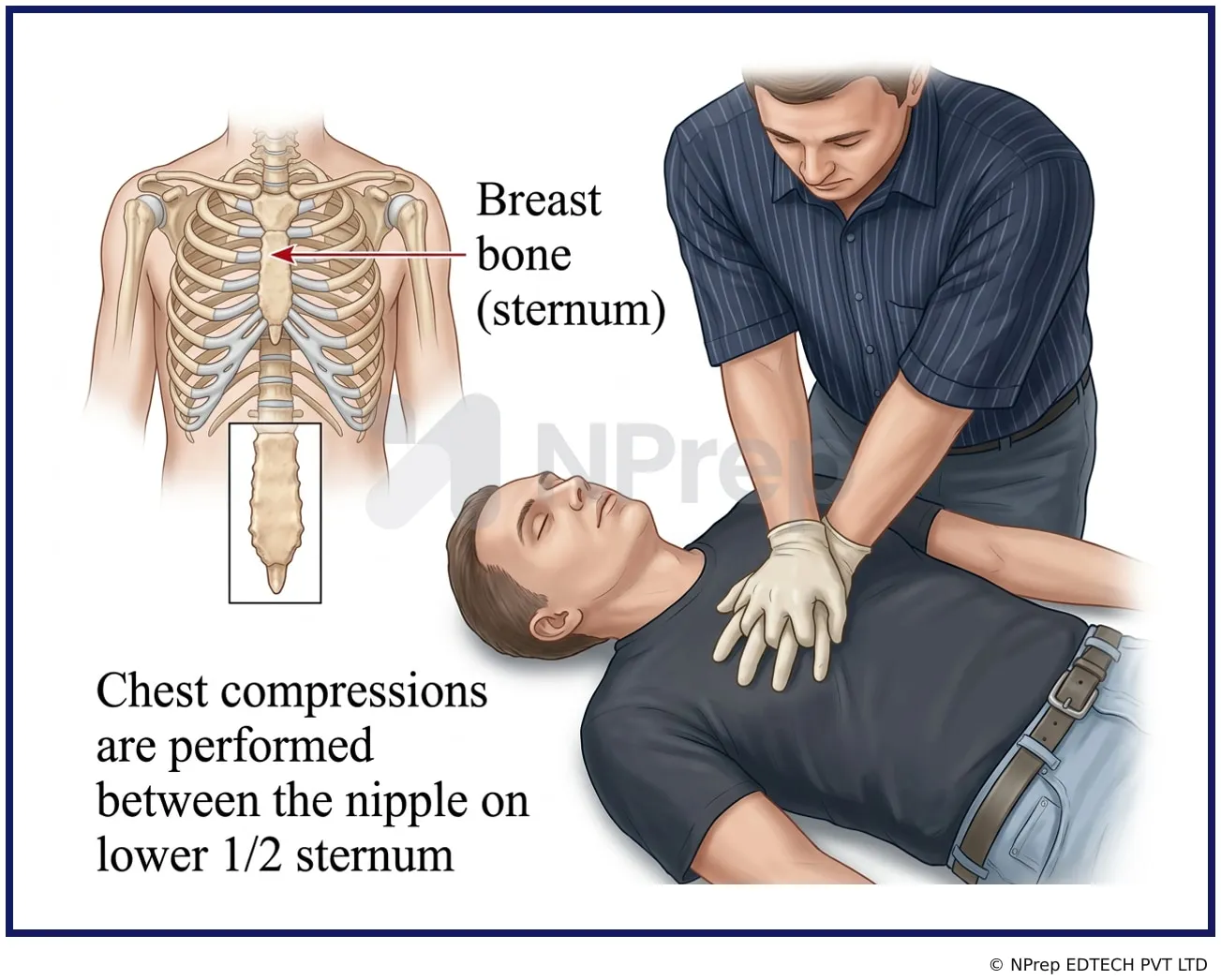
Appeared in: WCL Staff Nurse - 2019
Explanation
- The correct hand placement for chest compressions in an adult is the center of the chest, over the lower half of the sternum.
- This position is anatomically ideal because it allows the rescuer to compress the heart between the sternum and the spine, which is necessary to circulate oxygenated blood.
- Placing hands on the lower half of the sternum avoids the fragile xiphoid process at the bottom and the less effective compression area at the top.
- As shown in the image, this landmark is typically found between the nipples.
Why Other Options Were Wrong
- Option A: Compressing on the upper half of the sternum is ineffective. The force is not transmitted efficiently to the heart's ventricles, leading to poor blood circulation.
- Option B: Similar to the upper half, the upper third of the sternum is too high. Compressions in this area will not adequately compress the heart to generate sufficient cardiac output.
- Option D: This location is incorrect and dangerous. The lower third of the sternum includes the xiphoid process. Pressure on the xiphoid can cause it to fracture and lacerate the liver or spleen, leading to life-threatening internal bleeding.
Related Visual

Clinical Relevance
- Nursing practice connection: This is primarily an exam-oriented knowledge point with limited direct bedside application, so retain Cardiopulmonary Resuscitation (CPR) Technique as background academic context rather than a clinical decision trigger.
- Correct hand placement is a fundamental, life-saving skill in Basic Life Support (BLS). Improper placement can render CPR ineffective or cause severe iatrogenic injury.
- Nurses must be able to rapidly and accurately identify this landmark in an emergency to initiate high-quality CPR without delay.
- During resuscitation, team members may provide feedback on hand placement to ensure CPR quality is maintained.
How to Approach the Question
- First, identify that the question is asking for a specific, critical detail of a medical procedure: hand placement for CPR.
- Recall the anatomical structures of the chest, including the sternum, ribs, heart, and underlying organs like the liver.
- The goal of CPR is to compress the heart. Visualize where the heart is located relative to the sternum (centrally, under the middle to lower part).
- Evaluate each option based on effectiveness and safety.
- Eliminate the upper portions of the sternum as they are not directly over the heart's main chambers, making them ineffective.
- Eliminate the lowest portion (lower third) because it includes the xiphoid process, and compressing it is known to be dangerous.
Concept Tested & Keywords
- Concept Tested: Cardiopulmonary Resuscitation (CPR) Technique
- Stem keywords: CPR, chest compressions, hand placement, sternum
- Lead-in keywords: correct
- Clinical cues: The image provided visually confirms the correct hand placement on the lower half of the sternum.
Question ID
QbVdfaEa1YyKEjfV98Axht
Reference Book
E6 Ghai Essential Pediatrics(pp 26-904 of 913) p. 763-765
E6 Nelson Textbook of Pediatrics(2024) — Volume 1 p. 610-612
Practise the full WCL Staff Nurse - 2019
Attempt every question from this paper in a timed mock, then review the full solution for each one.
More Other Acute Problems Questions
- Identify the following image:
- A patient presents to the emergency department with the following vital signs: blood pressure 120/66 mmHg, pulse rate 88 beats per minute, respirator…
- A 30-year-old patient presents to the emergency department with a body temperature of 104°F (40°C). The patient’s additional vital signs are as follo…
- A patient was in an automobile accident, and sustained a head injury. Following admission to the hospital, a diagnosis of increasing ICP was made. Th…
- A patient was in an automobile accident and sustained a head injury following admission to the hospital a diagnosis of increased ICP was made. Which…
- What is the first step to take if someone has a convulsion? (Choose the most appropriate option from below)
- A patient admitted in the emergency is having tachypnoea with a respiratory rate of 28 breaths per minute. The likely diagnosis is:
- An example of an Open Drainage system used in surgical wounds is:
- You observe that a patient of head injury opens his eyes on painful stimuli but not on command; he localizes the site of the painful stimulus; and mu…
- An emergency room nurse is assessing a 22-year-old male who has been using opioids. What symptoms indicate that the client has overdose?
More WCL Staff Nurse - 2019 Questions
- Colour coding for nitrous oxide cylinder is?
- Tonicity of Ringer Lactate is?
- Sharp instruments should not be sterilized by?
- Systolic blood pressure slightly falls during normal inspiration due to?
- A patient is to receive 2000 ml of IV fluid in 12 hours. The Drop factor is 10gtt/ml. At how many drops per minute should the flow rate be set?
- Endoscopic catheters are sterilized by?
- Blood vessel which connects artery and vein?
- The technique of administering BCG vaccine is?
- During ABG analysis blood is collected from?
- Which of the following medication order is administered immediately and only once?