
KGMU 2023
Medical Surgical Nursing
Easy
During CPR for an adult, what is the recommended rate of chest compressions per minute?
Appeared in: KGMU 2023
Explanation
- The recommended rate for chest compressions in adult CPR is 100 to 120 per minute, as per the latest American Heart Association (AHA) guidelines.
- This rate provides an essential balance between pushing blood out of the heart to circulate to vital organs and allowing enough time for the heart to refill with blood between compressions (chest recoil).
- Maintaining this rate is a key component of high-quality CPR, which is directly linked to improved patient survival outcomes after cardiac arrest.
Why Other Options Were Wrong
- Option B: A rate of 70-90 compressions per minute is too slow to generate adequate blood flow and pressure, resulting in insufficient oxygen delivery to the brain and other vital organs.
- Option C: A rate of 140-160 compressions per minute is too fast. It does not allow for complete chest recoil, which is necessary for the heart to refill with blood, thereby reducing the effectiveness of each compression.
- Option D: Similar to the 140-160 range, a rate of 130-150 compressions per minute is excessively fast and impairs cardiac filling between compressions, leading to poor cardiac output and reduced perfusion.
Related Visual
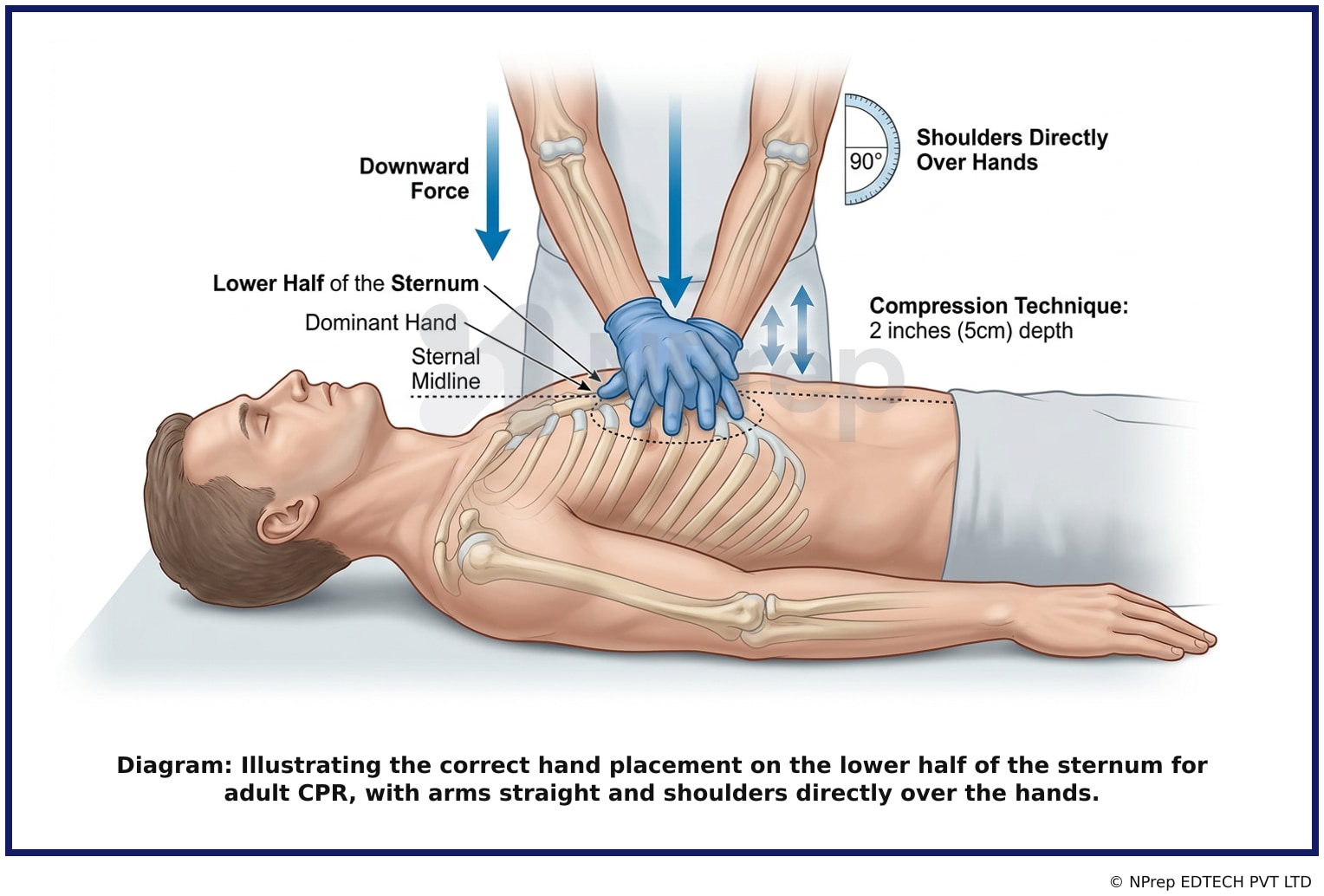
- Visual 1: Diagram: Illustrating the correct hand placement on the lower half of the sternum for adult CPR, with arms straight and shoulders directly over the hands.
- Visual 2: Infographic: Summarizing the five critical components of high-quality CPR (correct rate, depth, full chest recoil, minimizing interruptions, and effective ventilations).
Clinical Relevance
- Nursing practice connection: This is primarily an exam-oriented knowledge point with limited direct bedside application, so retain Cardiopulmonary Resuscitation (CPR) Guidelines as background academic context rather than a clinical decision trigger.
- Performing high-quality CPR at the correct rate and depth is a fundamental and life-saving skill for nurses that directly impacts patient survival after cardiac arrest.
- In a 'Code Blue' situation, nurses are often the first responders. Their role includes not only initiating CPR but also leading the team to ensure guidelines are followed, such as switching compressors every 2 minutes to prevent fatigue.
- What if? If the patient is a child (1 year to puberty), the compression rate remains the same (100-120/min), but the compression-to-ventilation ratio changes to 15:2 if two rescuers are present.
How to Approach the Question
- This is a factual recall question based on established clinical guidelines for emergency care.
- First, identify the key terms in the question: 'CPR', 'adult', and 'rate of chest compressions'.
- Next, recall the standard guidelines from the American Heart Association (AHA) for Basic Life Support (BLS).
- The recommended rate is a specific range. Evaluate the given options against this standard.
- Eliminate options that are clearly too slow (less than 100) or too fast (greater than 120).
- Select the option that precisely matches the current recommended range of 100-120 compressions per minute.
Concept Tested & Keywords
- Concept Tested: Cardiopulmonary Resuscitation (CPR) Guidelines
- Stem keywords: CPR, adult, chest compressions, rate
- Lead-in keywords: recommended rate
Question ID
QxcNl_61NvPMfJsFaG4kWJ
Practise the full KGMU 2023
Attempt every question from this paper in a timed mock, then review the full solution for each one.
More Cardiopulmonary Resuscitation Questions
- During CPR after how many cycles does a rescuer change?
- While 2 rescuers providing CPR, after providing 2 minutes CPR, rescuers should change their position every?
- The objective of BLS include:?
- According to AHA guideline 2015, the compression ventilation ratio in adults is?
- Compression to ventilation ratio in adults with two rescuers is?
- During cardiopulmonary resuscitation, the compression-ventilation ratio for the adult patient with cardiac arrest is:
- For adults the ratio of chest compression-to-ventilation in case of single rescuer Cardiopulmonary resuscitation (CPR) is
- What is the ratio of two rescues for adult patient CPR?
- How long would you check the pulse rate of an unconscious client?
- Depth of chest compression in adult CPR
More KGMU 2023 Questions
- The teacher scalded Aruna in front of her classmates during Project submission. Conclusion I: Aruna was not as popular as her other classmates. Concl…
- Aruna leaves and goes 8 meters in the North direction from a certain point. Then she turns right and travels for 12 meters. She again turns right and…
- Kiran is Sister of Raj. Raj is Son of Suresh and Vinita is Mother of Suresh then what is relation between Vinita and Kiran?
- A person who lives at the same time with another?
- Select the most appropriate meaning of the below idiom. A black sheep?
- The train has arrived...the station.
- A vendor sold 20 kg of potato at 18 Rs. per kg. He bought 2-liter milk at the rate of 46 Rs./liter, 2 kg sugar at the rate of 35 Rs./kg and 10 packet…
- Which one is the perfect square?
- A is the smallest. C is taller than B and D. E is neither the tallest nor the smallest. Find which one is the tallest?
- From an entrance, a person walks 28 meters left, then turns right and walks 13 meters. They turn right again and walk 12 meters, and then walk 16 met…