
Digoxin (lavoxin) 0.125 mg is ordered. It is available in a dose vial 500 mcg/mL. How many mL does the nurse administer?
Explanation
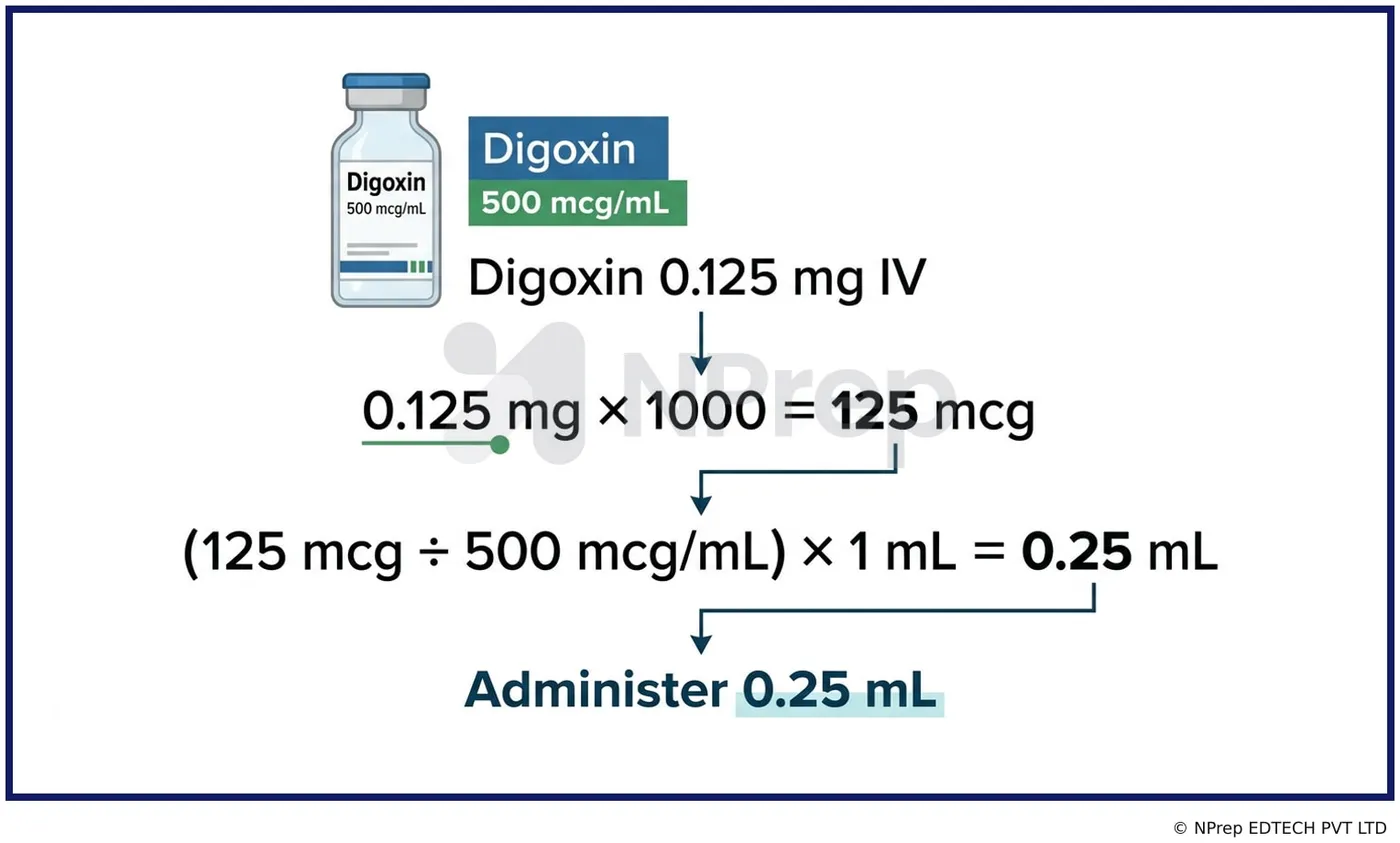
- The first step is to convert the ordered dose to the same unit as the available concentration. The ordered dose is 0.125 mg, which converts to 125 mcg (0.125 × 1000).
- The medication is available at a concentration of 500 mcg/mL.
- Using the formula (Dose Ordered / Dose on Hand) × Quantity:
- (125 mcg / 500 mcg/mL) × 1 mL
- The calculation (125 ÷ 500) results in 0.25, meaning the nurse should administer 0.25 mL.
Why Other Options Were Wrong
- Option A: 5 mL is incorrect. This volume would be administered if the ordered dose was 75 mcg, based on an assumed concentration of 50 mcg/mL.
- Option B: 5 mL is incorrect. This volume would be administered if the ordered dose was 175 mcg, based on an assumed concentration of 50 mcg/mL.
- Option D: 2 mL is incorrect. This volume would be administered if the ordered dose was 100 mcg, based on an assumed concentration of 50 mcg/mL.
Related Visual
Clinical Relevance
Nursing practice connection: Knowing Drug Dosage Calculation helps nurses interpret findings accurately and avoid errors in routine assessment, medication administration, and patient teaching.
Accurate medication calculation is a critical nursing skill to prevent medication errors and ensure patient safety. Errors with high-alert medications like Digoxin can have severe consequences.
Digoxin has a narrow therapeutic index (0.5-2 ng/mL), meaning the margin between a therapeutic dose and a toxic dose is very small. This makes precise dosing essential.
Always double-check calculations, especially for high-alert medications. Many facilities require a second nurse to verify calculations for drugs like Digoxin.
Change this too
How to Approach the Question
- First, identify the key information: the ordered dose (0.125 mg) and the available concentration (500 mcg/mL).
- Recognize that the units (mg and mcg) are different and a conversion is necessary. Convert the ordered dose to match the unit of the available concentration.
- Apply the standard dosage calculation formula: (Dose Ordered / Dose on Hand) x Quantity.
- Perform the calculation. If the result does not match any option, re-read the question carefully to check for potential typos. In this case, the concentration is likely a typo (50 instead of 500).
- Calculate the answer based on the most plausible correction that matches an option.
- Select the option that corresponds to your calculated volume.
Concept Tested & Keywords
- Concept Tested: Drug Dosage Calculation
- Stem keywords: Digoxin, lanoxin, 0.125 mg, 500 mcg/mL, dosage calculation
- Lead-in keywords: How many
Question ID
Q4Al_sFc8KoZm_yES0ZPEU
Reference Book
E6 Nursing Fundamentals Taylor p. 848-850
E6 Nursing Fundamentals Potter Perry 12e Part 3 p. 142-144
E6 Pharmacology Nursing Lilley 11e Part 2 p. 77-79
Practise the full NVS- 2025
Attempt every question from this paper in a timed mock, then review the full solution for each one.
More Administration of medications Questions
- Which is the appropriate site to administer Intramuscular injections in children?
- The route of Mantoux skin test is:
- What is the size of needle for Intramuscular (IM) injection in adults?
- You are administering an intravenous medication to a patient, and the medication label instructs you to infuse 50 mL over 15 minutes. What is the cor…
- A physician orders a medication to be administered to a patient in a dose of 200mg twice daily (BD). The pharmacy provides tablets of the medication,…
- Desired dose of Morphine for a patient is 0.4 mg. Dose available is 1 mg/mL. The correct formulation for this patient is:
- Cefuroxime sodium, 1 g in 50 mL normal saline (NS), is to be administered over 30 minutes to a client with an infection. The drop factor is 15 drops…
- To ensure accurate medication administration and prevent errors, what is the most comprehensive method for verifying a patient's identity?
- Maximum chance of sciatic nerve injury during which site of I.M injection?
- Identify route of drug administration:
More NVS- 2025 Questions
- The daily recommended intake of vitamin A for adults:
- A single rescuer performs both artificial respiration and compression at the ratio of:
- Semen has a pH of:
- Which of the following indicates ventricular repolarization?
- The World Health Organization (WHO) defined how many moments for hand hygiene?
- Which theory conceptualizes that the emotions result from our perception of the changes taking place in the body during emotional experience?
- Phallic stage of psychosexual development as per Sigmund Freud:
- Damage of which region of brain markedly impairs the understanding of speech and written language?
- The mechanism of ATP generation that links chemical reaction with pumping of hydrogen ions is called:
- The chamber of the heart with the thickest myocardium