
KGMU 2023
Child Health Nursing (Pediatrics)
Easy
Baby Ravi is undergoing phototherapy treatment for Hyperbilirubinemia. Which parts of his body should be covered to prevent tissue damage?
Appeared in: KGMU 2023
Explanation
- The correct answer requires identifying the specific body parts that must be shielded during phototherapy despite the need for maximal skin exposure.
- The eyes must be covered with opaque patches to prevent retinal damage from the high-intensity light.
- The genitalia are covered with a small diaper to protect the sensitive gonads from radiation.
- All other areas, including the abdomen and extremities, should remain exposed to maximize the effectiveness of the light treatment in breaking down bilirubin.
Why Other Options Were Wrong
- Option A: The abdomen must be left exposed to the light. Covering it would significantly reduce the surface area available for treatment, making the phototherapy less effective.
- Option C: The extremities (arms and legs) have a large surface area and must be exposed to the light to maximize the breakdown of bilirubin.
- Option D: This option is incomplete and incorrect. While the genital area is covered, the abdomen must be exposed. Critically, it omits the mandatory protection for the eyes, which are at high risk of damage.
Related Visual
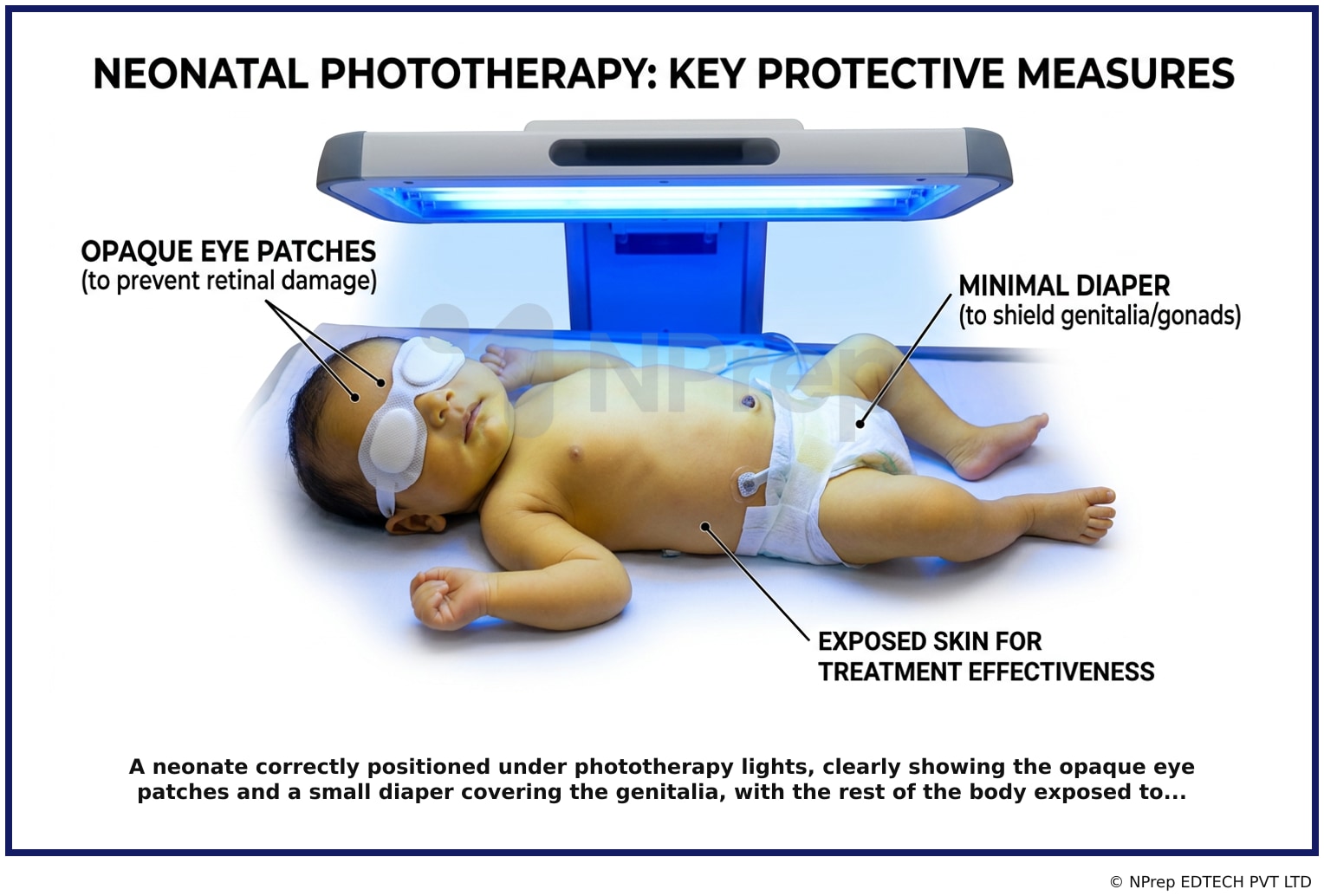
- Visual 1: Photograph - A neonate correctly positioned under phototherapy lights, clearly showing the opaque eye patches and a small diaper covering the genitalia, with the rest of the body exposed to the blue light.
Clinical Relevance
- Nursing practice connection: Knowing Nursing care and safety protocols for neonatal phototherapy helps nurses interpret findings accurately and avoid errors in routine assessment, medication administration, and patient teaching.
- A nurse's primary responsibility during phototherapy is to ensure both treatment effectiveness and patient safety.
- Incorrectly applied or omitted protection can lead to serious, irreversible harm, such as retinal damage, or render the treatment ineffective.
- Nurses must also monitor for side effects like dehydration, temperature instability, and skin rashes, and ensure the infant is repositioned regularly.
How to Approach the Question
- First, identify the core clinical procedure in the question: phototherapy for neonatal jaundice.
- Recall the primary goal of this procedure, which is to expose as much skin as possible to the therapeutic light.
- Next, consider the safety principles and contraindications. Think about which body parts are most sensitive and might be harmed by the treatment.
- Evaluate each option by weighing the need for skin exposure against the need for protection. The eyes (retinas) and genitalia (gonads) are known to be sensitive areas requiring protection in this context.
- Eliminate options that suggest covering large surface areas needed for treatment (abdomen, extremities) or that omit protection for a critical area (eyes).
Concept Tested & Keywords
- Concept Tested: Nursing care and safety protocols for neonatal phototherapy.
- Stem keywords: phototherapy, Hyperbilirubinemia, covered, tissue damage
- Lead-in keywords: Which parts
- Clinical cues: Neonate undergoing phototherapy for jaundice
- Negative lead-in flag: false
Question ID
QT66q07tUukgRiVjwjiDuj
Practise the full KGMU 2023
Attempt every question from this paper in a timed mock, then review the full solution for each one.
More Newborn Infants Questions
- When palpating the abdomen of hypertrophic pyloric stenosis infant, the Nurse finds:
- A pre-eclampsia woman's baby is lying with her mother. Neonate is born in 37 weeks. After 57 hours, when nurse is monitoring vital signs of baby, tem…
- Normally enteral feedings are flushed with water to open blocked tube and ease feeding. In which area it is done with air?
- A nurse is advised to give injection vitamin K for new born baby. The route and dose of Vitamin K is:
- Identify the following instrument used in hyperbilirubinemia monitoring based on the image:
- Which of the following equipment is used in Neonatal Resuscitation program?
- All of the following are the benefits of KMC (Kangaroo mother care); EXCEPT:
- Waxy or cheese like white substance found coating the skin of newborn human baby is known as:
- Identify 'at risk' infants from the following:-
- What is the normal length of the neonate body?
More KGMU 2023 Questions
- The teacher scalded Aruna in front of her classmates during Project submission. Conclusion I: Aruna was not as popular as her other classmates. Concl…
- Aruna leaves and goes 8 meters in the North direction from a certain point. Then she turns right and travels for 12 meters. She again turns right and…
- Kiran is Sister of Raj. Raj is Son of Suresh and Vinita is Mother of Suresh then what is relation between Vinita and Kiran?
- A person who lives at the same time with another?
- Select the most appropriate meaning of the below idiom. A black sheep?
- The train has arrived...the station.
- A vendor sold 20 kg of potato at 18 Rs. per kg. He bought 2-liter milk at the rate of 46 Rs./liter, 2 kg sugar at the rate of 35 Rs./kg and 10 packet…
- Which one is the perfect square?
- A is the smallest. C is taller than B and D. E is neither the tallest nor the smallest. Find which one is the tallest?
- From an entrance, a person walks 28 meters left, then turns right and walks 13 meters. They turn right again and walk 12 meters, and then walk 16 met…