
KGMU 2023
Medical & Surgical Nursing
Easy
Asbestosis is what type of disease?
Appeared in: KGMU 2023
Explanation
- Asbestosis is a lung disease caused by inhaling asbestos fibers.
- Exposure to asbestos fibers primarily occurs in specific work environments, such as construction, shipbuilding, and manufacturing.
- Diseases that arise from or during the course of employment are defined as occupational diseases.
- Therefore, asbestosis is correctly classified as an occupational disease.
Why Other Options Were Wrong
- Option B: While the fibers are transmitted through the air, 'airborne disease' typically refers to conditions caused by infectious microorganisms (e.g., bacteria, viruses) like tuberculosis or measles. Asbestosis is a non-infectious fibrotic condition.
- Option C: Waterborne diseases are caused by pathogenic microorganisms transmitted through contaminated water, such as cholera or typhoid.
- Option D: Vector-borne diseases are transmitted by vectors, typically biting insects or arthropods like mosquitoes or ticks. Examples include malaria and dengue fever.
Related Visual
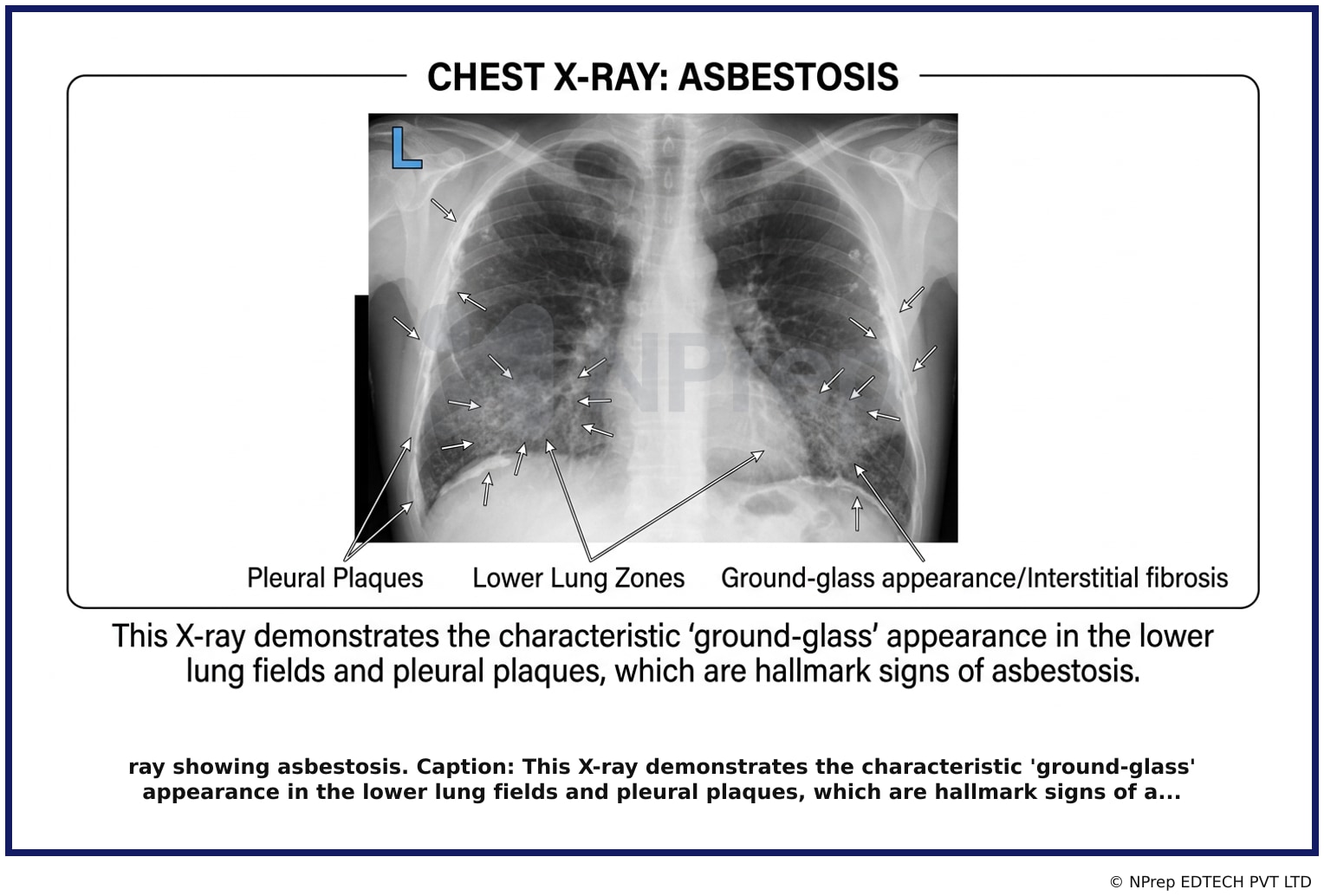
- Visual 1: Chest X-ray showing asbestosis. Caption: This X-ray demonstrates the characteristic 'ground-glass' appearance in the lower lung fields and pleural plaques, which are hallmark signs of asbestosis.
- Visual 2: Infographic. Caption: An infographic comparing different types of pneumoconiosis (Asbestosis, Silicosis, Byssinosis) with their causative agents, associated occupations, and key pathological features.
Clinical Relevance
- Nursing practice connection: Knowing Classification of Asbestosis helps nurses interpret findings accurately and avoid errors in routine assessment, medication administration, and patient teaching.
- A crucial nursing responsibility is to obtain a detailed occupational history from any patient presenting with chronic respiratory symptoms to identify potential workplace exposures to hazards like asbestos.
- Nurses play a key role in educating at-risk workers about the dangers of asbestos, the importance of using personal protective equipment (PPE), and the synergistic risk of smoking, which significantly increases the chance of lung cancer in exposed individuals.
- What if? If a patient who worked in a textile mill presented with chest tightness that was characteristically worse on Mondays and improved throughout the week, the most likely diagnosis would shift from asbestosis to byssinosis (caused by cotton dust).
How to Approach the Question
- First, identify the key term in the question, which is 'Asbestosis'.
- Recall the fundamental cause of asbestosis: the inhalation of asbestos fibers.
- Consider the primary context of asbestos exposure. This exposure is strongly and almost exclusively linked to specific jobs and industries (e.g., construction, mining, shipbuilding).
- Evaluate the given options based on this understanding. 'Occupational Disease' directly aligns with a condition caused by job-related exposure.
- Systematically eliminate the other options by defining them. 'Airborne disease' usually implies infection, 'waterborne disease' involves contaminated water, and 'vector-borne disease' involves insects or other carriers. None of these fit the profile of asbestosis.
Concept Tested & Keywords
- Concept Tested: Classification of Asbestosis
- Stem keywords: Asbestosis, type of disease
- Lead-in keywords: is what type
- Negative lead-in flag: false
Question ID
QGswfQgQXYB2EkZJQac0S3
Practise the full KGMU 2023
Attempt every question from this paper in a timed mock, then review the full solution for each one.
More Gas Exchange and Respiratory Function Questions
- Which is the most relevant knowledge about oxygen administration to a client with COPD?
- Patient in emergency department diagnosed to have fluid and air present in lung. What is the above-mentioned condition known as?
- Patient is suffering from dyspnea. Which position will you provide for patient to relieve?
- Which of the following is not involved in chest physiotherapy?
- Respiration which is abnormally shallow for two or three breaths followed by irregular period of apnea is termed:
- Identify the following instrument which is used in diagnostic procedures:
- Identify the instrument shown in the following image:
- Identify the tube in the following image:
- A patient suddenly develops respiratory difficulties such as dyspnea, what is the first priority of the nursing officer?
- Which of the following method is used for high flow oxygen administration:
More KGMU 2023 Questions
- The teacher scalded Aruna in front of her classmates during Project submission. Conclusion I: Aruna was not as popular as her other classmates. Concl…
- Aruna leaves and goes 8 meters in the North direction from a certain point. Then she turns right and travels for 12 meters. She again turns right and…
- Kiran is Sister of Raj. Raj is Son of Suresh and Vinita is Mother of Suresh then what is relation between Vinita and Kiran?
- A person who lives at the same time with another?
- Select the most appropriate meaning of the below idiom. A black sheep?
- The train has arrived...the station.
- A vendor sold 20 kg of potato at 18 Rs. per kg. He bought 2-liter milk at the rate of 46 Rs./liter, 2 kg sugar at the rate of 35 Rs./kg and 10 packet…
- Which one is the perfect square?
- A is the smallest. C is taller than B and D. E is neither the tallest nor the smallest. Find which one is the tallest?
- From an entrance, a person walks 28 meters left, then turns right and walks 13 meters. They turn right again and walk 12 meters, and then walk 16 met…