
INI-CET EXAM -2025
Medical & Surgical Nursing
Hard
Arrange the following steps of surgery in order:
A. Creating pneumoperitoneum
B. Dissection of hepatocystic triangle
C. Ligation of cystic duct and artery
D. Separation of gallbladder from liver bed
Appeared in: INI-CET EXAM -2025
Explanation
- The correct sequence for a laparoscopic cholecystectomy is creating pneumoperitoneum, dissecting the hepatocystic triangle, ligating the cystic duct and artery, and finally separating the gallbladder from the liver bed.
- This sequence follows the fundamental surgical principles of access, exposure, identification, control, and removal.
- Creating pneumoperitoneum (A) is always the first step to establish a working space for laparoscopic surgery.
- Dissection of the hepatocystic triangle (B) to achieve the 'critical view of safety' must precede ligation (C) to prevent bile duct injury.
- Separation from the liver bed (D) is the final step of removal after the gallbladder's connections have been safely divided.
Why Other Options Were Wrong
- Option B: This sequence (A-C-B-D) is incorrect because it involves ligating the cystic duct and artery (C) before fully dissecting the hepatocystic triangle (B).
- Option C: This sequence (B-A-C-D) is incorrect because it suggests dissecting the hepatocystic triangle (B) before creating the pneumoperitoneum (A).
- Option D: This sequence (D-A-B-C) is incorrect because it places the separation of the gallbladder from the liver bed (D) as the first step.
Related Visual
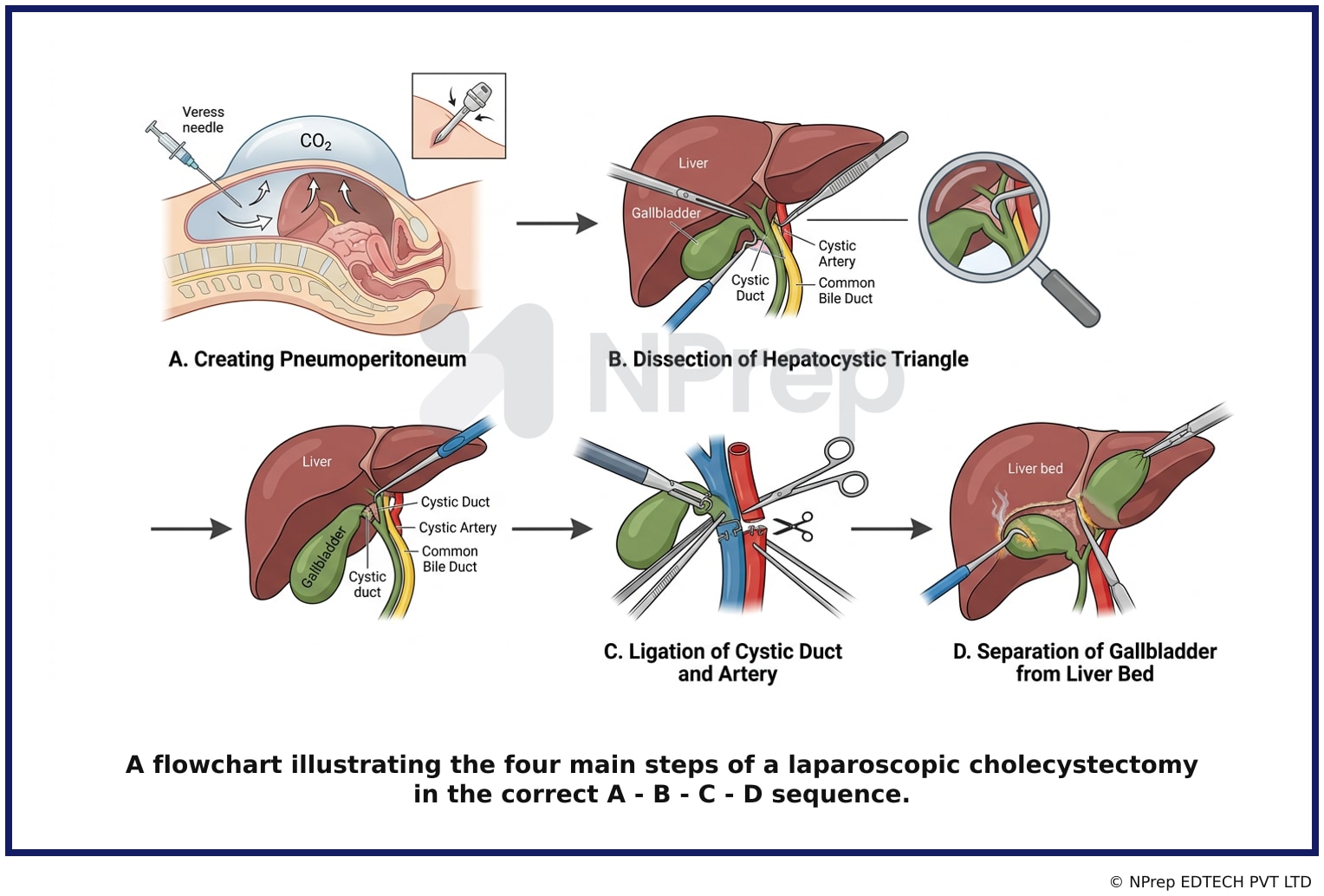
- Visual 1: Flowchart - A flowchart illustrating the four main steps of a laparoscopic cholecystectomy in the correct A -> B -> C -> D sequence.
- Visual 2: Diagram - An anatomical illustration of the hepatocystic triangle (Calot's triangle), clearly labeling the cystic duct, cystic artery, and common hepatic duct to emphasize the importance of the 'critical view of safety'.
Clinical Relevance
- Nursing practice connection: This is primarily an exam-oriented knowledge point with limited direct bedside application, so retain Surgical procedure steps for laparoscopic cholecystectomy as background academic context rather than a clinical decision trigger.
- Understanding the correct sequence of a laparoscopic cholecystectomy is crucial for perioperative nurses to anticipate the surgeon's needs for instruments and supplies.
- Knowledge of the steps helps the nurse identify any deviation from standard procedure, which could indicate a complication or a change in the surgical plan (e.g., conversion to open surgery).
- The 'critical view of safety' (Step B before Step C) is the single most important concept for preventing bile duct injury. Nurses should be aware of its significance in patient safety.
How to Approach the Question
- First, identify the core subject of the question, which is the correct order of steps for a specific surgical procedure (laparoscopic cholecystectomy).
- Think logically about the principles of surgery: first, you need access and visibility; second, you identify what you need to cut; third, you safely control and cut it; and finally, you remove the target organ.
- Apply this logic to the given options. Step A (creating pneumoperitoneum) must be first to provide access and visibility.
- Next, evaluate the safety-critical steps. Step B (dissection to identify) must come before Step C (ligation and cutting) to prevent injury to vital structures like the common bile duct.
- Step D (detaching the organ) is the final removal step after its main connections are severed.
- Based on this logical and safety-oriented flow, determine the only possible sequence: A -> B -> C -> D. Match this sequence to the given options.
Concept Tested & Keywords
- Concept Tested: Surgical procedure steps for laparoscopic cholecystectomy.
- Stem keywords: surgery, order, pneumoperitoneum, hepatocystic triangle, ligation, cystic duct, cystic artery, gallbladder
- Lead-in keywords: Arrange
- Negative lead-in flag: false
Question ID
Q3RaZtODM3k7sDjt0RvCOX
Practise the full INI-CET EXAM -2025
Attempt every question from this paper in a timed mock, then review the full solution for each one.
More Perioperative Concepts and Nursing Management Questions
- The nurse is informed that a client with a large surgical incision is being transferred from the intensive care unit to the surgical unit. What medic…
- Why it is necessary to remove dark coloured nail paint before surgery?
- A patient planned for surgery advised to remove Jewellery because:
- Vicryl 3-0 is:
- All of the following are correct regarding stoma formation; EXCEPT:
- A surgeon is going to give a skin incision on patient. Which of the following is to be done?
- Following is the picture of sterile sponge used in emergency. It has a blue colour thread. What is the purpose of this colour thread?
- How many items are included in the WHO surgical safety checklist: SITOSO?
- In operation theater during cauterization, the electric current passing from a single electrode is called:
- Which position is given to a client by nursing officer, who has been brought from OT after craniotomy surgery?
More INI-CET EXAM -2025 Questions
- The highlighted structure in the provided image articulates with which bone?& x20;
- Through which of the following foramina does the nerve supplying the muscles of mastication pass?& x20;
- In the given image, which region is correctly paired with its corresponding brain structure? • Middle cerebellar peduncle • Fasciculus cuneatus • Sup…
- Which of the following muscles is NOT typically associated with dysphagia or dysarthria?
- A muscle of mastication involved in opening the mouth exhibits the following characteristics. Identify the incorrect statement about it:
- In the illustrated image, which of the following structures is NOT associated with the area marked by the arrow?& x20;
- Match the following embryonic aortic arches with their respective adult derivatives: A. 1st Arch 1. Maxillary artery& x20; B. 2nd Arch 2. Common caro…
- Which of the following histology image is not an endocrine structure?& x20;
- Marked structure separates which of the following:
- Which of the following bones of the skull gives passage to a nerve arising from the brain & x20;